A Connecticut Yankee
Many of our early patriots were accomplished men of letters—lawyers, judges, planters, and merchants—but relatively few were involved in science and technology. David Bushnell belongs to the latter group. Born in Saybrook, Connecticut, on August 30, 1742, he was the son of a farmer. As the eldest of five children, he grew up working on the family farm near Westbrook. After his father died in 1769, he sold his half interest in the farm to his brother Ezra and entered Yale College in 1771.
 |
| David Bushnell |
Bombs to Boats
While at Yale, he became intrigued by the idea of underwater explosions. An inventive tinkerer by nature, Bushnell successfully combined a black powder charge with a clockwork timing device, creating the first naval mine. He used this knowledge not only in building the underwater mine but also later in making floating torpedoes that exploded on contact.
He worked with the wealthy New Haven inventor and manufacturer Isaac Doolittle to develop the first mechanically triggered time bomb as well as the first screw propeller. As he worked on developing a practical delivery system for this unique weapon, the start of the American War for Independence gave a new sense of urgency to his efforts.
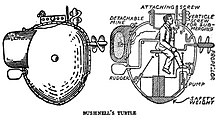
By fall that year, he had designed and built the American Turtle (better known simply as Turtle), a primitive submarine. He named it Turtle because it looked like two turtle shells lashed together. It wasn't pretty, but it worked.
 |
| Turtle Design Sketch |
Test and Evaluation
 |
| Gen Israel Putnam |
This primitive submarine was operated by a single operator, who powered it with two hand-cranked screw propellers. A system of water pumps took in and expelled water to control the craft's climb or descent, which could reach a depth of about 15 feet. The pilot had a small conning tower with several windows. The tower contained a depth gauge and a phosphorus-lit compass.
The Turtle’s punch was Bushnell’s original clock/mine combination connected to a metal drill engineered to bore through the copper sheathing coating the hulls of British warships. Once the mine was attached and released, the timing mechanism engaged, giving the Turtle one hour to escape before a 150-pound charge exploded, detonated by a flintlock trigger device.
Bushnell arranged a successful demonstration, essentially a “demval” in today’s acquisition parlance. Present for the event on the Thames River was Connecticut General Israel Putnam, who urged the American government to continue funding for its “full operational capability.”
 |
| Turtle Replica |
Run Silent, Run Deep - Sorta
History was made in the summer of 1776 when the Turtle attacked the British fleet anchored in New York Harbor under the command of Admiral Richard Howe. Unfortunately, Bushnell fell ill, and a sergeant named Ezra Lee volunteered to take his place. On the night of September 6, a pair of whaleboats towed the Turtle offshore, where it began its attack. Pumping feverishly, Lee slowly guided the Turtle toward the British fleet.
Despite challenging tides, Lee managed to reach the primary target, Lord Howe’s flagship, the 64-gun ship of the line, HMS Eagle. The Turtle’s drill failed to penetrate the hull because it was blocked by an iron bar. With air running low, Lee abandoned the effort and released the mine, which floated free. The mine ultimately exploded in a massive blast that sent a plume of water into the night sky.
The unexpected iron bar prevented what could have been a disastrous hit to a major target, potentially changing British naval tactics for the rest of the war. See my Yankee Doodle Spies post on "The Boat" for a more detailed discussion of this attack.
 |
| Bushnell's Turtle takes on HMS Eagle and initiates submarine warfare |
Torpedoes are Running
Bushnell remained undaunted. Confident in his progress, he kept improving the Turtle. He launched several small attacks on individual British ships, but inexperienced pilots and unfavorable tides prevented each attempt. The Turtle was lost the following October when a transport carrying it was sunk by British cannon fire on the North (Hudson) River. Undeterred by setbacks, Bushnell continued experimenting with naval mines and explosives. On August 13, 1777, he released another mine that floated toward the HMS Cerebus, anchored in Black Point Bay. This time, the tides were favorable, but the device got caught on a small schooner. It exploded, killing three British sailors.
 |
| Turtle needed to be towed into attack position by rowboats |
Battle of the Kegs
 |
| A Bushnell mine exploding unnerved the British |
He tried again in January 1778, this time releasing 20 large kegs filled with explosives off Bordentown, New Jersey. The kegs were intended to float down the Delaware River and destroy the British fleet at Philadelphia. One mine exploded near a British rowboat, killing several sailors.
The attack so rattled the British fleet that it spent the rest of the day shooting at the floating kegs and nearly anything else that floated. This event was satirized in the poem, “Battle of Kegs,” by Francis Hopkinson. Rebel propaganda portrayed this as an embarrassment for the hapless Royal Navy. However, Bushnell's career as an undersea weapons developer was over.
 |
| Captain David Bushnell's sappers and miners fought during the siege at Yorktown |
The Sapper
Bushnell returned to Saybrook in the spring of 1778. Local Loyalists had once detained him, but he managed to secure his release. Later that year, Bushnell left the world of maritime warfare and joined the Continental Army after General George Washington appointed him as commander of the first company of sappers and miners at West Point, NY. Captain Bushnell served competently for the rest of the conflict and led the sappers during the siege of Yorktown, the battle that effectively ended the war. After his discharge from the Continental Army, he briefly returned to Connecticut and later spent some time in France before coming back to the United States to settle in Warrenton, Georgia, where he practiced medicine. He died there in 1824.
 |
| David Bushnell Memorial in Georgia |
Seminal Submariner
In the long run, David Bushnell’s efforts laid the groundwork for the later development of underwater mines, torpedoes, and, of course, the submarine. His fundamental use of water for ballast still applies today, as does the use of the propeller. Although his impact on the course of the American War for Independence was limited, he nonetheless shaped the future direction of naval warfare. No small feat for a Connecticut farm boy.
 |
| Today's submarines are descendants of Bushnell's Turtle and still share its basic design, albeit on steroids |