Followers

Showing posts with label Richard Howe. Show all posts

Saturday, September 29, 2018

Fort Mifflin

A War of Posts


Over eight years of struggle, the American Revolutionary War shifted from guerrilla warfare to limited battles, and sometimes to maneuver warfare. However, the demands of 18th-century fighting across a vast area filled with rough terrain, dense forests, and uncooperative rivers made it almost always a war of posts. A war of posts is similar to a chess match, with carefully placed defensive positions designed to protect supply lines, stop an enemy advance, and control vital regions. 

Think of the game, Risk, but with real people, sweat, and effort, not small wooden or plastic pieces. The fight for North America included several key battles featuring fixed fortifications. In many ways, these defined the war: West Point and Ticonderoga immediately come to mind. But many battles also involved temporary or hastily constructed forts. These were just as important. Fort Moultrie, Stony Point, and Yorktown serve as notable examples.


Fort Ticonderoga


The Siege


The war featured several key sieges. Most were short-lived, with one side surrendering or the other breaking off the siege due to outside factors like weather, supplies, or reinforcements. Fort Stanwix, Savannah, Charleston, and Newport are examples. Even a brief defense of a position could buy crucial time for a commander to gather forces, regroup, maneuver for advantage, or simply escape. 

That’s why, when a commander faced a long siege or was forced to storm a position, they often treated the defenders and any civilians left behind harshly. Ironically, when the British treated defenders roughly, it fueled rebel propaganda, which played a significant role in the conflict. Not only was the American public watching closely, but the whole world was paying attention. That’s a topic for another post, however.


Fort Stanwix


Fort Mifflin


Arguably, the longest active defense of a post under siege in the war was also one of the least celebrated. We will try to shift the focus toward celebration. Fort Mifflin is located on the Delaware River, in what is now South Philadelphia, at a place called Mud Island. Construction on the fort began in 1772 to block access to the city. 

Ironically, the original construction was overseen by the famous British engineer Captain John Montressor. The fort was completed in 1777 under the leadership of American Major General Thomas Mifflin, for whom it is named. It protected a series of water barriers that stretched across the river to its sister fort, Fort Mercer, in New Jersey.


Maj Gen Thomas Mifflin
finished construction of the fort that bears his name


Most Formidable Defenses


A fort guarding a sea approach needed more than just strong walls and good firing positions. So, Philadelphia built a series of chevaux de frise, placed in "tiers" beneath the waters of the Delaware between Forts Mercer and Mifflin. They were constructed within wooden-framed boxes, 30 feet square, made from massive timbers lined with pine boards. The engineers sunk these frames into the riverbed. 

Each box was filled with 20 to 40 tons of stone to keep it in place. Each frame had two or three large timbers tipped with iron spikes set underwater and angled downstream. These chevaux created a tough obstacle that could trap unwary ships. The chain of chevaux had gaps so friendly shipping could pass through. The locations of these safe passages were tightly kept secret. Any British ship not caught on the spikes or caught in the chain still faced fire from the forts themselves.


Sketch of chevaux crates filled
with stones


A Strategic Position


The British captured Philadelphia in September 1777 through an overland campaign that avoided the fortified Delaware approach. However, the British commander in chief, General William Howe, now faced the urgency of establishing a communication line to the sea. He needed the protection of the Royal Navy and an open supply route, or his position in Philadelphia could become a liability. 

The British commander recognized that their control of the sea was an invaluable advantage over the Americans, which had to be leveraged to the fullest. Howe's brother, Admiral Richard "Black Dick" Howe, commander of the Royal Navy in America, had already started weakening American defenses downriver. But brother Billy couldn't wait for their arrival; he needed to advance overland against Fort Mifflin and hold the navy at Fort Mercer on the Jersey side.


Control of the lower Delaware River and bay
was crucial to British success

Doughty Defenders


Samuel Smith
But the American commander in chief, General George Washington, also recognized the importance of the Delaware. After being driven from near the capital following his defeat at Germantown, Washington prepared for a lengthy series of operations aimed at disrupting British efforts to strengthen their control over Philadelphia. 

On September 23, Washington sent Lieutenant Colonel Samuel Smith of the 4th Maryland Regiment with a detachment of Continentals to the fort on Mud Island in the Delaware River. 

Readers may recall I featured this first patriot in an earlier Yankee Doodle Spies post. Smith's initial force numbered 200 soldiers, along with Major Robert Ballard of Virginia, Major Simeon Thayer of Rhode Island, and Captain Samuel Treat of the Continental Artillery. Determined to hinder British plans at any cost, the Continentals began preparing defenses and calling in more troops. 

Eventually, they would have 400 men, which was far from enough to properly garrison a fort of Mifflin's size. This problem was similar to issues faced by other forces trying to hold forts Ticonderoga and Washington. Still, Smith and his men chose to make the best of the fort.


Fort Mifflin plans


The British Approach


John Montressor
General Howe ordered a move against nearby Providence Island on October 10, 1777. Washington's land forces resisted but were quickly driven off, and soon heavy siege guns were positioned to face the American fort. Despite its strength, Fort Mifflin had not been heavily fortified against a threat from Philadelphia. 

Ironically, Captain John Montresor, who had designed and built Fort Mifflin, planned and constructed the siege works used against his own fort. The situation was certainly against the rebels. Soon, heavy cannonballs started crashing into the American positions. The intense pounding on that side of the fort was horrific, but the Americans fought valiantly, inflicting heavy damage on several British ships attempting to bypass upriver. 

The British mounted guns on floats, creating water batteries that moved closer to the besieged outpost. American casualties increased, and supplies dwindled during the month of relentless bombardment and hardship.


The Royal Navy Engages


"Black Dick" Howe -
so named for a swarthy complexion
But Billie Howe's brother, "Black Dick," would have the final say. He finally managed to unleash the Royal Navy. On November 10, a floating battery with twenty-two heavy 24-pound guns came within 40 yards of the fort. 

At close range, the British gunners could do as much damage as they wanted. This ended up being the heaviest bombardment of the Revolutionary War. Shot and shell shattered walls and buildings. The defenders suffered severe injuries, with limbs torn away or crushed. 


The battle was leaning towards the besiegers, but Smith and the defenders were determined to hold the fort. Cold weather was arriving early, and if they could hold until the Delaware froze, the British supply line might be cut, forcing Howe's army to abandon the recently captured capital. 

On the British side, news of Major General John Burgoyne's army’s disastrous surrender at Saratoga increased pressure on both Howe brothers. A victory over the stubborn defenders could help boost the sagging morale. The stakes were high for both sides!


The Pennsylvania Navy (yes, they had a navy) came to the aid of the forts guarding the Delaware approaches. Commodore John Hazelwood, with a sizable fleet of galleys, sloops, and fire-vessels, launched several raids on British positions onshore and constantly harassed British river operations while patrolling the waters around the fort. But British naval strength eventually prevailed. Rebel resistance persisted. Cold, ill, and starving, the garrison, reduced to much less than 200 of the original 400-450 men, refused to surrender. 

Under the leadership of French Major Francois de Fleury, an engineer of remarkable energy, the Americans worked each night to repair the damage from the day’s combat. Fleury himself was wounded in the battle. A British ship of the line and sloop-of-war both ran aground under heavy fire from Mifflin's defenders. However, British naval superiority virtually guaranteed an unfavorable outcome. Behind the cover of the intense fire from the big guns of the floating battery, the British naval vessels closed in, and soon British marines were sniping at the fort from high in the rigging. With nearly all their guns knocked out, the Americans were running out of options - but not out of spirit.


Fort Mifflin, aka Mudd Island
was the key to the Delaware


The Final British Assault


Clear weather on November 15 gave the British a chance to deliver a final burst of heat. They sent two ships, Vigilant and Fury, armed with nineteen guns, along the backchannel west of Fort Mifflin. At the same time, three large ships with 158 cannons anchored directly off the fort, in the main channel of the Delaware. To the east, three more vessels with about 51 guns guarded Mifflin from all sides. A trap of smoke, fire, and iron.


The Royal Navy had to commit
massive resources to subdue the fort


To oppose this British juggernaut, the defenders of Fort Mifflin had only ten cannons remaining. Soon, hundreds of cannonballs began pummeling what was left of the fort. The large-caliber 18- and 24-pound balls tore through the defenders in another burst of smoke and fire. During the peak of the bombardment, about 1000 shots were fired into the fort. 

To worsen the defenders' plight, British Marines climbed to the crow’s nest of Vigilant and tossed grenades at the fort's defenders. The defenders fought bravely but suffered for it as casualties increased. They returned fire until all their guns were silenced by the heavier British shot. Lieutenant Colonel Smith was seriously wounded and had to be evacuated. The end was near.


The End


Nightfall found the surviving defenders exhausted, cold, and out of ammunition. But not out of options. The new commander of the fort, Major Simeon Thayer, decided to evacuate the now indefensible Mifflin under the cover of darkness. The garrison rowed their way with muffled oars to Fort Mercer. Forty men volunteered to stay behind and set fire to what was left. 

Their work done, around midnight, they also crossed the Delaware to the safety of New Jersey. But Thayer decided on one last act of resistance. So as the last of Mifflin's valiant defenders rowed to safety, they would see it ablaze - but they would see the flag still flying in a final gesture of defiance.


The unusual-looking flag that flew over Fort Mifflin during
the long siege, and in a final act of defiance


The Result


During the siege, about 400 American soldiers held off more than two thousand British troops and 250 ships. The Americans suffered over 250 killed and wounded and lost the fort. However, the time and resources spent by the Howe brothers to capture the fort and control the Delaware allowed Washington to move his army to White Marsh and ultimately reach the safety of winter quarters at Valley Forge, where a new American army was formed.


A new American army would emerge from
the hard winter at Valley Forge


Aftermath


Fort Mifflin was rebuilt after the war and served as a U.S. base for many years, providing one of the strategic harbor defenses for Philadelphia. Later, it became a historic site. Today, only the white stone walls of the original Fort Mifflin remain. The pockmarks in these walls testify to the intensity of the British bombardment in 1777. Local residents refer to this siege and bombardment as the Battle of Mud Island. However, this once-critical fort in the defense of the Delaware and Philadelphia never saw military use again.


Sunday, August 31, 2014

In the Navy!

 The Naval Advantage in 1776


This past week marked the anniversary of the British landing on Long Island and the battle that shares its name. As most readers of this blog know, the invasion and the events that followed set the background for my novel, The Patriot Spy. I thought I’d use this blog to discuss the role of naval power in the campaign. The American Army under General George Washington essentially had no information about British plans after General William Howe withdrew his besieged forces from Boston. However, it wasn’t hard to see that the main British advantage in the war was the Royal Navy.


Royal Navy in Combat


Early Success, Defeat, and Triumphs


In some ways, Britain's story is tied to its navy. During the time of the Yankee Doodle Spies, Britain had the greatest navy in the world and, more importantly, had over a century of knowledge and experience in using that advantage effectively. Many are familiar with the victories of the 16th-century English navy under Elizabeth I against the Spanish. However, during the 17th century, England and its navy went through a period of upheaval. 


Destruction of the Spanish Armada


The English Civil War, three wars with the Dutch (who had surpassed Spain as the world's leading mercantile and naval power), and the "Glorious Revolution" all affected the navy's development, both positively and negatively. During that period, the English and Scottish fleets merged but remained separate on paper. The Dutch Wars initially favored the Dutch, who achieved remarkable naval victories. 

Still, Britain gained the key Dutch colony of New Amsterdam (1664), and it learned how to develop its navy through the experience of defeat. By 1692, the British boasted the finest fleet in the world. The political alliance with the Dutch, which recognized their ruler William of Orange as William III of England, strengthened both navies. 

In a curious partnership, the Dutch fleet operated under British admirals in the subsequent wars with France and Spain that dominated the late 17th and most of the 18th century. The British expanded their global operations and, through a series of wars, captured colonial possessions both large and small to support their naval and commercial needs.


Dutch Burn British Fleet at Chatham


 Britannia Rules the Waves!


The Royal Navy of 1776 had a confidence rooted in achievement. Part of that success included what would later be called "combined arms" operations—using Royal Marines for small sea-land actions and collaborating with the Royal Army for major campaigns, mainly moving forces and guarding supply routes. Britain developed this approach during the Seven Years' War (French and Indian War) in North America. 


Royal Navy in Action


As the rebellion began, the Royal Navy became Britain's greatest advantage over the poorly connected coastal colonies, which were linked by a few poor roads. America depended on the sea, and controlling it was central to any plan to suppress the colonies. Trade could be blocked, starving the colonies that relied heavily on Britain for many finished goods. 

Ironically, this policy was among the grievances that sparked the rebellion. Britain's dominance at sea swayed some Loyalists' sympathies or at least their hostility toward the rebellion. To many, it seemed reckless to challenge the world’s strongest naval power—what was then the greatest global naval force ever. These concerns proved valid for most of the war. America had no real navy and was hurriedly building a small one, mostly to boost national pride rather than for strategic advantage. 

In reality, America’s naval strength came from privateers—many from merchant ships converted due to British control of the seas—another irony. Effective naval use allowed Howe to escape a tactical trap in Boston. It enabled him to execute a successful sea envelopment and move into New York Harbor, shifting the war’s focus and pace in Britain's favor.


Invasion, they're coming!


British landing at Gravesend on Long Island
(near the site of Brooklyn's Verazano Bridge)


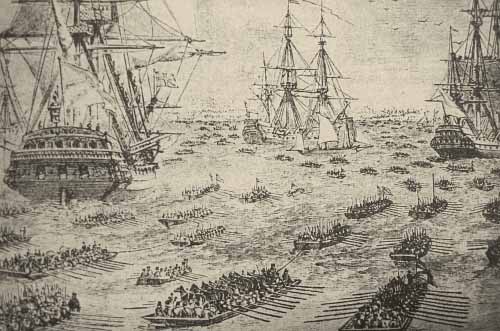
The Royal Navy isolated New York from the sea, making its port useless. The port gave the city its strategic importance, as New York was not the largest city in America in the 18th century. The Royal Navy provided reconnaissance, naval gunfire, and transport for a series of landings at Staten Island, Gravesend, Kips Bay, and Westchester (Throgs Neck, Pelham, etc.). 

British naval movements confused the Americans and threatened nearby areas. General Howe had no plans to attack. More importantly, it limited General Washington's ability to move troops and forced him to defend a larger area than he could cover with his soldiers and guns. Surprise, maneuver, and firepower are key multipliers in any conflict, but they are even more effective when you also have overwhelming forces! 

As discussed in The Patriot Spy, only extremely unfavorable winds and tides kept the other Howe (Admiral Sir Richard, William's brother, and naval force commander) from surrounding Washington's forces on Long Island, who were tucked into a desperate defensive position on Brooklyn Heights. 

If conditions had been right, Howe's fleet could have bombarded Washington from behind and, combined with the army besieging Washington's front, forced surrender in the summer of 1776. Would losing George Washington and a large part of the Continental Army have ended the war then and there in Britain's favor? Well, that's the subject of another blog.


Sunday, September 8, 2013

The Boat

Fans of the fabulous German naval flick Das Boot should not necessarily be disappointed by my little bait-and-switch. As I write this blog, it is the anniversary of the first submarine (sort of) attack in the American Revolution.

Development of a Secret Weapon


Connecticut has a long history of weapons development. The Nutmeg State has been a center of weapons development from colonial times to the present. Think Colt, Norden, etc. In the early 1770s, a Yale man named David Bushnell began developing underwater explosives. When the war with Britain erupted, he turned his efforts toward a delivery system. He moved his work to Old Saybrook, Connecticut, where he developed a submersible boat that could attach one of his underwater charges to a ship. Bushnell named his boat the Turtle, although it looked more like a shellfish. 


David Bushnell


The Turtle measured 10 feet by 3 feet and 6 feet tall. Letting water into a bilge tank lowered the Turtle into the water. It climbed when a hand pump evacuated the water. Crude hand-cranked propellers moved the boat. The Turtle held a crew of one and could operate underwater for thirty minutes at three miles an hour.


Diagram of the Boat


In the summer of 1776, the British invaded New York and seized western Long Island (see my highly acclaimed novel, The Patriot Spy), so Bushnell moved the boat back to Connecticut. Driven from post to post by superior British soldiers, weapons, and discipline, the Americans were even more outmatched by the Royal Navy. Desperate times called for desperate measures.       


British landing at Staten Island
                             

The Black Operation


In a secret operation (the term "black op" had not yet been coined), approved by General George Washington, an expedition aboard the Turtle was launched in New York Harbor. An hour before midnight on September 6, Sergeant Ezra Lee began his daunting mission: to navigate the untested Turtle through hazardous waters in an attack on British Admiral Richard Howe's flagship, HMS Eagle. We know Howe from earlier posts. Black Dick was the brother of William Howe, the British commander-in-chief in North America. Taking out his ship (and possibly him) would be what we today call an asymmetrical attack. 


The Turtle takes on the Eagle


The Eagle was moored near Governors Island, just off the southern tip of Manhattan. Yankee rowboats towed the Turtle from the Battery to within striking distance of the British ships at anchor. Lee struggled to navigate for over two hours, and his chances seemed bleak. Then suddenly, the river's tidal currents subsided. Lee, against all odds, reached the Eagle! He tried to fix an explosive charge to the hull, but he failed. The Turtle's boring device struck metal - likely a plate connected to the ship's rudder. Tired and struggling to stay afloat and breathe, the undaunted Sergeant Lee tried once more to pierce the hull. However, he could not keep the Turtle beneath the ship.

Treachery


Unknown to Sergeant Lee (or George Washington), a spy had alerted the British to the possibility of an unconventional attack. Expecting subterfuge, alert British soldiers on Governors Island spotted the submarine and rowed out to investigate in the dark waters. Rather than risk capture or an unwanted explosion, Lee cut loose the "torpedo," a specially designed explosive device intended to sink the Eagle. The torpedo floated half-submerged toward the approaching British boat. Fearing the worst, the British turned their longboat around and made straight for Governors Island. Sergeant Lee, meanwhile, pedaled madly toward the safety of The Battery. Fortunately for the British, the torpedo was caught in the strong currents at the confluence of the North (Hudson) and East rivers and exploded, sending plumes of wood and water high into the dark September sky. But fearful of another such attack, the British ships pulled anchor and moved to the upper bay. 

A spy may have alerted the British


Both Ezra Lee and David Bushnell went on to serve in other battles and campaigns. Sergeant Lee served in several pitched battles: Trenton, Brandywine, and Monmouth. Bushnell led several other "mining" operations along the Delaware River and served at Yorktown. His torpedoes wreaked havoc near Philadelphia.


Bushnell also received a medal from the commander in chief after the war. Many "black operations" were only grudgingly recognized by Washington, and all of them were acknowledged after the conflict. His Excellency understood that secrecy must be maintained before, during, and after covert operations. Bushnell moved to Georgia after the war, where he died. After the war, Lee returned to Connecticut. Remarkably, both men lived into the third decade of the next century.

What Gives?


Most of the account of the attack comes from Ezra Lee's report. Of the events of the night of September 7th, 1776, the British logs are strangely silent. They record no rebel attack nor any explosions in the vicinity of the Eagle. So what gives? Did this actually happen? It seems implausible that Lee (along with Bushnell) would concoct a tale of failure...or would he? 

Another attack was tried a month later with similarly disappointing results. It is axiomatic that proponents of a program zealously pursue it, sometimes fudging figures or achievements to maintain support. Or did the British keep the attack secret to protect their spy? Would they forgo the obvious propaganda value of exposing a foiled attack? Were they hesitant because they were unsure that future attacks might succeed? Then there is the matter of historiography: some British naval historians assert that the Turtle could not have sustained itself and navigated as the Americans claimed. So they believe it was a hoax. If so, this would not be the last hoax operation in America's military history. Maybe the hoax was on them.


Another rendition of the Boat


Saturday, August 10, 2013

How(e) did he lose?

Okay, sue me. I’m the king of bad puns. But today, August 10th, is Lord Howe's birthday, so let's move on to the main topic. With a formidable professional army, paid German mercenaries (the world's better fighters), a large Loyalist following, real money, and the best navy in the world—how could Lord William Howe lose his job and set a trend that led to an impasse and eventual defeat by the pitiful rebels in America? Howe took command of British forces in Boston in 1775, replacing General Gage, whose failures included Concord and Bunker Hill. Howe's leadership shaped British actions from then until his recall in early 1778. When his reinforcements arrived, he commanded the largest force England ever sent to America during the trying times that tested men's hearts.


William Howe


Let's examine William, the 5th Viscount Howe, before discussing his death. We can begin with his background. William Howe was born on August 10, 1729, to the 2nd Viscount Howe and Charlotte Von Keilmansegg, daughter of the Countess of Leinster and Darlington. This connection helped launch him and his two brothers into notable military careers. But it gets better—his grandmother was the illegitimate daughter of King George I, making him a cousin to George III. Whether illegitimate or not, connections—including land and titles—carried significant weight in Georgian England. Howe and his brothers served their kinsman, King George II, during the Seven Years’ War (the French and Indian War). 

William rose to command the 58th Regiment of Foot as a lieutenant colonel. To say he served bravely and effectively is an understatement. At the siege of Louisbourg in Nova Scotia, he led an amphibious landing that earned him praise. Howe's greatest achievement in the war (though not his last) was leading a force of elite light infantry up a steep, narrow trail that climbed the cliffs overlooking the St. Lawrence River. His bold move under the cover of darkness surprised the French and helped General Wolfe's army defeat the Marquis de Montcalm on the Plains of Abraham outside Quebec. This victory ultimately placed French Canada under British rule. Later in the war, Howe achieved further successes in Canada, France, and Cuba.


 Howe's brother George, a general, died during the French and Indian War, and William took his seat in Parliament in 1757. His politics were, as they said back then, "Whiggish." The Whig party, while not as liberal as today, supported limits on the King's authority. He was sympathetic to many American grievances and kept that sympathy throughout the American War for Independence. When he assumed command of the British forces besieged in Boston, Howe was promoted to lieutenant general in January 1776. 

Howe was a thorough planner and understood tactical, operational, and strategic warfare better than most of his peers. He was well helped by his equally wise brother, Admiral Richard Howe. Richard, called "Black Dick" by Royal Navy sailors because of his dark complexion, was a daring and charismatic leader. With more reinforcements on the way, the Howes started a strategy to isolate New England from the other colonies instead of trying to conquer it. A large naval maneuver moved his forces to Newport, Rhode Island, and from there launched an "envelopment from the sea" on New York, through Staten Island and Long Island. This campaign served as the background for my novel, The Patriot Spy.


The Howe brothers organized multiple amphibious landings, sieges, and sweeping flanking maneuvers under cover of darkness, and they won several pitched battles. Truly, a masterwork of combined arms warfare in 18th-century style! Howe eventually took New York and pushed Washington's army across the Jerseys in a blitzkrieg-like manner. 

Howe liked Americans (but not rebels), so in the Jerseys, Howe's whiggish tendencies led him to attempt a clumsy form of rehabilitation that, had it succeeded, might have ended the war. But it didn't, and his grand maneuvers, successful assaults, and (not so) hot pursuits ultimately failed. To top it off, Howe's decision to move south in his own campaign against the rebel capital at Philadelphia sealed General John Burgoyne's fate at Saratoga in 1777, which proved to be the turning point (sorta) in the war.


Howe liked Americans so much he took one as his mistress. Mrs. Elizabeth Loring was the beautiful young wife of Loyalist schemer Joshua Loring, who traded his wife's charms for a position as Commissary for Prisons, a post that offered Loring opportunities for graft at the expense of his charges. The starvation and disease that plagued American prisoners throughout the war attested to that fact. Howe's interest in his amiable companion led to accusations that she was causing him to linger so long that victory might slip away from the grasp of the victorious British. Many ribald poems and ditties were crafted by citizens and soldiers to celebrate the affair and poke fun at Howe.

One such ditty went...

Sir William he,
snug as a flea,
Lay all this time a snoring,
Nor dreamed of harm
as he lay warm,
In bed with Mrs. Loring.


And another...

Awake, arouse, Sir Billy, 
There's forage on the plain. 
Ah, leave your little filly, 
And open the campaign.


So where did Howe fail? Simply put, he was not a closer—except, it seems, in bed. He also lacked the respect of his two main subordinates, Charles Cornwallis and Henry Clinton. Howe sometimes moved at a sluggish pace. The blitz across New Jersey was led by the vanguard under General Cornwallis. Throughout Howe's campaigns, Cornwallis and Clinton often chafed and complained that Howe was missing decisive follow-up. 

Howe's slow approach repeatedly allowed George Washington's forces to escape. Confident of victory, Howe preferred a steady, methodical approach, hoping to reconcile the rebels. Although he outmaneuvered and outfought Washington from New York to Philadelphia, he never managed to defeat him completely. Washington endured two harsh winters, fearing Howe would attack his weakened Continental Army, but he ultimately escaped.


Henry Clinton


The surrender of Burgoyne's army sent shockwaves from Horse Guards to Hampton Court. Parliament erupted in reaction. Maintaining professional armies was expensive, and the Royal Treasury had its limits. Sensing the pressure, Howe resigned as the winter of 1777-78 drew to a close. His occupation of Philadelphia offered no strategic benefit to the British war effort, and Lord George Germain, the Minister for the Colonies, accepted his resignation. With Charles Cornwallis back in England to care for a sick wife, General Henry Clinton was set to take command.


The story ends in a strange way. Howe was sent off with a wild and costly farewell party called the "Mischianza." This was a Bacchanalia-like mixture of music, plays, exotic costumes, and women dressed in elaborate outfits. The event concluded with a grand revue featuring fireworks and plenty of food, drink, and merrymaking. The organizer was Major John Andre, who would later become known for recruiting the spy, Benedict Arnold. Many British officers attending the Mischianza thought it was an over-the-top display of luxury during a wartime period of hardship. Sir William Howe went back to England and held a series of pretty unremarkable positions until he died in 1814.