Followers

Showing posts with label Washington. Show all posts

Sunday, June 28, 2020

Scotch Willie


The Winter Spy, the next book in the "Yankee Doodle Spies series," introduces some new characters, both real and fictional. This post highlights one of those historical figures, an acerbic, two-fisted Scots-Irishman who seemed to tick off everyone but was often called upon when there was fighting to be done and battles to win.


Our subject is William Maxwell, who hailed from County Tyrone, Ireland. Born in 1733, young Maxwell emigrated to the colonies with his parents in 1747, settling in what was then Sussex County, New Jersey. Little is known of his early life until he followed the drum and enlisted in the provincial forces when the French and Indian War erupted in 1754. 


Maxwell played a key role in the 
 Winter Spy


The 21-year-old Maxwell was with Braddock's forces during the disastrous defeat at the Monongahela River in western Pennsylvania. But the brave Maxwell survived the massacre and continued service to King and Country, first as an ensign in Col. John Johnson's New Jersey Regiment and later as a lieutenant in the Jersey Blues.  


Maxwell was under arms during the 1758 campaign and the British defeat by General Montcalm at the Battle of Carillon (Fort Ticonderoga). But two disasters did not lead to three. Third time's a charm - he participated in the decisive British victory on the Plains of Abraham and the fall of Quebec in 1759. 


French Victory at Fort Carillon


The drum and musket seemed to become our fiery Irishman. The end of the war saw him remain in the service of the crown. He was posted to the western frontier (Britain now had a larger empire to guard). Over time, he rose to the position of commissary officer at Fort Michilimackinac. This highlights Maxwell's administrative talent, as he was responsible for purchasing and delivering the army's supplies.


When tensions between the colonies and the crown increased, Maxwell firmly supported the rebellion. He resigned his commission and moved east. Wanting to join the cause, he returned to his now adopted colony of New Jersey and actively participated in its political scene. Maxwell was appointed to the provincial Congress and eventually became Chairman of the Committee of Safety. This position utilized his military experience, as Committees of Safety were responsible for arming and preparing the colonies for potential war.


Shot Heard 'round the World:
Lexington turned insurgency into rebellion


 The shot heard 'round the world in April 1775 resonated loudly in the Jerseys, and the call to arms was answered. Maxwell abandoned his political role for a military one, this time to defend his adopted country. In November of that year, he was appointed colonel of the 2nd New Jersey Continental Line infantry. His field service would come quickly and intensely.  


Continental Line Infantry


A late 1775 campaign to win Canada for the American cause was faltering. So, in the spring of 1776, he joined General John Sullivan’s expedition to bolster American forces in Canada. He fought under General William Thompson in the battle at Trois Rivieres on June 6, 1776. Although he endured another defeat, he was now a highly experienced field commander, and there was more fighting to prevent the shattered army from falling apart during its retreat back to New York. 


General John Sullivan


Like many military men of the war, Maxwell was quick to feel slighted, especially regarding his achievements. When Colonel Arthur St. Clair was promoted to brigadier general ahead of him, he bitterly wrote to Congress. He was also outspoken against the commander of the Northern Department, General Philip Schuyler, and his plan to abandon the French fort at Crown Point, New York, to the advancing forces of General Guy Carleton. Crown Point is just north of Ticonderoga on Lake Champlain. Perhaps he felt some resentment at witnessing another defeat on the lake.


Fort Ticonderoga


But Maxwell received good news when, on 23 October 1776, he was also appointed brigadier general. The promotion brought him back to the Jerseys, this time serving under General George Washington at the very end of the New Jersey campaign. His knowledge of the Jerseys kept him in active service, screening against British inroads after the successful one-two punch Washington dealt at Trenton and Princeton. 


The American attack on Trenton


The Continental Army settled into winter quarters at Morristown, New Jersey. During the winter of 1777, he led a mix of continental and militia units in a series of forage fights. He demonstrated the ability to orchestrate quick strikes, utilize intelligence and terrain, and secure victories. The British suffered heavy casualties during a period when they were supposed to rest and recover. 


Maxwell struck at British forays for food throughout the Winter


Maxwell was proving to be a brave combat officer, but there were some murmurs about his personality and habits. His taciturn demeanor and thick Ulster accent earned him the nickname, “ScotchWillie.” 


Brigadier General William Maxwell


In the spring, Maxwell received a high command and took control of the Light Infantry Brigade. This elite unit included carefully selected men from every regiment in the army. The brigade was intended to fill the gap created when Colonel Daniel Morgan's riflemen were sent to northern New York.


Maxwell's Light Infantry Brigade was an elite corps


Not for the last time, Maxwell was thrust into the spotlight. Charged with guarding the British advance, he skillfully led his men at Cooch's Bridge, Delaware, on September 3, 1777. This was the first skirmish in General William Howe's crucial campaign to capture the rebel capital, Philadelphia. Maxwell's troops fought bravely until outflanked by Hessian enemies and forced to retreat by stronger forces. This battle was reportedly fought under the new “Stars and Stripes” flag recently adopted by Congress. 


 Cooch's Bridge


Maxwell performed well at Brandywine and Germantown that fall, although he was accused of excessive drinking. A court of inquiry proved inconclusive, so he returned to Valley Forge that winter, leading a newly recruited New Jersey brigade. The following summer, Maxwell’s troops were heavily engaged at Monmouth in August 1778, and he later testified against General Charles Lee at his court-martial for abandoning his post.


At Monmouth, Washington rallied the Army when
General Charles Lee mishandled the advance guard


In the summer of 1779, Maxwell again joined General Sullivan, this time for his controversial punitive expedition into the heart of Iroquois territory in central New York. Sullivan specifically requested his services. His brigade played a key role at the Battle of Newtown. Maxwell did not disappoint, and in August, when Sullivan fell ill, he temporarily took command of the entire army. 


Battle of Newtown, Sullivan's Iriquois Campaign


That fall, Maxwell returned to the Jerseys with his brigade. In June 1780, he proved crucial in organizing troops and militia. With his forces now deployed to defend the Continental Army base at Morristown, they played a key role in resisting the advance of British and Hessian units at Connecticut Farms and later Springfield. 

At Connecticut Farms, on June 7, his men successfully delayed the advance of General von Knyphausen's six thousand British and Hessian troops. Maxwell was able to harass and slow the enemy's advance while inflicting roughly an equal number of casualties. Frustrated, von Knyphausen ultimately withdrew. 


Maxwell delayed the British-Hessian
forces at Connecticut Farms


A few weeks later, von Knyphausen launched another attack, his column clashing with Maxwell’s brigade and once again covering the army’s advance. Maxwell continued to fight a delaying action, giving the American commander, General Nathanael Greene, time to set up his defenses around Springfield. When Maxwell took command of one of the reserve wings, Greene managed to repel von Knyphausen, who then retreated back to Staten Island. These were among the last actions in the north, as the British shifted their focus to a southern strategy.


Around this time, Maxwell was troubled by various issues. He was worried about the shrinking size of his brigade due to failed enlistments and a wave of mutinies in the Army. Tensions with subordinate officers also weighed heavily on him. Additionally, he had become dissatisfied with the lack of recognition. He urged General Washington to send his resignation to Congress, possibly incorrectly believing he could secure a promotion. However, the plan backfired when it was accepted, and command of the New Jersey troops passed to Colonel Elias Dayton, who had supporters both in and out of the army.


Elias Dayton succeeded Maxwell
as Brigadier General


In a petition to Washington, Maxwell tried but failed to secure reinstatement. Politics had caught up with Scotch Willie. Dayton now held his former general officer position, and Congress was not willing to demote him. With his military career over, Maxwell turned back to politics. In 1783, he served a term in the New Jersey state legislature but otherwise failed to make a mark and returned to his farm at the end of the term. The hard-drinking Maxwell died at Lansdowne, New Jersey, on November 4, 1796.


ScotchWillie's Grave

  
Scotch Willie falls into an interesting group of Revolutionary War commanders: not brilliant, flawed, but competent, brave, and resolute. Sullivan himself and Lord Stirling fall into the same category. Yes, they are overshadowed by the likes of Nathanael Greene, Henry Knox, Anthony Wayne, and the Marquis de Lafayette. But they served in key posts, in key campaigns, and brought enough leadership and success to keep the cause alive during some of its toughest moments. 


Sunday, January 11, 2015

Somerset Court House

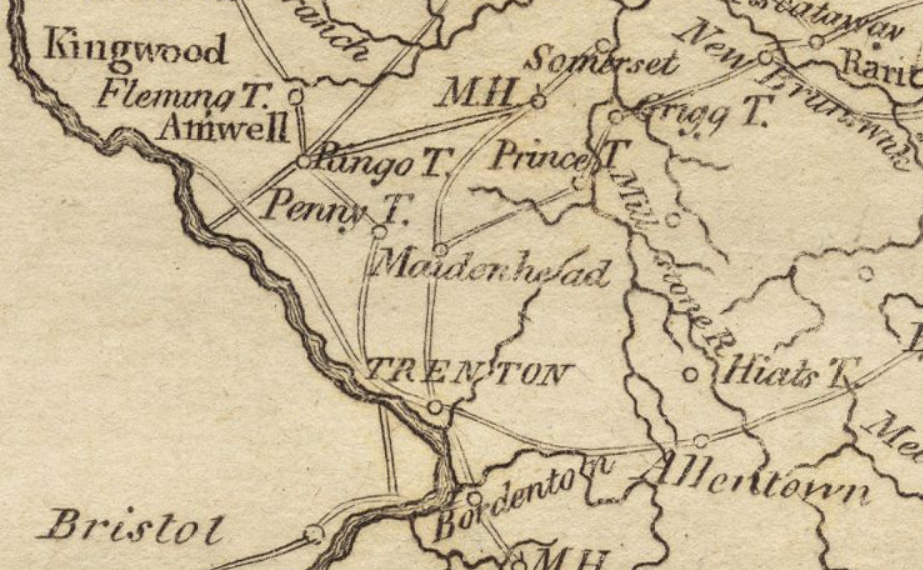
The area around Somerset Court House in central New Jersey saw an extraordinary amount of Revolutionary War military activity. Reason: it was on the main approach between north Jersey and Princeton, and between Princeton and New Brunswick, a British stronghold in Jersey. Not unexpectedly, the militia around Somerset Court House, now Millstone, New Jersey, saw action on several occasions. Somerset lay in that "middle area" between the British and American outposts, which had some quite vicious but little-celebrated fighting. Besides being in a strategic crossroads, the area around Somerset Court House was full of thriving farms with an abundance of crops and animals. During the winter in particular the ground was often frequented by British foraging parties from nearby New Brunswick.


Background


After General Washington took Trenton for the second time and fought past the British under General Cornwallis at  Princeton on January 3, 1777, he faced being caught between Cornwallis and the main the British Army around New Brunswick. But Washington's troops were exhausted after weeks of marching and fighting in extreme weather with inadequate food and clothing. So His Excellency decided to send his beleaguered regiments up the Millstone River valley toward Morristown, which could provide suitable and secure winter quarters. Morristown was protected by the Watchung Mountains, which could be strongly fortified at the passes to stop a British attack.


New Jersey was a battleground


 After the rebels fought at Princeton, Washington moved north to Somerset Court House. The advanced guard, part of the Delaware Line, came upon the village of Stone Brook (seat of Somerset Court House)  15 miles up the valley from Princeton, arriving around at twilight. However, the British had already evacuated supplies desperately needed by the Patriots. And the Americans were simply to exhausted to pursue. But within a few weeks, the winter war for forage between both sides would be in full swing and the area around Somerset was one of the prime battlegrounds of that campaign.


The Forage War Begins


At the urging of General William Maxwell, New Jersey Militia General Philemon Dickinson, and others, Washington ordered his Continental regiments and the local  New Jersey militia to engage  British outposts, patrols, couriers, and most especially forage parties Washington wanted to contain, harass and tire the British and Loyalists so they couldn't (or wouldn't) leave the main bases at New Brunswick and Amboy without sending considerable forces of say 1500 to 2000 men. The militia responded to this call with enthusiasm. Thus began a series of actions in the middle of what was normally the quiet time in 18th-century warfare. But warfare in North America, especially the war for independence took a different turn.


Militia General Philemon Dickinson


Battle of Millstone or Van Nest's Mill


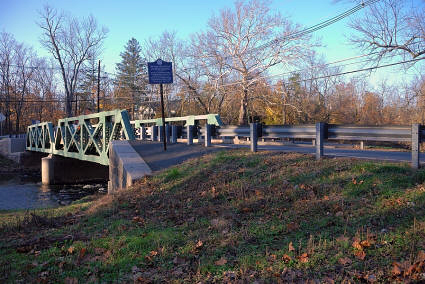
On January 20th, 1777, British Lieutenant Colonel Abercromby, with 500 men and several cannon, went on a foraging party towards Hillsborough. American militia patrols spotted them and sent word back to  General Dickinson that "the enemy were out plundering." Dickinson had around 400 men in hand plus a company of 40 or so Pennsylvania Continental Riflemen under the command of Captain Durkee from the Wyoming Valley. The British were posted at a bridge over the Millstone River, near Abraham Van Nest's mill, about two miles from Somerset Court House. The Millstone ran into the nearby Raritan River. Abercromby had placed three field pieces on a hill, about 50 yards from the bridge to prevent any rebel forces from crossing there. The rivers were covered with a crust of ice and the water beneath, about waist high by most accounts, and of course ice cold.


Millstone River Today

The Action


Seeing the bridge crossing protected,  Dickinson ordered his men downriver (towards the Raritan), where they broke through the ice and waded into the cold waters that reached well above their knees. Dickinson divided his forces, sending one force to meet the front of the British wagon train, while a second moved to flank them. One wing of the American attack successfully surprised the British wagon train in the lane near Van Nest's Mill, cutting it off before it reached the main road and the bridge toward New Brunswick. Well-placed fire struck horses from the first wagon, halting the train,  Panicked, the wagon drivers scattered. This caused the British to beat a hasty retreat to the bridge, leaving their booty behind. But when the pursuing militiamen reached the bridge, the Hessian rearguard fired grapeshot from its artillery to cover the retreat. After an exchange of fire across the river, the British withdrew. As was the case with most such actions, the actual combat was brief. The British taking the brunt of causalities and lost around a dozen prisoners and twice that in killed and wounded. The British admitted that the rebel surprise attack "occasion'd such disorder Amongst the Waggon Drivers that 42 Waggons were left behind." They also lost 104 horses, 115 head of cattle, and about 60 or 70 sheep. Valuable livestock denied the enemy in winter quarters and most needed by the always deprived rebels.


Militias defeat Regulars: How Could this Happen?


This was no major battle or great victory. Yet it proved significant. Stalwart and determined, these once disparaged New Jersey militiamen had gained confidence and were less in awe of redcoats and Hessians due to American successes Princeton and Trenton. Even before Trenton, exaggerated reports of enemy depredations across the Jerseys began to stir the fires of revenge and retribution in many (but not all).  This was not the only instance when anger fired up the militia into ferocity against enemy regulars and Loyalists. In fact, it would become a growing theme throughout the remainder of the war. So in many ways, the action at this place called Somerset Court House was a harbinger of greater things to come.


Thursday, May 23, 2013

A Yankee Doodle Memorial

This is Memorial Day weekend.  For most Americans, just another reason to have a party, go to ball games or watch the Indianapolis 500 or Preakness.

But for some, especially those who have a military connection, Memorial Day is truly something special because it is the one day that commemorates those who have fallen in the service of their country. Memorial Day was promulgated on 5 May 1868 by General John Logan, the Commander of the Grand Army of the Republic, a Civil War veterans group made up of northern vets -sort of the American Legion/VFW of its day. To honor Civil War fallen, flowers were placed on the graves of Union and Confederate dead on 30 May although most southern sympathizers clung to separate holidays to commemorate their fallen. This changed after World War 1 when veterans of both regions who had served side by side began to be honored as well.


General John A. Logan


The trauma of the Civil War, followed by that of the Great War brought industrial age carnage to new heights and the need for some sense of spiritual closure for those fallen in massed attacks such as those at Gettysburg, Cold Harbor, or the Marne and the Meuse-Argonne offensives.  To honor them, huge cemeteries and memorials span the nation and the battlefields of Europe and Asia honoring the hundreds of thousands of fallen. By "modern" standards casualties during the War for Independence were laughable and most soldiers died from sickness and starvation while in service to their nation.


But our First Patriots cherished and honored their fallen no less. And after the war, the need to honor those who gave all for an idea sanctified both the idea and those whose sacrifice enabled it.  Here are just a few examples:


General Montgomery Memorial
at St. Paul's
The first commemoration was ordered by the Continental Congress in 1776 to honor General Richard Montgomery, who fell during the American assault on Quebec, Canada. Our first fallen general's monument was designed and built under the supervision of Benjamin Franklin by one of France's best artists, King Louis XVI's personal sculptor, Jean Jacques Caffieri. Shipped to America upon completion, it rested in Edenton, NC.  Although Congress originally intended to place it in Philadelphia, it ultimately ended up in
New York City, where, in 1788, it was installed under the direction of France's Pierre Charles L'Enfant (who later designed Washington, DC)  beneath the portico of St. Paul's Chapel, which served as George Washington's church during his time in New York as the United States' first president in 1789, and where it remains to this day. Montgomery's body, which was originally interred on the site of his death in Quebec, was moved to St. Paul's in 1818.


Those who read my earlier blogs also know that I began the Yankee Doodle Spies idea, and particularly The Patriot Spy because as a boy I was inspired by the Maryland Monument in Brooklyn's Prospect Park (scroll down to read of it). But an important and little known monument was erected at the site of the Brooklyn Navy Yard.  Why? Because there the remains of perhaps as many as 15,000 First Patriots were interred there.  These were prisoners of war, the victims of the notorious British prison ships anchored as "hulks," that is de-masted sailing ships, docked in an area called Wallabout Bay.  These First Patriots later became known as the "Prison Ship Martyrs."


Unveiling Prison Ship Memorial at Ft Greene Park 1908


For years after the war, the bones of Martyrs would wash up on shore and finally  a monument was erected near the site of the hulks at the famed Brooklyn Navy Yard at a place called Vinegar Hill.  In the mid 19th century a stone crypt was erected at nearby Fort Greene Park and the bones were interred there. Fort Greene was one of several forts erected by Washington to defend Brooklyn from the British in 1776 (you can read about that in The Patriot Spy). In the late 19th century the martyrs' remains were once again moved to a new Fort Greene monument  - a tall (148 foot) obelisk that looked down on Brooklyn. When President Taft dedicated it in 1908, it was one of the finest structures in the nation and a fitting final resting place for the Prison Ship Martyrs.


General Wooster Monument

One of my recent blogs was on Connecticut's General David Wooster who was killed in the fighting that followed the British/Loyalist raid on the arsenal at Danbury, CT. On June 17, 1777, Congress voted that a
suitable monument should be erected in his memory, but measures were never inaugurated to execute the resolution. His grave was not identified until 1854 when the Connecticut legislature laid the cornerstone of a monument. Today, a monument 30 feet high marks his final resting place at Mount Moriah in Danbury. Coincidentally, Wooster fought at Quebec as Montgomery's second in command and took much unjust blame for the campaign and its result.


Many argue that Philadelphia, our nation's first capital, marks the spiritual, political, and geographic center of the American War for Independence and in 1954 an impressive monument was built to commemorate those who fell in the war. The Tomb of the Unknown Revolutionary War Soldier is  located in
Philadelphia's Washington Square. It honors the thousands of soldiers who died during the American Revolutionary War, but especially those who were buried in mass graves in that park.
The actual  plaque upon the tomb of the Unknown Soldier reads: "Beneath this stone rests a soldier of Washington's army who died to give you liberty."

Tomb of the Unknown Revolutionary War Soldier
Philadelphia

Bunker Hill Monument
Boston
If Philadelphia was the heart of the new nation, Boston was the heart and soul of the rebellion that forged the nation. The entire area is a virtual monument to the American Revolution but I'll single out one for this piece - the Bunker Hill Monument. The battle of Bunker Hill (which took place on Breed's Hill) is legendary, and for years General Washington (vainly) sought to replicate the scenario of entrenched Americans mowing down disciplined British troops who calmly marched into a hale of rebel lead. The first monument on the site was an 18-foot wooden pillar with a gilt urn erected in 1794 by King Solomon's Lodge of Masons to honor fallen patriot and mason, Dr. Joseph Warren. In 1823, a group of prominent citizens formed the Bunker Hill Monument Association to construct a more permanent and significant monument to commemorate the famous battle. The existing monument was finally completed in 1842 and dedicated on June 17, 1843, in a major national ceremony. The exhibit lodge was built in the late nineteenth century to house a statue of Dr. Warren.


So this weekend and throughout the year, we should remember all Americans who died in their nation's service. But we should especially recollect those who died to establish the nation and the idea of a free and independent people. Wherever and however you decide to celebrate the occasion, take a moment to think of those who had no Arlington - the fallen at Saratoga, Brandywine, Brooklyn, Harlem, Paoli, Bennington, Germantown, Charleston, King's Mountain, Guilford Court House, Valley Forge, Yorktown, and hundreds of battlefields fields so small only the local patriots know of them. Give them a roaring "Huzzah" for duty well done.

Arlington

Saturday, December 22, 2012

Silent Night...Silent Might

Christmas celebrations in colonial America were much more staid than those we know today. December 25th in colonial America was just another day unless it fell on a Sunday, in which case it was just another Sunday. America's celebration of Christmas as a very special holiday began with the large wave of German immigrants in the early 1800s. Germans always held Christmas as the most special of days. Christmas's role in the English-speaking world peaked during the Victorian era. Victoria's consort, Albert, brought many Christmas traditions with him, and later Charles Dickens and other novelists popularized the season. Of course, Santa Claus is derived from Sant Niklaus, a Dutch character based on the original Saint Nicholas, a Roman bishop in what is today Turkey. Full disclosure: the original Saint Nicholas is buried in my grandparents' home city of Bari, Italy.

As Christmas approached in December 1776, the fortunes of the American rebellion had plummeted. The British juggernaut advanced into the Jerseys (back then, New Jersey was sometimes referred to as East and West Jersey). Lord Charles Cornwallis led the invading vanguard of some 5,000 British and Hessian troops in pursuit of Washington's dwindling army. Washington abandoned Fort Lee and maneuvered to Hackensack, where he checked the British only briefly before retreating without pause through Newark, New Brunswick, Princeton, and Trenton. On the 8th of December, Cornwallis and his scouts reached the east bank of the Delaware just in time to watch Washington and his personal escort depart on the last boat.


Herssian Grenadier


The patriot cause was at its nadir. Panic had set in, especially in Philadelphia. Lord Howe had issued a proclamation offering amnesty to any rebels willing to swear an oath to the King. Some had begun to accept it. Worse still, many of Washington's best troops had enlistments expiring, with little likelihood that replacements would arrive. Fearful of a British assault on the capital, the Continental Congress fled and turned governance over to the military. To stall the British, Washington had all the serviceable boats along a 70-mile stretch of the Delaware confiscated. The British advance had to await their engineers to plan a crossing. Fortunately, Lord Howe had decided he had all but whipped the rebels and ordered his army into winter quarters, with brigade-sized garrisons at Brunswick, Trenton, Princeton, Bordentown, and Cherry Hill. The remainder took quarters on Staten Island or Manhattan.


Gathering Boats was Critical


But morale across the colonies remained dismal. The end seemed in sight, as Howe assumed. The December 23rd edition of Thomas Paine's pamphlet "The Crisis" inspired many Americans. A desperate Washington gambled on a winter strike against the rebels before many of his best regiments dissolved. He had the pamphlet read to his troops and conceived a plan for a Christmas thrust in three divisions to take the enemy garrisons at Trenton and Bordentown. At first, demoralized by the British advance, New Jersey militia units began probing and harassing the British garrisons, isolating them in their posts. Then General John Sullivan arrived with a division from the Hudson Highlands. These reinforcements gave Washington the strength he needed to complete his plan.


Dramatic portrait - Washington crossed over
in the dark of a December night


On the night of December 25, Washington made his famous crossing at McConkey's Ferry and marched nine miles along the Delaware to Trenton. Divisions under Generals Cadwallader and Ewing (mostly Pennsylvania and New Jersey units) were to cross near Bordentown and link up with Washington, but worsening weather and rapidly forming ice floes prevented them from crossing. Nevertheless, Washington struck with just over 2,000 men just after dawn, even as a mix of rain and snow descended on them.


Overrunning the Hessian guns at Trenton

So what's the Christmas connection? The German garrison, a brigade under the command of the renowned Hessian Colonel Johann Gottlieb von Rall, was caught unprepared. Germans celebrate two days of Christmas, and Washington struck between them. Indeed, the Germans themselves had been worn out by the rigors of the campaign, and the Jersey militia had played a part in tiring them and causing a "hunker down" effect. But Rall never expected the onslaught that caught them in the weary hours of their holiest of days. Rall fell mortally wounded while rallying his battalions, and soon after the garrison surrendered more than one thousand men. The battle did not last an hour. The stunning victory saved the American cause, which was all but finished.