Followers

Sunday, June 25, 2017

The Palmetto Fortress

A Tour de Force


In the spring of 1776, the British planners in London aimed to turn their recent stalemate and embarrassing withdrawal from Boston into a strategic victory that would end the rebellion that year. One fleet was ready to strike the crucial port of New York with a direct attack, while another planned a quick left hook at the equally important port of Charleston. The latter strike was to come first, setting the stage for a more decisive blow in the middle Atlantic colonies. Charleston, the major southern city at the time, had vital connections to the key islands in the West Indies, which were always a top priority for British interests. Dominated by a planter class, South Carolina wasn't seen as a heavily rebel area that would fall easily. However, a few brave patriots proved them wrong.


A Last-Minute Plan


Lord Dartmouth
The British strike at the southern colonies actually began earlier in the year when William Legge, Lord Dartmouth, and Secretary of State for the Colonies ordered General Henry Clinton and Commodore Peter Parker to rendezvous with another armada under General Lord Charles Cornwallis off Cape Fear, North Carolina. Misfortune on land and at sea turned the North Carolina plan to mud. But before Clinton could sail north, Parker reported that a reconnoiter of Charleston indicated the defenses were ill-prepared and that a quick strike against Fort Sullivan on Sullivan's Island in the harbor would be successful. After that, the city could be successfully assaulted. Anxious for some "low-hanging fruit" after the Tar Heel frustration, Clinton concurred, and so they made their way south, anchoring off the city on 7 June 1776.


A City Prepares


Charleston's waters were treacherous
as the British would soon discover

But the South Carolinians in Charleston had long anticipated that they would be a target of the British and eagerly built up defenses on Sullivan's Island. This was a three-sided fort with sixteen-foot-high sand walls surrounded by softwood palmetto logs. The spongy palmetto wood absorbed the impact of cannonballs—the main threat to the fort. The fort was armed with twenty-five guns of various sizes and calibers, and housed a garrison of over four hundred men. Most importantly, the commanding officer of Fort Sullivan was militia Colonel William Moultrie, who would soon prove to be one of the most capable fighting generals of the war. The city itself had a garrison of over six thousand troops, including Continental Line infantry. In command was Major General Charles Lee, a former British officer and widely regarded (especially by himself) as the finest officer in the American cause. Lee believed that Fort Sullivan was too exposed to the fire of British warships and ordered it to be abandoned. However, South Carolina Governor John Rutledge overruled Lee, viewing it as a necessary buffer against a naval attack. Geography and hydrography favored the defenders; the narrow harbor channel, with strong currents and shoals, troubled the British as they planned where to land and how to position their ships. It took a month before they were ready to attack the city that was just within their reach.


Colonel William Moultrie's militia
staged a gallant defense


Bombs Bursting in Air... Sand.. and Wood


The South Carolina flag hoisted in battle
boosts morale

On 28 June, a bombardment commenced between Parker's warships aligned off Sullivan Island and Moultrie's raw militia manning the guns protected by sand and palmetto logs. The barrage went on for hours. The British gunners were frustrated that, despite hit after hit, the combination of sand and spongy logs inflicted little damage on the fort. Shot after shot from the warships either bounced off the walls or got absorbed into the soft walls of the palmetto. The Americans fired back. But low on gunpowder, Moultrie insisted that each shot be well-aimed. In the middle of the hours-long engagement, a British shot cut down the South Carolina flag. A brave sergeant named William Jasper, in full view of the British and the Americans, ignored the hail of lead and iron to mount the parapet and restore the flag. The impact on the morale of both sides was telling. As the battle continued, the defenders' deliberate fire took its toll on the British ships, scoring hit after hit. Things took a final turn against the British when Parker sent three frigates around Sullivan Island to take the defenders in the flank. Unaware of the dangerous waters of the channel, all three suddenly grounded in the shallows. After a struggle, the two freed themselves, but the third, HMS  Acteon, remained stuck. The frustrated crew burned it to prevent the rebels from taking it.


The savage naval bombardment was decided
by shoals, sand, and wood


Fight  on till Dark


Commodore Parker
The firing continued on both sides. Commodore Parker's flagship had its anchor cable severed by a shot, causing the ship to turn and present its exposed stern to American fire. The rounds poured in, and one actually passed between Parker's legs as he shouted out commands. The commodore was unhurt but indignant as the shot tore his pants off. When darkness descended on the harbor, Parker signaled the fleet to disengage. Exasperated, the British fleet sailed from the harbor. It would be four long years before they would deign to return to face the Carolinians and their palmettos. The next one would end differently, but in 1776, the failed attack presented the British with a near disaster. The Royal Navy incurred well over two hundred casualties - Moultrie's men less than forty. And what of General Clinton? His men had landed on nearby Long Island to prepare for an assault on the mainland once Fort Sullivan fell. With the warships gone, this would not be. Instead, they remained exposed there for several weeks before the British transports were able to sail in and they could re-embark.


The Result


The British armada returned to New York at the end of July with ships damaged and sailors and soldiers discouraged. However, they soon had a chance for some revenge when the British launched their massive attack on Long Island in late August. Still, the victory at Fort Sullivan kept the South safe for four crucial years. It introduced the world to a brave new leader and boosted morale across the Carolinas and the entire rebellion. And in honor of the palmetto’s role in the victory, the noble tree with soft bark was added to the South Carolina state flag, where it remains today.


South Carolina State Flag


Saturday, June 17, 2017

First Fathers

N.B. This is an edited reprise of an earlier post on the subject. With Father's Day tomorrow, I decided to revisit the tragic case of the Lynch father-son team.

Who’s your Daddy?
 There were many father-son pairs during the American War of Independence, especially in the local militia units that fluctuated with the intensity of hostilities. However, some served at the highest levels of the Revolution. The Lynches were one such duo.

Father-Son Signers...

Thomas Lynch Sr. was the son of Jonas Lynch from the Galway branch of the Lynch family, who were expelled from Ireland after their defeat in the Irish wars of William of Orange. Jonas Lynch came to America and became a successful planter. His son Thomas was born in Berkeley County, South Carolina, in 1727. 


Eighteenth-century rice house


By the time his son Thomas Jr. was born in 1747, he owned a large estate called Hopsewee Plantation along the North Santee River and other watercourses. He was also active in politics. As tensions with Britain grew, the elder Lynch became a prominent and often fiery supporter of the revolution. He later served in the Continental Congress from 1774 to 1776. The senior Lynch was set to sign the Declaration of Independence for South Carolina, but he suffered a massive stroke early in 1776.


With the father fallen, the South Carolina Assembly appointed his son, Thomas Lynch Jr., to succeed him. Thomas Jr. was born at Hopeswee and, unlike his father, had the benefit of a top-tier education. He attended prestigious schools in America and then Eton, Cambridge, and finally studied law in London. He returned to America and married well. He then went into planting. As the heir of a passionate revolutionary and influential man in the colony, Lynch Jr. naturally took a keen interest in politics. He enjoyed strong support from voters. During 1774-76, while his father served in the Continental Congress, he worked on the home front, attending the first and second provincial congresses as well as the first State legislature and sitting on the State constitutional committee.

A Military Career Curtailed

In 1775, Lynch took a captaincy in the First South Carolina Regiment of Continentals. This upset his father, who wanted to use his influence to secure a higher rank for his son. Unfortunately, young Lynch caught bilious fever (an intestinal fever) while on recruiting duty in North Carolina. Sick and unable to serve, he had to give up his promising military career.

The Stand-In


But in the spring of 1776, when Thomas Sr.’s condition became critical, South Carolina’s Assembly elected Thomas Jr. to the Continental Congress. Despite facing his own serious health issues, the younger Lynch dutifully traveled to Philadelphia, where he stayed for the entire summer. During that revolutionary season, he was able to vote for and sign the Declaration of Independence at just twenty-seven years old. The Lynches were the only father-son pair to serve simultaneously in the Continental Congress.


Signing the Declaration of Independence


Double Tragedy

Political triumph was met with personal tragedy, and more blows to the patriot family were yet to come. Both Lynchs' health worsened, and by the end of the year, they headed homeward. En route, in Annapolis, MD, a second stroke took the life of the senior Lynch. Thomas Jr. returned home a broken man—physically and emotionally. Late in 1779, he and his wife traveled to France in an attempt to regain his health. They sailed for the Dutch island of St. Eustatius in the West Indies to find a ship to return across the ocean, but a storm struck, and their ship was lost at sea.


Sunday, May 21, 2017

Rev War Talk: Veterans & Leaders


Dick Winter's Memorial at Veteran's Plaza in Ephrata. Pennsylvania


The Lecture


As part of their ongoing Veteran's Lecture Series, the Winters Leadership Memorial Committee invited me to speak on the American Revolution, the Yankee Doodle Spies, and related topics. The committee sponsors one such talk each month, typically the last Tuesday. The talk will encompass an overview of the eight-year struggle for independence plus a series of cameos on various aspects of the war such as intelligence, maritime, geography, etc. It will take place in the library at Ephrata, Pennsylvania. The Lecture Series itself began back in 2014 as a way to continue the effort we started with the construction of Ephrata’s Veterans Plaza & installation of the Winters Leadership Memorial. The driving purpose behind building the Veterans Plaza was to honor all veterans from all wars. One of the plaques in the plaza says it best, “They are not dead who live in the hearts they leave behind.”


The Man


The Winters Leadership Memorial is named after Major Dick Winters, legendary WWII commander of Easy Company of the 101st Airborne (Screaming Eagles) commemorated in the book and television mini-series: Band of Brothers. Winters grew up in and around Ephrata, in central Pennsylvania, where he eventually returned.

Winters was immortalized in the book and HBO series, "Band of Brothers"

The Memorials


In June of 2012,  a statue was installed at Utah Beach in Normandy.  It was created in Richard D. Winters' likeness, designed to honor all leaders, especially those of the Junior Officer’s.  Winters felt that the leadership and decision making of these young and inexperienced men was critical to the success of the D-Day invasion and other critical WWII battles. The artist who created the Winters Statue also offered the community of Ephrata the opportunity to erect a reproduction of the Normandy statue.  A committee was formed,  and the group set out to raise the funds required to acquire the statue, build the Veterans’ Plaza it would rest in, and maintain the site. In May 2015  the statue was dedicated at the plaza.


Actor Damian Lewis, who portrayed Dick Winters in the HBO series,
speaks with 101st vet during the commemoration of the Winters Memorial
  in Normandy, France


America's Veterans Issues & the Revolutionary War


So what does all of this have to do with the Rev War? Well, everything as it turns out. Issues regarding veterans commenced even as the American War for Independence was in its waning years. Soldiers released from services often failed to receive compensation promised by the states and Congress, little as that was. There were several "affairs" sometimes even mutinies over lack of compensation, food and clothing.


Newburgh Conspiracy


One of the most famous was the Newburgh Conspiracy, a rebellion of Continental Army officers in March 1783 that was nipped in the bud by George Washington himself. Washington personally confronted the conspirators, who planned to march on Congress and overthrow the fledgling confederation government. In 1780, Congress had passed a resolution providing half-pay for retired soldiers. But as late as  1783 the states (who had the power of the purse) had yet to comply with Congress’s request for money. The British Army was still quite ensconced in North America - the last troops would not leave until very late in the year. So the action of these conspirators could have resulted in stamping out the new nation before it could be established.


Continental Army at New Windsor Cantonment


How did it happen? As the conspirators gathered at an assembly hall/chapel  (the Temple Building) at Newburgh's  New Windsor Cantonment, to the surprise of all, Washington suddenly appeared before the assembly. The group had an inflammatory ultimatum penned by Major Armstrong, a former aide to cashiered General Horatio Gates (no friend of Washington). Washington denounced Armstrong and the ultimatum in very strong (for the 18th Century) terms.


The Temple Building - chapel where the officers gathered and Washington
confronted the conspiracy

The commander in chief remarked of the ultimatum, "...something so shocking in it, that humanity revolts at the idea." Taking the pulse of the audience he went on, "My God! What can this writer have in view, by recommending such measures! Can he be a friend to the army? Can he be a friend to this country? Rather is he not an insidious foe?" He also asked that they, "Give one more distinguished proof of unexampled patriotism and patient virtue." He asked for their, "full confidence in the purity of the intentions of Congress."


Washington's Headquarters at Newburgh


In closing, Washington attempted to read a letter he recently received from Joseph Jones, a Congressman from Virginia. The letter was to assure the commander in chief of (some in) Congress's assurance that the needs of the soldiers would receive a full measure of support. But Washington’s vision had recently begun to fail. He struggled with the opening paragraph. Frustrated Washington retrieved a pair of glasses from his pocket.  Then, the usually formal and stiff Washington made a rare casual remark. "Gentleman, you must pardon me, for I have not only grown gray but almost blind in service to my country."

This spontaneous act of demonstrating his humanity, from a man almost all held as next to God, had the immediate effect of taking the air out of the sails of mutiny and rebellion. Many officers began to weep. Possibly the greatest threat to the American Revolution and the new nation had evaporated due to the heartfelt and humble words of Washington. Sadly, veterans have had to fight for their rights from that day forward. Sometimes things did not end as peacefully and quickly as that March day in the Hudson Valley.


Washington did as much in saving The Cause with
his talk as in all the battles he fought


Saturday, May 13, 2017

Yankee Doodle Spies Mothers Day

I just thought I'd take a moment to salute all the mothers of the American Revolution. Motherhood was an unrelenting, painful, tedious, demanding, unforgiving, and too often underappreciated vocation during the time of the Yankee Doodle Spies. Sadly, not unlike today in many cases. I use this blog, in great part, to hail the so-called second tier of first patriots. The untold and little-mentioned men and women who played important roles in the struggle that birthed the first modern republic. Okay, I do post on the top tier from time to time, but that is to fill out the story. This one is for the moms...


Mary


I posted a previous blog about the greatest (sorta) mother of the American Revolution: Mary Ball Washington. This steely widow gave birth to the age's "indispensable man," George Washington. She was kind of a Beeyoche, but her stubborn, strong-willed nature clearly passed to George. The result: a leader who, although flawed, managed to adapt to adversity, rally diverse peoples, and keep a nation (and himself) together for eight long years until the millennium's most unlikely victory came to be. Despite their often strained relationship, Washington doted on his mother. We can be thankful to the woman who raised a son to become the leader of a new nation and the idol of most of his age.

Mary Ball Washington's fire and
stubbornness passed on to her noted son


Martha


I truly think the Lord above was having fun with these two mothers who influenced, molded, and simply made George Washington the man he was. Martha Custis was a wealthy widow when she married George. She was also his senior and already a mother. George adopted her children as his own and doted on the family he married into. Martha was short and, in middle age, tended to stoutness. But although Washington was admired by the most glamorous women in the hemisphere, Martha was his lodestone. Her strength in maintaining his farm and family enabled him to ride off from Mount Vernon and return eight long years later. But he could not remain apart from Martha that long. Almost every winter, he requested that she leave their farm and join him in winter quarters, where she became the surrogate mother of his officers and men.


Martha as a young woman


Abigail


Abigail Smith is best known as Abigail Adams. David McCullough's book about John Adams and the resulting TV series have made her the most renowned of "First Mothers." Adams admired and encouraged Abigail's outspokenness and intelligence. She supported him by running the family farm, raising their children, listening to him, and trying to help him with his problems. Despite her own bouts with illness, she gave birth to five children. One daughter, Susanna, born in 1768, lived for only a year. Beyond being the bedrock of the founding father who would become America's second (and first controversial) president, Abigail was also the mother of the nation's sixth president - their son John Quincy Adams.


Abigail's letters bolstered her husband
while informing him of family doings


Caty


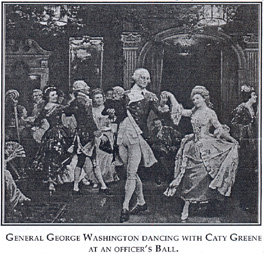
Nathaniel Greene is considered the second greatest (and for some, the greatest) commander in the American army. Catharine Littlefield married Nathaniel Greene in 1774 at the age of nineteen. When her husband marched off to war a year later, she was abruptly thrust into the role of head of household. Eager to be with her husband, she joined Gen. Greene at his military headquarters whenever possible. Over the course of the war (and shortly after), Catharine had five children. Conflicted between caring for her children and longing to be with her husband, Caty (as she was also called) settled on a compromise. To maintain a normal family life when conditions allowed, she brought her young children with her to camp. At other times, she left them in the care of family or friends. It was during these separations that Caty felt the war's effects most keenly on her family. She was a staple at winter quarters, and her presence had a positive effect not only on her husband but also on the other officers and the commander in chief himself - they were often dance partners.


Happy Mothers Day! 

Wednesday, April 26, 2017

Ramsour's Mill

Background


One of the least known but still crucial sites of the American Revolution was a small mill in North Carolina's Piedmont region. A modest backcountry mill, Ramsour's Mill, first played its part in the fight for independence during the summer of 1780. After Charleston, South Carolina fell in May 1780, General Charles Cornwallis was well on his way to dominating the South. Georgia and South Carolina were under British control, allowing the ambitious British general to turn his attention to North Carolina with an army of over 8,000. The southern strategy appeared to be working.


Lord Charles Cornwallis


Loyalists Gather


While Cornwallis rested his army in Charleston to prepare for his next move, two Loyalist leaders chose to act independently. The war for independence was, after all, a civil war, and these are often fought locally by the people who live there. So, Loyalists Lt. Colonel John Moore and Major Nicholas Welch decided to pursue their own goals by launching the first British attack on the North Carolina colony—their home turf. By June 13, 1780, they had successfully assembled a group of Loyal recruits at Jacob Ramsour’s Mill, near Clark’s Creek in Lincoln County, NC.


Patriot Response

However, General Griffith Rutherford, the shrewd and determined leader of the patriot forces in western North Carolina, had learned of the Loyalists gathering in Lincoln County. He immediately contacted patriot leaders, Colonel Francis Locke and Major Robert Wilson, and ordered them to assemble the militia to stop the Loyalists' assembly. To that end, 400 militia from Burke, Iredell, Mecklenburg, and Rowan Counties gathered at Mountain Creek on June 19. 

The recent British victory at Waxhaws boosted Tory morale, enabling Moore and Welch to collect around 1300 Loyalists - more than three times the number of local patriots. Recognizing that the Loyalists' numbers would only increase, Rutherford decided on a surprise attack against the Loyalist camp. A battle was about to unfold, pitting neighbor against neighbor.


Patriot mounted militia led the attack


Battle or Fratricide?

In the early hours of June 20, Locke led a militia band to Ramsour’s Mill to meet Adam Reep, a local patriot spy with intelligence on Loyalist troop location and strength. As the sun rose over Ramsour’s Mill, the rebel militia quietly moved through the early morning fog. The patriot cavalry launched a swift attack, aiming to surprise the Loyalists. Though initially repelled by the Loyalists' defenses, the rebel infantry advanced. The Tories were initially confused but were rallied by Moore and Welch to push back the patriot assault. 

The defenders held off the attackers at first, but soon rebel marksmen closed in, leading to close combat. Many on both sides were poorly armed. The chaos was intense, as this was a battle without uniforms. The Loyalists wore green pine twigs in their hats, while the patriots had white paper on theirs. The fighting was fierce—neighbor against neighbor, even brother against brother. It was as much personal as political, with each side viewing the other as a traitor. The battle lasted nearly two hours—a lengthy engagement for such a fight. Eventually, the Loyalists became disorganized, and many fled. When Colonel Rutherford arrived, the Loyalists requested a truce but demanded an immediate surrender. While negotiations took place, the remaining Loyalists fled, and about 50 were captured as prisoners.


The fighting was intense - and personal for many


The Result


The action at Ramsour's Mill cost seventy lives and left two hundred wounded. Most of the fallen, both patriots and Loyalists, were buried in a mass grave. The defeat so severely demoralized the Loyalists in that part of North Carolina that they never reorganized in that area again. As for the headstrong Colonel Moore, he and about 30 of his men were able to reach General Cornwallis, who was then at Camden. But Cornwallis, angered by Moore's rash actions and the defeat, threatened him with charges for disobeying orders.


Aftermath


Ramsour’s Mill deprived Cornwallis of Loyalist recruits when he finally invaded western North Carolina. More importantly, patriot morale received a significant boost from the unlikely victory. Additionally, the Loyalists' morale was so low that they never managed to properly recruit from that area again. This indirectly led to the chain of events that culminated in the patriot victory at King’s Mountain later that year. 

In a curious and ironic postscript, Ramsour's Mill played another role in the struggle for the South and Lord Cornwallis's ambitions. It was at Ramsour's Mill in January 1781 that Cornwallis paused his advance north to burn his wagons and excess baggage before resuming his futile pursuit of American General Nathanael Greene to the Dan River. 

This campaign exhausted Cornwallis's forces, and he eventually fell back under heavy pressure from ambushes and skirmishes initiated by the rebels who now sensed blood. Cornwallis finally faced Greene's resurgent army at Guilford Courthouse—a "victory" that proved costly and marked the beginning of the end for the Southern strategy.


Ramsour's Mill played a role in the fateful
race to the Dan of 1781


Tuesday, March 21, 2017

The First President

Who was John Hanson?

 The "Major Deegan Expressway" is a busy and famous road in the Bronx, named after someone nobody ever heard of. William Francis Deegan was a major in the Army  Engineers in WWI, a renowned civil engineer, and NY Democratic politico.  Deegan also helped found The American Legion.

Suburban Washington, DC, has its own version of the "Major Deegan." In Maryland, there is a road called the "John Hanson Highway." The John Hanson Highway is actually US Route 50 heading east from the District towards Annapolis. Just as in the Bronx, I am sure the thousands of drivers who transit that road each day have no idea who John Hanson was. They would be amazed to learn it was named after the nation's first president!


John Hanson Highway


Early Life

John Hanson was born in Mulberry Grove, Charles County, Maryland on 2 April 1721. He was the son of a  planter of English ancestry. His grandfather, also named John, came to Charles County, Maryland as an indentured servant around 1661. In 1744 Hanson married a wealthy landowner (Martha Washington was no the only wealthy colonial woman to marry a future president). Within the decade Hanson had expanded the holding to over 1,300 acres. Also like Washington, Hanson entered public life. In 1750 he was elected sheriff and seven years later was elected to a seat in the Maryland Assembly. By all accounts, he was a solid and efficient bureaucrat with a knack for finance.


Maryland Plantation


Political Strife

As friction between England and her colonies grew during the 1760s, Hanson identified with those who supported American grievances. Hanson publicly denounced the Stamp Act of 1765 and drew instructions for the first Maryland delegates attending the Stamp Act Congress in New York. In 1769, Hanson signed the Non-Importation Resolution adopted by Maryland to protest the Townshend Acts - a series of measures introduced into the English Parliament by Chancellor of the Exchequer Charles Townshend. The Townshend Acts of 1767 imposed duties on glass, lead, paints, paper, and tea imported into the colonies.


Move West

Hanson moved to Frederick County in the western part of Maryland in that same year. He took up life as a merchant. But he did not forgo politics. Instead, he became involved in the "extra-legal" political activities protesting British policy. In a word, he became a rebel. In 1774 Hanson chaired a town meeting to protest the Coercive Acts, the series of laws passed by the British Parliament to punish the colonies. Four of the acts were issued in direct response to the Boston Tea Party of December 1773. The following year, Hanson went on record declaring that armed force might be necessary to resist British tyranny. Those were serious words that clearly placed him at the center of the rebellion.


Coercive Acts were enacted in response to Boston's Tea Party


War Supplier

When armed conflict erupted in April 1775, Hanson used his fiscal expertise and organizational skills to help arm and equip soldiers of the Continental Army. As a result, soldiers from Frederick County were among the first soldiers to join General George Washington's army gathering at New York City. These were part of the famed First Maryland Regiment of the "Continental Line." Readers of the Yankee Doodle Spies series know that the main protagonist, Lieutenant Jeremiah Creed, was an officer leading a company from Frederick County as part of this esteemed outfit. The Marylanders, who made a gallant charge at the Battle of Long Island, were among the best equipped of Washington's soldiers - now we know it was thanks to one John Hanson.


Mark Maritato's  painting of the Maryland Line's gallantry on Long Island
(hangs in my office)


War Politician


Beginning in 1777, the people of Frederick sent Hanson back to the Maryland Assembly for five consecutive terms. In 1779 he was appointed a delegate to the Continental Congress. In Philadelphia, Hanson was appalled by the sloppy administration of the war and their wasteful spending. He was an early supporter of a stronger government in the form of the Articles of Confederation. Now known as a weak central form of government, the Articles had many advantages and were in fact more authoritative than the unstructured Congresses that preceded it.  Hanson delayed formal support until Virginia and other states gave up their claims to western lands. Once he accomplished that, Hanson became an ardent advocate and was elected as the first "President of the United States in Congress assembled" on 5 November 1781.


America's First President - John Hanson


Hanson's role was mostly ceremonial as under the Articles there was no executive. But he did oversee the day to day proceedings of the Congress. He corresponded with state governors, sent resolutions off to the various state assemblies, and helped orchestrate legislative functions.  Peace talks were initiated with Britain under Hanson. And he developed the structure of managing government through departments. Arguably, Hanson's most memorable war act was to accept the sword of General Charles Cornwallis from the victorious General Washington in November 1781.


Washington would present the sword Cornwallis surrendered
at Yorktown to President John Hanson


An Early Demise


Hanson was plagued by ill health and left his position after only one year as president when he resigned from office. John Hanson died on 15 November 1783, in Oxon County, Maryland, just ten days before the last British troops left New York City. Although not listed among the pantheon of "Founding Fathers," John Hanson can best be remembered as a highly trustworthy and efficient public servant and, technically, the nation's first president.


Statue of Hanson in Capitol's
 National Statuary Hall Collection


Sunday, February 12, 2017

Rodrigue Hortalez & Cie.


As I began my research into the American War for Independence to gain background and context for the Yankee Doodle Spies novels, I uncovered many things I had not known or even imagined existed. The struggle for independence was long and complex, featuring, in addition to traditional aspects of warfare, civil war, insurgency, guerrilla warfare, diplomacy, piracy, espionage, counterespionage, code-breaking, propaganda, spying, and covert operations.


A Secret War


Not widely known, the French began a covert operation to bolster the American rebels against the British crown. But some French secret activities began much earlier. The King of France, Louis XVI, and his ministers were smarting from the considerable losses of land suffered in the Seven Years' War, known as the French and Indian War in America. France lost all of her North American colonial possessions (except a few small islands off the maritime provinces) and had been militarily humiliated by the British. Shortly after the Treaty of Paris in 1763 was signed, French agents went to the American colonies to sow discord between the colonists and their masters. As the actual conflict drew closer, both the Americans and the British expected some sort of French intervention. The question was where, what, and how?


The French & Indian War cost France her
New World power and global prestige


The Minister


Any intervention would be directed by Charles Gravier, Comte de Vergennes, appointed foreign minister of France by Louis XVI in 1774. Vergennes hated the British, whom he considered France's natural enemy. With Vergennes at the helm of foreign policy, many believed France would be quick to provide aid following the actions at Lexington and Concord in April 1775. But Vergennes and the King moved deliberately. They anticipated another war (of revenge) against the British. They knew France was not yet ready, and they did not think the colonies could succeed. How to proceed?


Charles Gravier, Comte de Vergennes

The Playwright Spy


On the scene comes an unlikely figure: Pierre-Augustin Caron de Beaumarchais, a watchmaker, playwright (Marriage of Figaro, Barber of Seville, etc.), inventor, musician, politician, fugitive, spy, publisher, arms-dealer, and... revolutionary.  Something akin to the "world's most interesting man", Beaumarchais was well known at the highest circles of French society. Louis XVI was an amateur watchmaker and one-time student of Beaumarchais. 


John Wilkes


As America boiled with patriotic fervor and rebellion, Beaumarchais developed a passion for liberty and the colonists' cause. It is no small irony that many in the highly stratified, autocratic French society were also bedazzled by the ideals of the American cause. This included the king and Vergennes - although their bedazzlement was as much an opportunity for revenge as a love of liberty. Beaumarchais approached Vergennes with a proposal to support the Americans. 

At first, Vergennes demurred. He knew the king was not ready to commit to action that might be exposed prematurely. During the run-up to and early months of the American Revolution, Beaumarchais was a French agent in London. He had made numerous secret connections with Americans and British, particularly Arthur Lee and British radical politician John Wilkes. Beaumarchais penned a letter (via Vergennes) to the king in late 1775, proposing a scheme to deliver covert arms to the Americans via the West Indies in exchange for tobacco and other American produce. Louis XVI demurred again at first but soon agreed.


Pierre-Augustin Caron de Beaumarchais- the 
world's most interesting man in an age of
interesting men?

The Company


Arthur Lee
With the king's quiet approval, Vergennes instructed Caron de Beaumarchais to execute his scheme and set up a "proprietary" called Rodrigue Hortalez et Cie. This was a front company whose primary purpose was to protect France's role in aiding the American rebels. Beaumarchais, a master of intrigue, registered the company in Spain and ensured no paper trail could be traced to the French government or any other French public entity. Beaumarchais had "backers" for the company whose identities were kept secret. Beaumarchais engaged the sole American representative in Paris, Silas Deane of Connecticut. Secret correspondence across the Atlantic and into London and Spain set things in motion. Deane would eventually be joined by Arthur Lee and Benjamin Franklin, which would take things into intrigues best left for another time.


Silas Deane played a pivotal role that ended
in controversy and ignominy


The "Business"


When the king approved the operation, Vergennes granted Beaumarchais an initial one million livres (several million dollars) to purchase and ship weapons and other war materiel to the Continental Army. At the same time, Vergennes pressured Spain, which contributed the same amount. Spain chafed at British ascendancy but, suspicious of Americans' intentions in Louisiana, dragged its feet. The crafty and persistent Vergennes soon succeeded in pushing them along. The front company prospered. In its first year of "business," Rodrigue Hortalez et Cie shipped over 30,000 muskets, 100,000 rounds of shot, hundreds of cannons, tents, ordnance, and clothing through New England merchants with shipping connections to the Indies. These items were critical to continuing the war effort, as America, by design, had little industrial capacity. 

The neutral Dutch islands in the Caribbean, such as Sint Eustatius, became a hotbed of clandestine shipping. Experienced American smugglers would navigate around British naval pickets to make secret transactions: typically, tobacco for arms and equipment. France shipped surplus and old (if not obsolete) weapons from its fortresses and armories. The tobacco and goods received were to be sold for cash, which was used to finance the French armaments industry, procuring new weapons for the French armies and navies that would eventually fight Britain. Rodrigue Hortalez et Cie continued in business for two years.


Sint Eustatius was a major transit point for
the secret weapons-for-goods trade


The Covert War goes Overt


Franklin and Lee's arrival heated up the diplomatic situation as Franklin, surrounded by British agents, employed a masterful stratagem to woo the French public and ruling class. Yet the covert war had long been established by Deane and Beaumarchais. Now, however, Beaumarchais faded into the shadows, and Deane was soon recalled to America on corruption charges that were never proven. 

After the Continental Army soundly defeated the British at the Battle of Saratoga in October 1777, things changed dramatically. France entered into an alliance with the infant United States in early 1778, while a reluctant Spain finally declared war on Britain in 1779. Still suspicious of the Americans, Spain allied itself only with France. Regardless, much more aid was now shipped to the colonies, this time openly, in the bellies of warships and transports, rather than under cover of the covert and private enterprise that was Rodrigue Hortalez et Cie.


Benjamin Franklin waged a masterful subterfuge and
charm offensive as commissioner in Paris


The Legacy of Untidy Business


As the war's progress made Rodrigue Hortalez et Cie unnecessary, some "unfinished business" fell to the American Commission in Paris, which now included John Adams in place of Deane. The correspondence below offers a glimpse into the untidiness of wrapping up covert affairs... even in the time of the Yankee Doodle Spies...


From the American Commissioners

To Comte de Vergennes

Sir
By some of the last Ships from America, we received from Congress certain Powers and Instructions, which we think it necessary to lay before your Excellency, and which we have the Honor to do in this Letter.
We have the Honor to enclose to your Excellency a Copy of the Contract made between the Committee and Mr. Francy, a Copy of Mr. Francy's Powers, and a Copy of the list of Articles to be furnished, according to that Contract, that your Excellency, may have before you all the Papers relative to this Subject.
We are under a Necessity of applying to your Excellency upon this Occasion, and of requesting your Advice.
With Regard to what is passed, we know not who the Persons are, who constitute the House of Roderigue Hortalez & Company, but we have ever understood, and Congress has ever understood, and so have the People in America in general, that they were under Obligation to his Majestys good will, for the greatest part of the Merchandizes, and Warlike Stores heretofore furnished, under the Firm of Roderigue Hortalez & Company. We cannot discover that any written Contract was ever made between Congress or any Agent of theirs, and the House of Roderigue Hortalez & Co., nor do we know of any living Witness, or any other Evidence, whose Testimony can ascertain to us, who the Persons are that constitute the House of Roderigue Hortalez & Company, or what were the Terms upon which the Merchandises and Munitions of War were supplied, neither as to the Price, nor the Time or Conditions of Payment.
As we said before, we apprehend that the United States hold themselves under Obligation to his Majesty, for all these Supplies, and we are sure it is their Wish and their Determination to discharge the Obligation to his Majesty, as soon as providence shall put it in their Power. In the mean time, we are ready to settle and liquidate the Accounts according to our Instructions, at any time and in any Manner, which his Majesty, or your Excellency shall set out to us.
As the Contract for future Supplies is to be ratified, or not ratified by us, as we shall judge expeditious we must request your Excellencys Advice as a favor upon this Head, and whether it would be safe or prudent in us to ratify it, and in Congress to depend upon Supplies from this Quarter, because if we should depend upon their Resource for Supplies, and be disappointed, the Consequences would be fatal to our Country. 

We have the Honor to be
 with all Respect Your Excellencys
 most Obedient and very humble Servants

B Franklin
Arthur Lee
 John Adams