Followers

Sunday, November 29, 2020

The Queen’s Ranger


A Bad Rap

This profile is genuinely one of THE badasses of the American Revolution, a struggle that had more than its fair share of tough characters. But John Graves Simcoe wasn't your typical badass, driven by testosterone and a thirst for blood – even though the (very excellent) TV series TURN might make you think he was that and more – a psychopath comes to mind.    

                                                Simcoe, as played by actor Samuel Roukin


But the real John Graves Simcoe was quite different. He was, in fact, a well-educated professional officer, liked by his troops and superiors, and respected, and sometimes feared, by his enemies. Born in Cotterstock, England, on February 25, 1752, he was the son of a Royal Navy officer who received a classical education at Eton and Oxford. However, in 1771, Simcoe left school at 19 and bought an ensign’s commission with the 35th Regiment. His education gave him an advantage over most of his peers, as he had a thorough knowledge of classical Greek and Roman military writings. He soon had the chance to apply his knowledge in the dark woods and green fields of America.

                                                          Simcoe took a commission at 19

Off to America

Simcoe was delayed in sailing to America and arrived after his 35th Regiment had been decimated at Breed’s Hill. During the subsequent American siege, he purchased a captaincy in the grenadier company of the 40th Regiment, where he fought in several battles in New York and New Jersey. Ambitious, he had sought command of the Queen's Rangers as early as the summer of 1776, when the army was on Staten Island. However, it was not offered to him.

                                                                            Brandywine


Simcoe fought valiantly at the Battle of Brandywine in September 1777, suffering serious wounds during the British victory. While recovering, events unfolded that would change the course of his career, pulling him from a typical line officer’s path. Simcoe was a vocal critic of military tactics and had told his superiors that the British needed a light infantry force to counter the American skirmishing tactics.                               


New Kind of Unit

He must have impressed his commander-in-chief, Lieutenant General William Howe, who promoted him to major in October and gave him command of the Queen’s Rangers. The Rangers were once a legendary unit formed by the even more legendary hero of the French and Indian War, Major Robert Rogers. The unit’s reputation had faded along with Rogers, who had left the army. Simcoe quickly began training it in the unorthodox tactics needed for the American war. Clad in green uniforms and rigorously drilled to fight as skirmishers in deep woods, patrol dense forests, and carry out raids and ambushes, they would eventually instill fear in all they encountered. He eventually expanded the unit to about 11 companies, each with roughly 30 men. One was a “hussar” (light cavalry) company. He also added a light infantry and a grenadier company. 

                                   Queens Rangers were trained for strength and skirmishing

New Kind of Action

With the arrival of the spring campaign in March 1778, Simcoe’s new unit saw its first action. The Queen’s Rangers engaged two American militia detachments at Quinton’s and Hancock’s bridges in New Jersey. The Americans were defeated by the aggressive tactics of Simcoe and his men. A few months later, the rangers handed a heavy defeat to General John Lacey’s forces at Crooked Billet, Pennsylvania, on May 1. An attempt to trap a reconnaissance detachment led by the Marquis de Lafayette at the end of May was less successful. But things were changing in the middle Atlantic. The new commander in chief, Sir Henry Clinton, was ordered to abandon the American capital, Philadelphia, and march his army to the safety of New York City. With the replenished and newly trained Continental Army nearby in Pennsylvania, Clinton knew the move carried risks. Therefore, he asked Simcoe to help cover the force.


                                                    Rare photo of Queens Rangers screening

The Queen's Rangers were in their element and performed well at their task, covering the withdrawal through the hot, humid fields and woods of New Jersey. In June 1778, Simcoe received word of his promotion to Lieutenant Colonel, a rapid rise for a British officer and a sign of more to come. The year 1779 saw Simcoe, the Queen’s Rangers, and the kind of warfare they were made for, come to the forefront. A series of small actions and skirmishes occurred throughout the New York region, mainly along the North (Hudson) River. On August 31, 1778, he led a massacre of forty members of the Stockbridge Militia, Indians allied with the Continental Army, in what is now the Bronx. His men were known to burn houses, barns, and stores—actions not unfamiliar to American units in a war that had become one of fire and smoke.

                                                  Simcoe employed his rangers aggressively


In June 1779, his rangers successfully led the capture of Stony Point and Verplank’s Point on the North River. Simcoe’s men soon joined Lieutenant Colonel Banastre Tarleton’s British Legion in a successful raid against rebels at Pound Ridge, New Jersey. With two of the top three British leaders in command, it was difficult for the defenders. A series of small actions followed, including raids, ambushes, skirmishes, and patrols. During one raid on October 17, 1779, Simcoe was ambushed and captured by the New Jersey militia. He was briefly imprisoned and eventually exchanged on December 31. The Queen’s Ranger returned just as General Clinton’s amphibious expedition against South Carolina was beginning.

Rangers go South

In the spring of 1780, Simcoe sailed south to support the British siege of Charleston. After a brief siege, the city surrendered in May. In what may have been a costly mistake, Simcoe was sent back north with Clinton and was soon dispatched to assist Hessian General von Knyphausen in conducting large-scale operations in the Jerseys. His skills and his rangers would likely have been more effective in helping to subdue the South, as would Clinton’s presence. Instead, after a promising start, the southern strategy began to fall apart in the kind of warfare that required Simcoe and his men.


                                                                Siege of Charleston


Traitor’s Partner

In an odd twist (sic), in December 1780, Simcoe was assigned to support traitor-in-chief British General Benedict Arnold’s heavily destructive raid through Virginia. He was partly placed at Arnold’s side to keep a close watch on him. However, the two skilled leaders and co-badasses actually got along well. Brigaded with Hessian Jaegers under Major Johann Ewald, Simcoe’s command defeated the unfortunate Virginia militia in several bold attacks around Richmond. At a place called Point of Forks, Simcoe tricked former General Wilhelm von Steuben and seized a stash of valuable supplies.


                                                    Benedict Arnold  as a British general


Climax in the Old Dominion

As luck would have it, Simcoe was in the right place but at the wrong time. Britain’s eight-year effort to hold onto the 13 colonies would, for all practical purposes, end in the Old Dominion. Frustrated at every turn in the Carolinas, British General Charles Cornwallis marched his worn-out and exhausted army north into Virginia. There, Simcoe and his Queen’s Rangers joined him as part of the vanguard. Although battle-hardened, the rangers, like many other British units, found the rebels closing the gap. Things were clearly “going south.” One example is the engagement at Spencer’s Ordinary on June 26, 1781. In an unlikely turn of events, the Queen's Rangers were fiercely engaged by Pennsylvania riflemen under Colonel Richard Butler — the very enemies they were created to defeat. The rangers abandoned the field and their wounded, then hurriedly marched to Yorktown and the main army. 

          
Colonel Richard Butler


When they arrived at Yorktown, Cornwallis sent them across the York River to secure Gloucester Point. During the summer, the rangers were on a quiet front. This worked well for Simcoe, who had suffered several bouts of illness during the war, worsened by his wounds. His health was deteriorating. 


                                                                Yorktown under Siege

While ill with a fever, the French blockaded the York River. A week later, the French Admiral Comte de Grasse defeated Simcoe's godfather, Admiral Thomas Graves, and the British fleet in the Chesapeake. Cornwallis's army was trapped. In September, the American-French army arrived at Yorktown. Not long after, about 1,000 French troops cut off Gloucester Point. The siege was underway.


                                                     Chesapeake: French fleet drives off 
                                                    British fleet under Simcoe's godfather

But Simcoe was too ill to be of service, and his rangers fell under Tarleton’s command. Simcoe was not expected to survive. Still, in mid-October, he asked for permission to escape with his men on boats to Maryland and fight his way through to New York. He worried that many of his men, being deserters, would be hanged if captured. But Cornwallis insisted that the entire army share its fate. Lieutenant Colonel John Graves Simcoe did not die but suffered the shame of surrender at Yorktown on 17 October 1781. He was soon paroled and sailed to New York with his unit. The Queen’s Rangers eventually went to New Brunswick, Canada, and disbanded in October 1783. 


                                                                Surrender at Yorktown

Convalescent and Cupid

In 1782, the still ailing Simcoe returned home to Devon, England, to convalesce. There, he met and married Elizabeth Posthuma Gwillim, a wealthy heiress. Her adopted mother, Margaret, had married Admiral Samuel Graves, Simcoe's godfather. So it was a family affair. They had four daughters and a son. By all accounts, he was a devoted family man. Venus, it turns out, was better to him than Mars.


                                                                       Elizabeth Simcoe

Author, Author

It is beyond this blog’s scope to detail Simcoe’s post-war life in England. He briefly entered Parliament and offered to raise a ranger unit to fight the French. Simcoe wrote a book about his experiences with the Rangers, titled "A Journal of the Operations of the Queen's Rangers," covering the period from late 1777 to the end of the American War. He self-published it in 1787 for his friends.


     Simcoe added Author to his 
other accomplishments

Lieutenant Governor

Simcoe returned to North America after resigning from Parliament in 1792 to accept the position of Lieutenant Governor of Upper Canada (today’s Ontario) under Governor-General Guy Carleton. His resilient personality, well-suited for conflict, often put him at odds with London. However, Simcoe proved to be a highly effective and visionary leader. His ideas were considered progressive for his time. While he valued and supported British institutions, he also advocated for American-style economics and self-reliance. He supported agriculture, property rights, and settlement of what was then the Canadian frontier. He also built roads.


                                                        As Lieut. Gov. Simcoe was a builder

He was fair with the Indians, supported the loyalists, and promoted education and culture. He was anti-slavery even when slavery was still widespread in the British Empire. Fearing a war with America, he moved the capital from Newark to York on the north shore of Lake Ontario—today's Toronto. To help defend Upper Canada from possible American attacks or invasion, Simcoe created a Canadian version of the Queen's Rangers, with himself as its colonel. However, illness struck again. In 1796, neuralgia and gout forced him to take a leave of absence to England. Simcoe resigned from his position in 1798 and never returned to Canada.
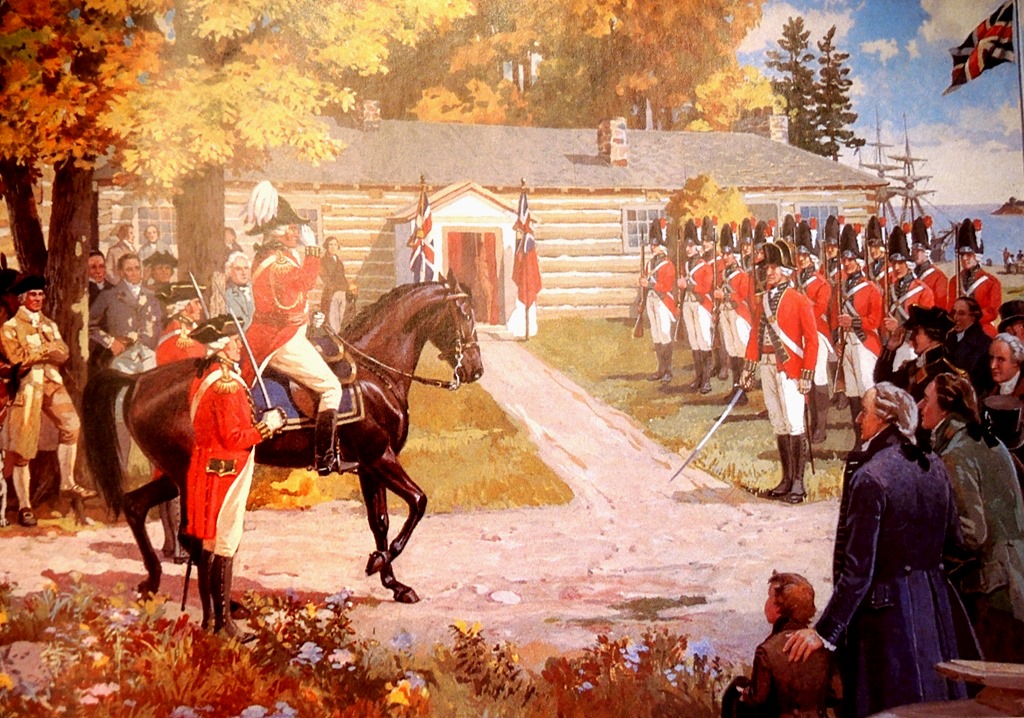

                                          Simcoe as colonel of the Queen's Rangers in Canada

War with France

By 1797, war with France resumed, and Simcoe was appointed governor of Santo Domingo. He faced a slave revolt supported by French Republicans and Spaniards. Simcoe was also promoted to Lieutenant General, the highest rank in the army at that time. Illness again shortened his tenure. He returned to England to prepare Plymouth’s defenses against a possible French invasion. Although Simcoe accepted command of the Western District, he did not receive another active field command from the Pitt government. When Britain assembled a coalition against Napoleon in 1806, General Simcoe traveled to Portugal as part of a military mission. However, his old illnesses struck again, forcing him to return home, where he learned of his appointment as commander in chief of British forces in India. 


                                                            Governor of Santo Domingo
                                             

Lost Opportunity

India was arguably the most prestigious and challenging overseas appointment for any British military officer or administrator. And Simcoe excelled at both. There is no telling how the future of the subcontinent might have turned out with him in charge. But it was not to be. He succumbed to his illness on October 26, 1806, in Devonshire. Lieutenant General John Graves Simcoe was only 54. Simcoe was not the crazy character often shown on television. Quite the opposite, Simcoe proved himself to be a learned and scholarly warrior and a forceful leader of partisan forces, among the best serving in the Revolutionary War. He was also a sincere man of peace who helped make Canada one of the best-governed provinces, and nations, on earth. And he might have done the same for India.


                                                            Simcoe monument in Toronto


Saturday, October 31, 2020

Noble Warrior of Peace


Clash of Empires

The Native American tribes played an interesting role in the American War for Independence. In some ways, the tension caused by the westward expansion of European settlers contributed to the strain between the colonists and the British authorities in London, who saw the Indian Territory west of the Alleghanies as a buffer zone against Spain. Americans moving westward posed a potential risk as future allies of Spain or even as a cause of war with Spain. The tribes found themselves caught in the middle, especially in the Carolinas and western New York.


In New York, the British had built strong trade and political alliances with the Six Nations of the Iroquois Confederation, who served as powerful military allies during the French and Indian War. Most of the tribes sided with the British. Among them was the Seneca nation. And among these proud people rose a leader who would earn fame in war and praise in peace. His name was Gyantwakia, which in English was Cornplanter.

Seneca Chief

Cornplanter was born in 1740 to a Dutch trader named John Abeel and a Seneca woman in the village of Conawagaus, now known as Avon, New York. He was raised as a Seneca, living among his mother’s influential family, the Wolf Clan, which was a warrior clan. He led a war party in support of the British during the French and Indian War, and by the start of the American Revolution in 1775, he was an established war chief, having gained his experience as a young warrior. The Iroquois were among the most skilled warriors of all the native tribes, and both sides sought their support. Cornplanter, showing notable caution, urged neutrality in the conflict between the white settlers.


                                                           Gyantwakia aka Cornplanter


Raising the Tomahawk


However, as the struggle grew more intense, he could not keep the Seneca on the sidelines. In August 1777, the Seneca joined their former allies, the British, in taking up the tomahawk. By that time, the war in New York was at its peak, with General John Burgoyne’s three-pronged campaign to capture New York already in progress. In many ways, this campaign would determine the outcome of the war.


                                                   The War Chief addresses the Wolf Clan


Valley of Death

Once committed, Cornplanter was fully involved. He soon led a Seneca war party in support of Lieutenant Colonel Barry St. Leger’s expedition east through the Mohawk Valley. Standing between him and his goal, Albany, was the small outpost known as Fort Stanwix. In this role, he participated in the siege of Fort Stanwix, New York, and later helped plan the ambush of Colonel Nicholas Herkimer’s relief column in the dense woods near Oriskany on August 6, 1777. 

The ambush was a typical Indian warfare tactic. Cornplanter’s warriors surprised and destroyed the column, mortally injuring Herkimer. However, the approach of another column under Benedict Arnold forced the British to withdraw their regular forces from New York and switch to hit-and-run guerrilla raids against frontier settlements.


                                    Seneca ambush at Oriskany mortally wounds Col Herkimer


Frontier on Fire

Cornplanter led many raids against American settlements, especially at Wyoming Valley, Pennsylvania, where on July 3, 1778, his warriors ambushed and defeated a pursuit force of 400 militia commanded by Colonel Zebulon Butler. In November, his Seneca allies supported Loyalist Captain Walter Butler (unrelated to Zebulon) in a brutal attack on Cherry Valley, New York. 

These Indian and Loyalist raids caused such significant damage to American lives, property, and morale that General George Washington ordered a punitive campaign against the Six Nations the following year.


                                                              Cherry Valley Massacre


Yankee Retribution

American retribution arrived with the 1779 expedition led by General John Sullivan, who launched a punishing attack on August 28, defeating the Iroquois and Loyalists at Newtown (Elmira), New York. Sullivan then carried out a scorched earth campaign to punish Iroquois villages in the region. 

Under pressure, he and the Seneca stood down for the winter, but the next summer, Cornplanter was back on the warpath with raids against Canajoharie and the Schoharie Valley, New York. At Canajoharie, his band took his father, John Abeel, prisoner. Cornplanter offered to make him a guest of his clan, but Abeel declined, so the dutiful son released him.


                                                                   Wolf Clan attacks

Smoking the Peace Pipe

At the end of the Revolutionary War, the Iroquois faced complications as they tried to adapt to the new American government. Cornplanter participated in numerous treaty signings, which gradually led to the loss of his people’s land. 

The Iroquois had little influence against the victorious Americans, who never forgot their wrongdoings in support of the British. Cornplanter defended his nation and clan with calmness and resolve. This led more aggressive leaders like Red Jacket to criticize him and strongly oppose land sales, hoping to improve their own standing among the clans.


                                                           The  Senecas and the rest of the 
                                                                Six Nations stood down

A Moderate Influence

The Ohio (Northwest) Territory ignited with conflict as tribes along the Ohio River grew restless over American expansion and British interference. These tribes formed a Great Confederation led by figures like Little Turtle and initially achieved victory, notably defeating an American army led by Revolutionary War General Arthur St. Clair in 1791.

 Due to his reputation and prowess as a warrior, the new American government appointed him to represent them in negotiations with the tribes at a major peace conference, known as the Council on the Auglaize. However, Cornplanter and other moderate native leaders were unsuccessful. 

The fierce fighting persisted until former Revolutionary War leader Anthony Wayne defeated the confederation at the Battle of Fallen Timbers, leading the Ohio tribes to sign a peace treaty at the Treaty of Greenville. In recognition of his efforts to unite the western tribes, Pennsylvania rewarded Cornplanter with a large land grant on the Allegheny River.


    Treaty of Greeneville settled Indian Affairs 
in the Northwest Territory


Smoking the War Pipe


With the outbreak of war with Britain in 1812, the now elderly Chief Cornplanter offered his services to the United States but was refused. However, his son, Henry O’Bail, served with some distinction. Cornplanter, one of the fiercest Seneca warriors, lived peacefully on his land grant for another two decades.


                                                   Monument to Chief of the Wolf Clan

When he died on February 18, 1836, the great war chief was widely mourned as a man of peace. Many decades later, in 1871, Pennsylvania chose to honor the noble Seneca by erecting a marble shrine on his grave as a symbol of respect and admiration.


Monday, September 28, 2020

The Winter War


“I shall constantly bear in Mind, that as the Sword was the last Resort for the preservation of our Liberties, so it ought to be the first thing laid aside, when those Liberties are firmly established.”

Letter from General George Washington to the Executive Committee of the Continental Congress, January 1, 1777


                                                Washington's pen was as mighty as his sword


January 1777

The Jerseys are aflame in a deep winter-war!

Backs against a frozen river and facing a column of crack redcoats intent on their destruction, George Washington’s army has a serious gut-check. They must outfight or outwit the British to preserve the faltering struggle for independence. With the help of the winter spy, General Washington intends to do both…

Back cover of The Winter Spy, June 2020


The Genesis

This is a book I never expected to write. But as I finished book two in the Yankee Doodle Spies series, my research and curiosity guided me to a straightforward question: what did Washington do AFTER crossing the Delaware? It turns out, quite a bit. I became so interested that I created a follow-up story to capture the feel and action of this important yet little-understood chapter in the American War for Independence.


                                       What did Washington do after he crossed the Delaware?


Winter Quarters

In the 18th century, armies typically fought from late April or early May through November. During the off-season, some soldiers and officers were sent home on furlough, but most simply tried to survive the winter while the armies were restocked and equipped for the next season of marching and fighting. The British had the advantage of quartering many of their forces in towns and cities, using stores, shops, stables, public buildings, and private homes.


                                         Gen Steuben drilling American troops at Valley Forge


For Americans, winter quarters were often a harsh experience of cold, disease, and starvation. For the British, it was a time of relative comfort between grueling military duties. Naturally, both sides had to keep guards and sentries posted. Some patrols were dispatched. During the 1778 Valley Forge encampment, winter quarters became a training ground with the arrival of General Steuben as Inspector-General and Drillmaster.


Winter Action


My readings for my second novel, The Cavalier Spy, opened my eyes to the actions General George Washington took after the Battle of Trenton: two major battles (2nd Trenton, Princeton), along with many skirmishes, marches, and hardships before his increasingly small army reached its final destination at Morristown, New Jersey. 

That decision was highly tactical. His actions compelled the British to withdraw most of their outposts in the Jerseys, leaving them in control of the area around Brunswick, Paulhus Hook (Jersey City), and their main strongholds in Staten Island, Long Island, and Manhattan. With the British in winter quarters, most armies would have hunkered down, recovered, and rearmed. The choice was tactical because Washington could monitor enemy movements with his forces safely behind the Watchung Hills, ready to move in any direction the British advanced in the spring. That was the original plan.


                                        Princeton was one of two actions fought in as many days


But as the British sent out foraging parties into New Jersey to buy or requisition foodstuffs, the Jersey militia responded. Small groups were ambushed, leading to larger foraging parties and bigger ambushes. The numbers grew until Washington authorized some of his Continental regiments, including those led by Generals Philemon Dickinson, William Alexander (Lord Stirling – an American who claimed a Scots peerage), and Ulster-born William “Scotch Willie” Maxwell. By the end of this winter of discontent, the British had lost roughly as many men killed or wounded during “winter quarters” as they did in the previous three pitched battles. Losses that British commander-in-chief, General William Howe, could not afford.


                                                     Gen William Alexander - Lord Stirling


The Plot

No spoiler alerts here – read the book! But needless to say, Lieutenant Jeremiah Creed and his White Knights are thrown into action once again, operating both within and outside the Continental Army. They clash again with the ruthless British dragoon, Major Sandy Drummond, who continues to use his intelligence network to break the rebellion. Along the way, a variety of soldiers and citizens clash, make friends, make enemies, fall in love, and struggle to stay sane during a time that tests men’s souls. Woven into the plot are two themes: the bonding of men in conflict and the war’s impact on families. And, there is always the weather—winds that can cut a man in two, frigid temperatures, and ice-covered roads and rivers play a significant role in a story that, after all, was named for them.


The Book


All three books in the Yankee Doodle Spies series are published by Lanyard Press.

The Winter Spy is available on Amazon in Paperback or Kindle.

https://www.amazon.com/Winter-Spy-Yankee-Doodle-Spies/dp/B08JVNPPKG/ref=tmm_pap_swatch_0?_encoding=UTF8&qid=&sr=


Monday, September 14, 2020

Tinkerer, Sailor, Soldier, Surgeon

A Connecticut Yankee


Many of our early patriots were accomplished men of letters—lawyers, judges, planters, and merchants—but relatively few were involved in science and technology. David Bushnell belongs to the latter group. Born in Saybrook, Connecticut, on August 30, 1742, he was the son of a farmer. As the eldest of five children, he grew up working on the family farm near Westbrook. After his father died in 1769, he sold his half interest in the farm to his brother Ezra and entered Yale College in 1771.


David Bushnell


Bombs to Boats


While at Yale, he became intrigued by the idea of underwater explosions. An inventive tinkerer by nature, Bushnell successfully combined a black powder charge with a clockwork timing device, creating the first naval mine. He used this knowledge not only in building the underwater mine but also later in making floating torpedoes that exploded on contact. 

He worked with the wealthy New Haven inventor and manufacturer Isaac Doolittle to develop the first mechanically triggered time bomb as well as the first screw propeller. As he worked on developing a practical delivery system for this unique weapon, the start of the American War for Independence gave a new sense of urgency to his efforts. 

By fall that year, he had designed and built the American Turtle (better known simply as Turtle), a primitive submarine. He named it Turtle because it looked like two turtle shells lashed together. It wasn't pretty, but it worked.


Turtle Design Sketch


Test and Evaluation


Gen Israel Putnam
This primitive submarine was operated by a single operator, who powered it with two hand-cranked screw propellers. A system of water pumps took in and expelled water to control the craft's climb or descent, which could reach a depth of about 15 feet. The pilot had a small conning tower with several windows. The tower contained a depth gauge and a phosphorus-lit compass. 

The Turtle’s punch was Bushnell’s original clock/mine combination connected to a metal drill engineered to bore through the copper sheathing coating the hulls of British warships. Once the mine was attached and released, the timing mechanism engaged, giving the Turtle one hour to escape before a 150-pound charge exploded, detonated by a flintlock trigger device. 

Bushnell arranged a successful demonstration, essentially a “demval” in today’s acquisition parlance. Present for the event on the Thames River was Connecticut General Israel Putnam, who urged the American government to continue funding for its “full operational capability.”


Turtle Replica


Run Silent, Run Deep - Sorta


History was made in the summer of 1776 when the Turtle attacked the British fleet anchored in New York Harbor under the command of Admiral Richard Howe. Unfortunately, Bushnell fell ill, and a sergeant named Ezra Lee volunteered to take his place. On the night of September 6, a pair of whaleboats towed the Turtle offshore, where it began its attack. Pumping feverishly, Lee slowly guided the Turtle toward the British fleet. 

Despite challenging tides, Lee managed to reach the primary target, Lord Howe’s flagship, the 64-gun ship of the line, HMS Eagle. The Turtle’s drill failed to penetrate the hull because it was blocked by an iron bar. With air running low, Lee abandoned the effort and released the mine, which floated free. The mine ultimately exploded in a massive blast that sent a plume of water into the night sky. 

The unexpected iron bar prevented what could have been a disastrous hit to a major target, potentially changing British naval tactics for the rest of the war. See my Yankee Doodle Spies post on "The Boat" for a more detailed discussion of this attack.


Bushnell's Turtle takes on HMS Eagle
and initiates submarine warfare


Torpedoes are Running


Bushnell remained undaunted. Confident in his progress, he kept improving the Turtle. He launched several small attacks on individual British ships, but inexperienced pilots and unfavorable tides prevented each attempt. The Turtle was lost the following October when a transport carrying it was sunk by British cannon fire on the North (Hudson) River. Undeterred by setbacks, Bushnell continued experimenting with naval mines and explosives. On August 13, 1777, he released another mine that floated toward the HMS Cerebus, anchored in Black Point Bay. This time, the tides were favorable, but the device got caught on a small schooner. It exploded, killing three British sailors.


 Turtle needed to be towed  into attack position by rowboats


Battle of the Kegs

A Bushnell mine exploding
unnerved the British

He tried again in January 1778, this time releasing 20 large kegs filled with explosives off Bordentown, New Jersey. The kegs were intended to float down the Delaware River and destroy the British fleet at Philadelphia. One mine exploded near a British rowboat, killing several sailors. 

The attack so rattled the British fleet that it spent the rest of the day shooting at the floating kegs and nearly anything else that floated. This event was satirized in the poem, “Battle of Kegs,” by Francis Hopkinson. Rebel propaganda portrayed this as an embarrassment for the hapless Royal Navy. However, Bushnell's career as an undersea weapons developer was over.


Captain David Bushnell's sappers and miners
fought during the siege at Yorktown

The Sapper


Bushnell returned to Saybrook in the spring of 1778. Local Loyalists had once detained him, but he managed to secure his release. Later that year, Bushnell left the world of maritime warfare and joined the Continental Army after General George Washington appointed him as commander of the first company of sappers and miners at West Point, NY. Captain Bushnell served competently for the rest of the conflict and led the sappers during the siege of Yorktown, the battle that effectively ended the war. After his discharge from the Continental Army, he briefly returned to Connecticut and later spent some time in France before coming back to the United States to settle in Warrenton, Georgia, where he practiced medicine. He died there in 1824.


David Bushnell Memorial in Georgia


Seminal Submariner


In the long run, David Bushnell’s efforts laid the groundwork for the later development of underwater mines, torpedoes, and, of course, the submarine. His fundamental use of water for ballast still applies today, as does the use of the propeller. Although his impact on the course of the American War for Independence was limited, he nonetheless shaped the future direction of naval warfare. No small feat for a Connecticut farm boy.


Today's submarines are descendants of Bushnell's
Turtle and still share its basic design, albeit on steroids


Sunday, August 30, 2020

Matriarch of Spies

It's time to revisit two topics I haven't discussed in a while: women in the American War for Independence and espionage. Our subject today addresses both themes and was briefly mentioned in a previous Yankee Doodle Spies post. This female patriot supported George Washington’s efforts in a very unusual way—by letting the British quarter troops in her home. She is also notable because she was a Quaker, even though her actions eventually led to her being expelled from the pacifist Society of Friends.


Immigrant Patriot


Like many of our early patriots, Lydia Barrington was born in Ireland, Ireland, in 1729. At age 24, she met and married William Darragh, the tutor son of a clergyman. Soon after, the couple emigrated and settled in Philadelphia, where they became respected members of the local Quaker community. Although she was somewhat petite and frail, Lydia became a midwife, and like many women of her time, she did sewing on the side. Lydia and her husband enjoyed a prosperous and comfortable life in Philadelphia, as reflected in their large family of nine children (five of whom survived childbirth). The reliable Quaker, Darragh, grew alarmed when one of his sons decided to leave the Friends and join the Continental Army, holding a commission as a lieutenant in the Second Pennsylvania Line. The Society shunned any member who took an active role on either side, especially a military one.


Philadelphia in the 1700s


An Occupied City


Like many Americans, life changed when the war arrived in Philadelphia. In October 1777, the British army under General William Howe took over the former American capital. By chance, Lord Howe set up his headquarters in the home of patriot rebel leader John Cadwalader, just across the street from the Darragh residence at 177 South Second Street. At some point, Howe requested use of the Darragh parlor for staff councils and private meetings. Most war plans during that time were made by “councils of war,” so this was a significant matter. And a great opportunity.

Darragh's House

Making of a Spy

Who recruited Lydia for espionage and why is it uncertain? What motivated her—her son’s military service, concealed patriotism, or anger at the British occupation? Whether she volunteered or was recruited, she clearly became part of an established network. Although lacking formal education, Lydia possessed a brilliant mind, was incisive politically, and perceptive of her surroundings. She also had a remarkable memory. Perhaps her most valuable trait, especially for her role in serving her country, was her unassuming demeanor—the ability to blend in and hide.

Lydia's family operated at the center of
British-occupied Philadelphia


Family of Spies


During the occupation, Lydia’s nursing activities allowed her to move freely through British lines. Soon, her growing family was involved in supporting the cause by gathering intelligence from the heart of the British high command in North America. During the winter of 1777–1778, the occupation of the rebel capital gave the impression of British dominance and the inevitable downfall of the rebellion. After all, Washington’s struggling army was trapped on the frozen plains of Valley Forge. 

While the British enjoyed plenty of resources, the rebel army was deteriorating due to shortages of food, clothing, medicine, and other supplies. The British lowered their guard, holding meetings with the modest nurse in the background. Of course, they knew that the Darraghs, as practicing Quakers, could not support either side in the war or take part in anything related to it. Lydia was able to overhear most of the meetings and conversations in her parlor, then quickly relayed what she heard to her husband William, who carefully recorded the information in special shorthand on small strips of paper. 

Her seamstress skills played a vital role in her espionage efforts. Lydia would sew the thin paper strips into buttons on her 14-year-old son John’s coat. Once done, she sent John as a courier. He would slip through the British lines and meet up with his older brother Charles, who was with Washington’s army. Charles understood the shorthand, transcribed the messages, and transformed them into valuable intelligence.

Lydia Darragh: Nurse, Seamstress, Spy


Secret Mission


But the spy ring’s MO and tradecraft did not play a part in what is considered Lydia Darragh’s boldest achievement. On December 2, Lydia and her family were suddenly ordered to their rooms during an important meeting. An emergency war council took place. This was before the Continental Army had settled in Valley Forge. Washington was still near the capital, hoping to find an opportunity to act before both sides settled into “winter quarters." 

Undeterred, and perhaps spurred by the British’s urgency, Lydia put her ear to a keyhole and listened in as General Howe gave detailed instructions to his commanders. She overheard the British commander-in-chief give orders for a multi-column move against General Washington. The plan was for December 4. The strike was meant to catch the rebels off guard, scatter their army, and maybe even capture Washington in the process.

General Howe's secret plans to surprise and destroy
The Continental Army would spur a bold gambit


She would not leave this critical mission to her young son. Instead, she devised a quick “cover for action” and slipped out of town on December 3rd with sacks, hoping to refill them with flour at a mill near Frankford, located between the opposing army lines. The risk was high, as patrols from both sides roamed the area. It was a 13-mile trek in winter. Undeterred, she went to Pearson’s Mill and left the empty sacks for the owner to fill. She planned to pick them up on her way back. With her cover now in place, Lydia continued her true mission: to deliver the British plans to the American forces.

Clandestine Meeting


There are two versions of what happened next. In one, she encounters a friend, Colonel Thomas Craig, along the road. She tells him what she has learned, and he gallops off to report to Washington. Lydia then secures her flour and makes her way home. In the other version, Lydia heads to a tavern called The Rising Sun. There, she meets with Colonel Elias Boudinot, Commissary-General of Prisoners, who also acts as an intelligence officer. 

Allegedly, Lydia walks into the pub, hands him an old, tattered needlebook, and leaves. When he searches the book, Boudinot finds a roll of paper in one of the pockets. The paper indicates that General Howe will attack Whitemarsh the next morning with 5,000 men, 13 cannons, and 11 boats on wheels. Boudinot mounts his horse and gallops to Washington’s headquarters. He gives her report to Washington but keeps Lydia’s cover safe by naming “captured prisoners” as his source. 

This highlights the crucial role Lydia and the Darragh family played in gathering intelligence from Philadelphia. The fact that Lydia knew Boudinot might be at the tavern shows how sophisticated the spy ring was. I prefer the latter version.


Darragh at The Rising Sun

An Army Saved


Lydia's intelligence, a form of indications and warning (I&W), helped Washington prepare the Continental Army, which repelled General Howe’s “surprise” attack at White Marsh. The multi-day battle saved the army and the cause, allowing it to eventually settle at Valley Forge. The British returned to Philadelphia in disgust.


The series of skirmishes at White Marsh
ended the 1777 campaign with a modest
American victory


A Critical Source


Upon her return, Darragh was questioned by the British, who suspected treachery. She managed to disarm them and convince them she was unaware of their plans. However, Lydia and her family continued to gather information from the heart of the British high command throughout the winter. 

As Washington trained the army at Valley Forge, reports from the capital were critical as he prepared for the spring campaign he knew was coming. So the commander in chief was not caught off guard when Howe was relieved of command in the spring, and the British Army left Philadelphia on June 18, 1778. The departure of the British ended the need for the spy ring, and Lydia and her family’s service faded into the shadows like many effective clandestine operations.


Darragh's espionage continued into 1778


Banned by The Friends


In June 1783, William Darragh died. The Society of Friends was not so welcoming when rumors about the Darragh family’s involvement began to spread. The Friends expelled Lydia later that year. Her oldest son, John, had already been expelled in 1781. 

In 1786, Lydia moved from South Second Street into a new house and, along with her children, operated a store there until her death in 1789. She was buried with other family members in a Quaker cemetery not far from where she spent her post-war years.


Lydia returned to a "normal" life after
the war, but lost her standing with  her "Friends"

Shadow Heroes


Like many espionage and covert actions during the American Revolution, Lydia Darragh's story was scrutinized. Darragh’s daughter, Ann, published her mother’s spy activities in 1827. However, many doubted the story and questioned its truthfulness. 

Suspicion eased in 1909 when Elias Boudinot’s memoirs were released, confirming Darragh’s involvement. He described a woman matching Darragh’s profile, though he, for obvious reasons, did not name her. 

General Washington often expressed frustration over the inability to reveal and properly thank all those early patriots who participated in the shadow war, as they couldn’t receive recognition or rewards for their sacrifices. I, for one, believe Lydia Darragh and her family are among those shadow heroes.


Elias Boudinot's memoirs shed light
on Lydia Darragh's wartime espionage