Followers

Showing posts with label Cornwallis. Show all posts

Saturday, October 31, 2015

George Washington, Vampire Slayer!

Excuse the Halloween hyperbole, but now that I have your attention, I can discuss hauntings during the time of the Yankee Doodle Spies. Truth be told, if I had started the action and adventure series with a book titled, say, "The Marching Dead," I would be on easy street today. People enjoy being scared, and they prefer the macabre and horrifying over mundane things like action and intrigue. Just imagine, a tale of a rebel unit massacred while bivouacking at a cemetery. Only this unit of wraiths rises, zombie-like, whenever the Cause needs them. Still imagine a team of clever British officers desperately trying to find a way to stop this phantom army's onslaught, not realizing that silver, not lead balls, would do the trick... What's in your ammo box?


Greenwood Cemetery in Brooklyn, New York


The American Revolution has its fair share of hauntings and spooky stories. Most of these are known only locally, as most hauntings are celebrated in their own communities. Many are tied to specific places... like a Poltergeist-like phenomenon. But one legend has become a national story: Sleepy Hollow by Washington Irving. The original story of Ichabod Crane, the superstitious schoolteacher afraid of the legendary headless horseman of the Old Dutch Church, has haunted both young and old for generations. I remember driving through the story's setting, Tarrytown, New York, with my father when I was a boy. I was about ten. As we drove south on NY 9, he pointed to the church and cemetery and said, "the Headless Horseman of Sleepy Hollow is here, the Hessian's ghost haunts the cemetery," and I felt a chill run down my spine. It was broad daylight in summer. Can you imagine how I'd feel on a dark October night? I don’t think I knew what a Hessian was back then, but he had me at Headless Horseman. Over time, the story grew as new media brought it to wider audiences and stretched the original plot to its limits. It’s been adapted into radio shows, TV dramas, cartoons, and recently a major film (featuring Johnny Depp) as well as a TV series that takes the story even further.


The Headless Horseman is the iconic RevWar Spook


Ringwood Manor
The Mid-Atlantic is full of Revolutionary War hauntings. In a past Yankee Doodle Spies Blog, I discussed the Morris-Jumel House in New York's Harlem and the stories and tales of its haunting. The Van Cortlandt Mansion, Greenwood Cemetery (ground zero for the Battle of Long Island - a place that saw the most bloodshed of the war), are other notable New York sites. Just across the great North River, in Passaic, New Jersey, stands Ringwood Manor. 


This was once the home of General Robert Erskine, who was the geographer for George Washington's army. Later, he ran an ironworks on the property. He's buried near the manor house, and it's said that at dusk, he sits on his grave, gazing at the pond beyond. Some have reported his ghost walking the grounds, carrying a lantern. There are also French soldiers buried nearby, who fought for the American cause. They, too, emerge at night and walk along the pond, speaking in French. The house itself is not the original, but it has its own hauntings dating back to the 19th century.


Erskine's ghost haunts Ringwood Cemetery


New England Nightmare


New England, home of the Salem witch trials a century earlier, is no stranger to tales of the macabre. Boston Harbor’s scenic Long Island is known for one of the most tragic Boston ghost stories. At the end of the American Revolution's actions around Boston, the British still had several ships in the harbor, mainly to evacuate Loyal Americans who wanted to leave before the rebels took control of the city. Onboard one of these ships were William and Mary Burton. The young couple, passionate Loyalists, were among those fleeing. While sailing away from the harbor, a shot from the besiegers' battery on Long Island struck Mary in the back of the head.


Mary Burton's ghost roams
 Long Island Dunes


According to the legend, she lingered for several days in excruciating pain before dying. In her death throes, Mary supposedly asked her husband not to bury her at sea. After she died, William
returned to Long Island to fulfill his love's dying wish.

He wrapped her bloodied body in a red blanket that Mary owned and buried her beneath the island's sand dunes. Her headstone was a piece of driftwood carved with her name. Before leaving her
grave, William swore he would return someday with a proper headstone. He never did. But according to
the legend, Mary still waits for him.

Over the years, visitors to the island have reported seeing a woman with pallid skin, covered in mud,
wearing a scarlet cloak, walking among the dunes. Many have seen blood on her cloak and noticed a
gaping hole in the back of her head, where cannon fire had struck her skull.

Southern Spooks


The South is no stranger to incredible stories, and RevWar hauntings are no exception. The focal point is the site of a major war event, Yorktown, Virginia. In October 1781, a desperate British General, Charles Cornwallis, led his troops hoping the Royal Navy would rescue him from land now swarming with rebel soldiers and their French allies. Prolonged sieges under harsh conditions set the stage for eerie stories that still persist today. 

The anguish and suffering during the siege make Yorktown hauntingly memorable. From “Cornwallis’s Cave on the banks of the York River to Crawford Road – the town is filled with urban legends and ghost stories. Cornwallis’ Cave has no direct connection to Cornwallis, but legend says British troops hid in the cave to escape the constant bombardment by Continental and French artillery.


Cornwallis's Cave


Some legends suggest that the civilian residents of Yorktown took refuge there. Evidence does show that after the war, the cave was probably used by smugglers. It is located along the waterfront. Perhaps they spread haunting tales to keep prying eyes away from their lair? There are still reports that voices can be heard at night emanating from the dark recesses of the cave. Those who follow such stories believe them to be the voices of Revolutionary War soldiers, the moaning of the injured and dying hiding inside.

Myths are to cultures what dreams are to people. Similarly, horror stories are to cultures what nightmares are to individuals. The eight-year war for independence was a nightmare for everyone involved: the Americans who suffered during the rebellion; the Loyalists who lost their homes and property; and the British who lost their empire. It’s perhaps fitting that such a war serves as both a source of myth and horror. Have a spooky Halloween. Stay frightened, my friends.


Saturday, December 22, 2012

Silent Night...Silent Might

Christmas celebrations in colonial America were much more staid than those we know today. December 25th in colonial America was just another day unless it fell on a Sunday, in which case it was just another Sunday. America's celebration of Christmas as a very special holiday began with the large wave of German immigrants in the early 1800s. Germans always held Christmas as the most special of days. Christmas's role in the English-speaking world peaked during the Victorian era. Victoria's consort, Albert, brought many Christmas traditions with him, and later Charles Dickens and other novelists popularized the season. Of course, Santa Claus is derived from Sant Niklaus, a Dutch character based on the original Saint Nicholas, a Roman bishop in what is today Turkey. Full disclosure: the original Saint Nicholas is buried in my grandparents' home city of Bari, Italy.

As Christmas approached in December 1776, the fortunes of the American rebellion had plummeted. The British juggernaut advanced into the Jerseys (back then, New Jersey was sometimes referred to as East and West Jersey). Lord Charles Cornwallis led the invading vanguard of some 5,000 British and Hessian troops in pursuit of Washington's dwindling army. Washington abandoned Fort Lee and maneuvered to Hackensack, where he checked the British only briefly before retreating without pause through Newark, New Brunswick, Princeton, and Trenton. On the 8th of December, Cornwallis and his scouts reached the east bank of the Delaware just in time to watch Washington and his personal escort depart on the last boat.


Herssian Grenadier


The patriot cause was at its nadir. Panic had set in, especially in Philadelphia. Lord Howe had issued a proclamation offering amnesty to any rebels willing to swear an oath to the King. Some had begun to accept it. Worse still, many of Washington's best troops had enlistments expiring, with little likelihood that replacements would arrive. Fearful of a British assault on the capital, the Continental Congress fled and turned governance over to the military. To stall the British, Washington had all the serviceable boats along a 70-mile stretch of the Delaware confiscated. The British advance had to await their engineers to plan a crossing. Fortunately, Lord Howe had decided he had all but whipped the rebels and ordered his army into winter quarters, with brigade-sized garrisons at Brunswick, Trenton, Princeton, Bordentown, and Cherry Hill. The remainder took quarters on Staten Island or Manhattan.


Gathering Boats was Critical


But morale across the colonies remained dismal. The end seemed in sight, as Howe assumed. The December 23rd edition of Thomas Paine's pamphlet "The Crisis" inspired many Americans. A desperate Washington gambled on a winter strike against the rebels before many of his best regiments dissolved. He had the pamphlet read to his troops and conceived a plan for a Christmas thrust in three divisions to take the enemy garrisons at Trenton and Bordentown. At first, demoralized by the British advance, New Jersey militia units began probing and harassing the British garrisons, isolating them in their posts. Then General John Sullivan arrived with a division from the Hudson Highlands. These reinforcements gave Washington the strength he needed to complete his plan.


Dramatic portrait - Washington crossed over
in the dark of a December night


On the night of December 25, Washington made his famous crossing at McConkey's Ferry and marched nine miles along the Delaware to Trenton. Divisions under Generals Cadwallader and Ewing (mostly Pennsylvania and New Jersey units) were to cross near Bordentown and link up with Washington, but worsening weather and rapidly forming ice floes prevented them from crossing. Nevertheless, Washington struck with just over 2,000 men just after dawn, even as a mix of rain and snow descended on them.


Overrunning the Hessian guns at Trenton

So what's the Christmas connection? The German garrison, a brigade under the command of the renowned Hessian Colonel Johann Gottlieb von Rall, was caught unprepared. Germans celebrate two days of Christmas, and Washington struck between them. Indeed, the Germans themselves had been worn out by the rigors of the campaign, and the Jersey militia had played a part in tiring them and causing a "hunker down" effect. But Rall never expected the onslaught that caught them in the weary hours of their holiest of days. Rall fell mortally wounded while rallying his battalions, and soon after the garrison surrendered more than one thousand men. The battle did not last an hour. The stunning victory saved the American cause, which was all but finished.


Friday, November 9, 2012

The Cortelyou House

The House

This edition of the Yankee Doodle Spies highlights the Vechte-Cortelyou House in Brooklyn, New York, the site of the high-water mark of the Battle of Long Island.

"Here on the 27th of August, 1776, Two hundred and fifty out of four hundred brave Maryland soldiers, under the command of Lord STIRLING, were killed in combat with British troops under CORNWALLIS."
...Inscription on a plaque commemorating the action near the Vechte-Cortelyou House, now called the Old Stone House.


Frontal View of the House today


The Vechte-Cortelyou House in Brooklyn, New York, was built in 1699 by a Dutch settler named Claes Arenston Vechte. Vechte and his family worked the land, farming the neat fields and grazing animals in the verdant pastures of this rich farmland.  They also gathered oysters and other bounty from the nearby Gowanus Creek, which they used to ship their produce to Manhattan.  Around the time of the revolution the land was leased to the Cortelyou family, and one of them  purchased the property a decade after the war.  The simple architecture is classic Dutch colonial with a mixture of stone and mortar, steep tiled roof and a wood shingled appendage (what we might today call a "bump-out") that appears to function as the kitchen.

Major General Cornwallis

The house was situated near the intersection of today's 3rd Avenue and 5th Street in Park Slope. During the events leading up to the cataclysmic fight that took place there, the house served as the headquarters of William Alexander, who called himself "Lord Stirling," because of a claim to that Scottish peerage.While holding the passes south of the house, Lord Stirling found his army surrounded when Major General (himself a Lord) Cornwallis' force of several thousand seized the area around the house after a night march down the Jamaica Road into the unguarded east flank of the American Army. 


Lord Stirling


While he ordered most of his forces to attempt escape across the Gowanus Creek, Lord Stirling led some 400 Continental Line from Maryland and Delaware against the British defending near the Old Stone House, which they had turned into a strong defensive position. Stirling led six assaults against the British at that location and around 250 Americans were killed there and are buried nearby (see my earlier blog on trying to find them entitled "On Hallowed Ground").  The importance of this battle is fully described in The Patriot Spy, and the fictional events that I added form the genesis of the Yankee Doodle Spies.
Thumbnail for version as of 09:46, 25 August 2011

The Original House


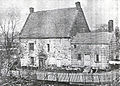
Interestingly, in the 19th century the original house once served as the headquarters of the Brooklyn baseball club that later became the famed Brooklyn Dodgers. You can see from this photograph the once prosperous farmstead had by the latter 19th century fallen into disrepair. 
Reconstructed Old Stone House in Brooklyn


The original Cortelyou House was later torn down but a reconstruction was built from dug up debris and replica materials and can be found in J.J. Byrne Park in the Park Slope section of Brooklyn. It serves as a museum that celebrates the events of August 1776 that took place on the hallowed ground around it. 
Sadly, little of the feel or look of the times can be found there.  However, nearby Prospect Park and Greenwood Cemetery do present views that might have been "enjoyed" by Lords Stirling and Cornwallis back in August of 1776.
As you can see, the reconstructed house is smack in the heart of a major urban area.  Note the Gowanus Canal, the remains of the Gowanus Creek, not too far distant. 

Where in the world is the Cortelyou House?