Followers

Thursday, May 23, 2013

A Yankee Doodle Memorial

This is Memorial Day weekend.  For most Americans, just another reason to have a party, go to ball games or watch the Indianapolis 500 or Preakness.

But for some, especially those who have a military connection, Memorial Day is truly something special because it is the one day that commemorates those who have fallen in the service of their country. Memorial Day was promulgated on 5 May 1868 by General John Logan, the Commander of the Grand Army of the Republic, a Civil War veterans group made up of northern vets -sort of the American Legion/VFW of its day. To honor Civil War fallen, flowers were placed on the graves of Union and Confederate dead on 30 May although most southern sympathizers clung to separate holidays to commemorate their fallen. This changed after World War 1 when veterans of both regions who had served side by side began to be honored as well.


General John A. Logan


The trauma of the Civil War, followed by that of the Great War brought industrial age carnage to new heights and the need for some sense of spiritual closure for those fallen in massed attacks such as those at Gettysburg, Cold Harbor, or the Marne and the Meuse-Argonne offensives.  To honor them, huge cemeteries and memorials span the nation and the battlefields of Europe and Asia honoring the hundreds of thousands of fallen. By "modern" standards casualties during the War for Independence were laughable and most soldiers died from sickness and starvation while in service to their nation.


But our First Patriots cherished and honored their fallen no less. And after the war, the need to honor those who gave all for an idea sanctified both the idea and those whose sacrifice enabled it.  Here are just a few examples:
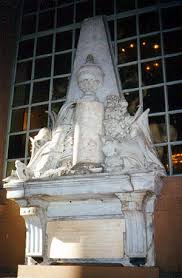

General Montgomery Memorial
at St. Paul's
The first commemoration was ordered by the Continental Congress in 1776 to honor General Richard Montgomery, who fell during the American assault on Quebec, Canada. Our first fallen general's monument was designed and built under the supervision of Benjamin Franklin by one of France's best artists, King Louis XVI's personal sculptor, Jean Jacques Caffieri. Shipped to America upon completion, it rested in Edenton, NC.  Although Congress originally intended to place it in Philadelphia, it ultimately ended up in
New York City, where, in 1788, it was installed under the direction of France's Pierre Charles L'Enfant (who later designed Washington, DC)  beneath the portico of St. Paul's Chapel, which served as George Washington's church during his time in New York as the United States' first president in 1789, and where it remains to this day. Montgomery's body, which was originally interred on the site of his death in Quebec, was moved to St. Paul's in 1818.


Those who read my earlier blogs also know that I began the Yankee Doodle Spies idea, and particularly The Patriot Spy because as a boy I was inspired by the Maryland Monument in Brooklyn's Prospect Park (scroll down to read of it). But an important and little known monument was erected at the site of the Brooklyn Navy Yard.  Why? Because there the remains of perhaps as many as 15,000 First Patriots were interred there.  These were prisoners of war, the victims of the notorious British prison ships anchored as "hulks," that is de-masted sailing ships, docked in an area called Wallabout Bay.  These First Patriots later became known as the "Prison Ship Martyrs."


Unveiling Prison Ship Memorial at Ft Greene Park 1908


For years after the war, the bones of Martyrs would wash up on shore and finally  a monument was erected near the site of the hulks at the famed Brooklyn Navy Yard at a place called Vinegar Hill.  In the mid 19th century a stone crypt was erected at nearby Fort Greene Park and the bones were interred there. Fort Greene was one of several forts erected by Washington to defend Brooklyn from the British in 1776 (you can read about that in The Patriot Spy). In the late 19th century the martyrs' remains were once again moved to a new Fort Greene monument  - a tall (148 foot) obelisk that looked down on Brooklyn. When President Taft dedicated it in 1908, it was one of the finest structures in the nation and a fitting final resting place for the Prison Ship Martyrs.
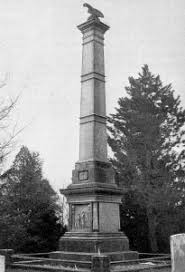


General Wooster Monument

One of my recent blogs was on Connecticut's General David Wooster who was killed in the fighting that followed the British/Loyalist raid on the arsenal at Danbury, CT. On June 17, 1777, Congress voted that a
suitable monument should be erected in his memory, but measures were never inaugurated to execute the resolution. His grave was not identified until 1854 when the Connecticut legislature laid the cornerstone of a monument. Today, a monument 30 feet high marks his final resting place at Mount Moriah in Danbury. Coincidentally, Wooster fought at Quebec as Montgomery's second in command and took much unjust blame for the campaign and its result.


Many argue that Philadelphia, our nation's first capital, marks the spiritual, political, and geographic center of the American War for Independence and in 1954 an impressive monument was built to commemorate those who fell in the war. The Tomb of the Unknown Revolutionary War Soldier is  located in
Philadelphia's Washington Square. It honors the thousands of soldiers who died during the American Revolutionary War, but especially those who were buried in mass graves in that park.
The actual  plaque upon the tomb of the Unknown Soldier reads: "Beneath this stone rests a soldier of Washington's army who died to give you liberty."

Tomb of the Unknown Revolutionary War Soldier
Philadelphia

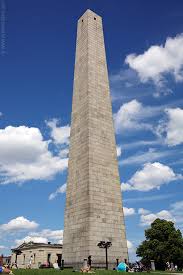
Bunker Hill Monument
Boston
If Philadelphia was the heart of the new nation, Boston was the heart and soul of the rebellion that forged the nation. The entire area is a virtual monument to the American Revolution but I'll single out one for this piece - the Bunker Hill Monument. The battle of Bunker Hill (which took place on Breed's Hill) is legendary, and for years General Washington (vainly) sought to replicate the scenario of entrenched Americans mowing down disciplined British troops who calmly marched into a hale of rebel lead. The first monument on the site was an 18-foot wooden pillar with a gilt urn erected in 1794 by King Solomon's Lodge of Masons to honor fallen patriot and mason, Dr. Joseph Warren. In 1823, a group of prominent citizens formed the Bunker Hill Monument Association to construct a more permanent and significant monument to commemorate the famous battle. The existing monument was finally completed in 1842 and dedicated on June 17, 1843, in a major national ceremony. The exhibit lodge was built in the late nineteenth century to house a statue of Dr. Warren.


So this weekend and throughout the year, we should remember all Americans who died in their nation's service. But we should especially recollect those who died to establish the nation and the idea of a free and independent people. Wherever and however you decide to celebrate the occasion, take a moment to think of those who had no Arlington - the fallen at Saratoga, Brandywine, Brooklyn, Harlem, Paoli, Bennington, Germantown, Charleston, King's Mountain, Guilford Court House, Valley Forge, Yorktown, and hundreds of battlefields fields so small only the local patriots know of them. Give them a roaring "Huzzah" for duty well done.
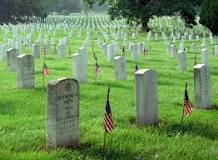
Arlington

Saturday, May 11, 2013

Yankee Doodle Angels of Mercy

I wanted to devote more time to this particular blog, but the computer gods hosed my operating system, which then imploded, causing me to spend about fifteen hours over three different days trying to get things back in order. Thus, my time has been consumed in less creative ways than I would like. On the positive side, I now have some very good friends in India...

Continental Nurse Corps?

One significant way women contributed to the Continental Army was through nursing. Female nurses were preferred over their male counterparts because every woman nursing meant one more man freed to fight. Women willing to care for the sick were in constant demand yet short supply throughout the war. A woman serving as a nurse received regular pay (which often turned out to be irregular or nonexistent), but the job carried many risks, including exposure to deadly diseases like smallpox, along with other viruses and infections. Nursing was one of the most challenging roles within the medical profession, leading many women around the camps to be bribed and coerced into the position. The promise of full rations and an allowance for volunteer nurses, or threats to withhold rations from women who refused to volunteer, often proved effective.

Shortly after the establishment of the Continental Army on June 14, 1775, Maj. Gen. Horatio Gates reported to Commander-in-Chief George Washington that “the sick suffered much for want of good female Nurses.” Gen. Washington then asked Congress for “a matron to supervise the nurses, bedding, etc.,” and for nurses “to attend the sick and obey the matron’s orders.”


General Horatio Gates recognized
 the need for nurses early in the war


In July 1775, a plan was presented to the Second Continental Congress that designated one nurse for every ten patients and stated “that a matron be allotted to every hundred sick or wounded.”


Second Continental Congress

Big Bucks

Congress allowed two dollars per month as a salary for these nurses, while matrons (women who supervised nurses and acted as liaisons to surgeons) received four dollars monthly. In 1776, Congress raised nurses’ pay to four dollars per month, and in 1777, to eight dollars, possibly to attract more women to nursing or to keep those who were dissatisfied with their jobs. 

Despite Congressional efforts to boost the number of female nurses for the army, a shortage persisted throughout the war. Regiments consistently sought women to care for their sick and wounded. Newspapers in Massachusetts and Virginia advertised requests for nurses to serve in the Continental Army. In July of 1776, Nathanael Greene wrote: "The sick Being Numerous in the Hospital And But few Women Nurses to be Had, the Regimental Surgeon must Report the Number Necessary for the sick of the Regt and the colonels are Requested to supply accordingly."

Nurse or Spy?

The demand for nurses was so high that commanders often overlooked suspicious circumstances to secure women for nursing roles. In April of 1777, General Israel Putnam questioned a woman named Elisabeth Brewer after she left British-occupied New Brunswick, New Jersey. Putnam wrote to Governor William Livingston that Brewer...

Israel Putnam


" . . . has an Inclination of entering the Hospital as a Nurse; in which employment she has been before
employ'd at this place, and the Surgeon giving her a good Character, I have that purpose to detain her here for that purpose—If you have any Objections and will let me know, I will send her Immediately to you."

Brewer was allowed to take up nursing duties with Putnam's units. The fact that she had come from a British-held town did not raise enough suspicion to stop a desperate army from utilizing her skills. However, Putnam should have investigated Brewer’s background more thoroughly, as she was found guilty of espionage in June 1777.

First Patriots

But for the most part, true patriot nurses answered the call. In July 1776, orders for the Pennsylvania battalions at Ticonderoga stated that one woman was chosen from each company to go to the hospital at Fort George to nurse the sick. The returns for the hospital in Albany in July 1777 list nine female nurses. In 1778, Washington ordered his regimental commanders to employ as many nurses as possible to assist regimental surgeons.

Nurses at Work


 In March 1780, an Albany hospital provided provisions for female nurses and their children, as well as for female and child patients. Nurses Rachel Clement (with two children) and Mary DeCamp (with one child) received two rations each, while Mrs. Perkins (with three children) and Sarah Lancaster (with one child) received one ration each. Nurses working there without children received one ration each.


Continental Nurse treating at the front line

In contrast to the skilled and highly educated professionals of today, Continental nurses' duties primarily focused on maintaining cleanliness for both the hospital and its patients. The "Rules and Directions for the better regulation of the military Hospital of the United States" outlined nurses' responsibilities. They were required to remain clean and sober, empty chamber pots as soon as possible after use, wash new patients, wash the hands and faces of existing patients, comb patients' hair daily, change linens, sweep the hospital, sprinkle the wards with vinegar (as a disinfectant) three to four times a day, and deliver deceased patients' belongings to the ward master. Nurses were prohibited from being absent without the permission of their supervising physicians, surgeons, or matrons.

These devoted women served tirelessly and without glory, status, or substantial compensation. Like nurses today, they cared for their patients with quiet and selfless dignity. These First Patriot nurses should be given all the accolades granted to their male counterparts. So this week—and every week—we should honor them above all...


Saturday, April 27, 2013

Gallant Old Patriot

Those of you who follow my postings on Facebook might have caught a flurry of them this week on the small  engagement that took place near Danbury, Connecticut, and the death of a "little known First Patriot, David Wooster." The American Revolution is replete with people from all walks of life who served quietly and diligently (on both sides) for the cause they believed in. This is the story of one...one of the First Greatest Generation.

Captain David Wooster
Much of David Wooster's fame came early in life during two of the many wars fought between England and France in North America.  A  Yale graduate, he had married the beautiful daughter of the president of that college but chose a life of action over books.  He took to the water (even today, Connecticut has more ports than any other state) and became an officer in that colony's coast guard.

During the War of the Austrian Succession (King George's War in America), the colonists of New England waged a bitter struggle against the French in Canada and Nova Scotia to their north. Wooster was commissioned a captain in command of a company in Colonel Andrew Burr's Regiment.  Coincidentally, Burr was the uncle of  Aaron Burr. He took part in the campaign against the mighty French fortress of Louisbourg. Captain Wooster distinguished himself enough to be named as part of the escort of prisoners back to France when the fortress finally fell.  His journey took him to Britain where his achievements were celebrated in the press. Wooster met the King and received for his service a commission in Sir William Pepperrell's Regiment (a regular British army regiment)  that included a pension for life. In 1748, the Treaty of Aix la Chapelle ended the war and Wooster returned to civilian life in Connecticut.


Jeffery Amherst at Ticonderoga,
the land between the waters
When the French and Indian War broke out, Wooster served from 1755 to the war's end in 1761, during which he was promoted to colonel and given command of the 3rd Connecticut regiment. In 1758 his regiment was at the disastrous Battle of Carillon, near the French fort of that name, at the southern extreme of Lake Champlain. There, General James Abercrombie launched a disastrous frontal attack that was torn to ribbons by Marquis de Montcalm's force of French regulars, Canadians, and Indians. This was the bloodiest battle of the French and Indian War, the British lost over  2,000 of the 3,000 casualties. But Wooster was  again in the thick of things in 1759 when General Jeffery Amherst captured the Fort Carillon and renamed it Ticonderoga, the Indian name
for that strategic place between the waters.


Rebels stopped cold at Quebec
By the time of the American Revolution, Wooster was in his mid-sixties and settled in the mercantile business in New Haven. But this First Patriot sacrificed his comfortable pension and status to serve the cause of his country at a time when most men of his age were enjoying home and hearth. Appointed general in the Connecticut militia, he planned the attack on Fort Ticonderoga that gave the newly forming rebel army its first artillery train. He was named a Brigadier General in the Continental Army and second in command of the failed rebel attack on Quebec that same year. Wooster stayed with the force during the bitter retreat to Fort Ticonderoga.  The defeat in Canada resulted in his recall from Continental command but likely his age ruled him out for further active campaigning with the field forces. But Wooster was then appointed Major General of the Connecticut Militia and commanded all militia troops in that state.

Governor William Tryon


That placed him at the center of the action for the Danbury April 1777 raid launched by New York's Governor Tryon.  At the time, an arc of territory stretching from southeast Connecticut through the Hudson Valley and Highlands was a no man's land of bitter fighting on both sides.  Danbury was a key rebel base in that struggle. Leading a force of regulars and Loyalists in a swift landing at Fairfield, Connecticut,  Tryon's column over 2,000 strong marched north towards the rebel arsenal at Danbury, looting and burning patriot homes along the way.  They reached the arsenal and destroyed it on April 26th.

 Learning of the attack, Wooster and General Benedict Arnold had rallied around 600 Connecticut militia who tried to stop the British at Ridgefield as they returned south to the coast near Compo Point. Arnold took the main body of troops to block the British advance while Wooster led a small detachment of them in the British rear. His undisciplined troops could not stand up very long against the regulars and they soon broke.  Wooster's ire was up though and he tried gallantly to rally his men.  However, a British cannon unleashed canister and a piece of metal pierced his side and struck his backbone.

Battle of Ridgefield - Arnold and Wooster
could not stop Tryon's forces


The battle continued in sporadic skirmishes as the British retreated to the coast. But they carried the gravely wounded old warrior back to Danbury. Before he died on May 2nd, his wife and son had been sent for. They arrived soon enough to receive his parting blessing. The gallant old Patriot  told them that he was dying, but "with strong hope and persuasion that his country would gain its independence."

Monument to Major General David Wooster
in Danbury, Connecticut


Saturday, April 13, 2013

The Tax Man and the Revolution

This week heralds our federal income tax deadline - a time that fills most Americans with dread. And no wonder. Our nation was founded by men who resisted unjust taxes. The American Revolution was precipitated, in part, by a series of laws passed between 1763 and 1775 that regulated trade and taxes. These laws caused tensions between colonists and British officials. British unwillingness to respond to American demands for change allowed colonists to argue that they were part of an increasingly corrupt and autocratic empire in which their traditional liberties were threatened. This position eventually served as the basis for the colonial Declaration of Independence.

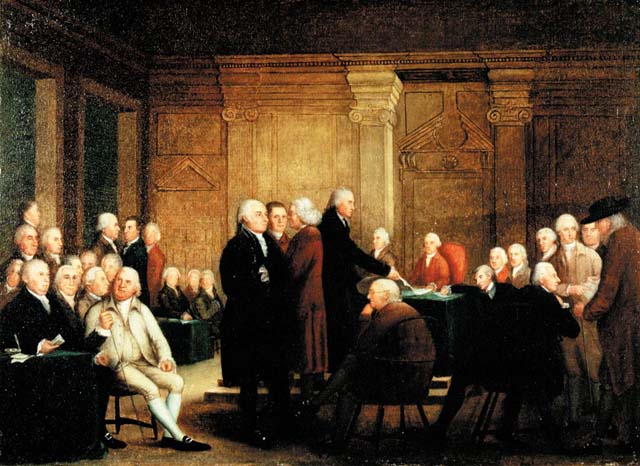
The Declaration of Independence was the result
of years of political turmoil and outright rebellion


After 1763, the British government emerged from the Seven Years' War (known in America as the French and Indian War) burdened by heavy debts. This led British Prime Minister George Grenville to reduce duties on sugar and molasses while enforcing the law more strictly. The colonial governments of New York and Massachusetts sent formal letters of protest to Parliament.


George Grenville


To ensure that the colonies did not try to pay for goods and their taxes in local currency, the British Parliament passed the 1764 Currency Act, which forbade the colonies from issuing paper currency. This made it even more difficult for colonists to pay their debts and taxes.


Following the Currency Act, Grenville proposed a Stamp Tax. This law would require colonists to purchase a government-issued stamp for legal documents and other paper goods. In effect, it was an indirect tax on many things colonists needed to conduct day-to-day business. Grenville submitted the bill to Parliament for debate, and only one member objected to Parliament's right to tax the colonies.


In response, the Virginia House of Burgesses passed resolutions denying the British Parliament's authority to tax the colonies. In Boston, tensions escalated. Colonists rioted and destroyed the house of the stamp distributor. News of these protests inspired similar actions in other colonies, and thus the Stamp Act served as a common cause that united the 13 colonies in opposition to the British Parliament. In October of 1765, delegates from 9 colonies met to issue petitions to the British government denying Parliament's authority to tax the colonies. An American boycott of British goods, coupled with a recession, also led British merchants to lobby for the act's repeal on pragmatic economic grounds. Under pressure from American colonists and British merchants, the British government decided it was easier to repeal the Stamp Act than to enforce it.


The Boston Tea Party

The repeal of the Stamp Act temporarily quieted colonial protest, but resistance to new taxes imposed in 1767 under the Townshend Acts soon returned. Tensions escalated as disgruntled colonists organized. In 1773, colonists staged more vocal, widespread protests after the British Parliament granted the East India Company a monopoly on the tax-free transport of tea. The tax-free status of the British East India Company meant that colonial tea traders could not compete. Enraged colonists responded by encouraging a general boycott of British goods. On December 16, 1773, American colonists disguised as Indians boarded East India Company ships in Boston Harbor and threw crates of tea overboard. This famous protest became known as the Boston Tea Party.


When news of the Tea Party reached England, British officials moved to enforce discipline and order in the colonies. The British government ordered the closure of the port of Boston until the East India Company was compensated for the destroyed tea. Parliament also passed several pieces of legislation in 1774, which Americans termed the Intolerable Acts. British control was further solidified by the appointment of General Thomas Gage as the military governor of Massachusetts. He attempted to place Massachusetts under direct British control. 


By 1774, most colonists agreed that a meeting to discuss an appropriate collective response to British actions was a good idea. Colonial legislatures sent representatives to Philadelphia, and the First Continental Congress convened in September 1774. The Continental Congress adopted the Articles of Association on October 20. These Articles listed colonial grievances and called for a locally enforced boycott across all the colonies, effective December 1. The delegates also drafted a petition to King George III outlining their grievances, although by then they doubted the crisis would be resolved peacefully.

King George III

Recognizing that further coercive measures would only enrage the colonists and might lead to war, British military governor Gage wrote to London, recommending the suspension of the Intolerable Acts. Gage hoped to appease many colonists and thereby split colonial moderates from radicals. If London was not amenable to his recommendations, Gage stated that he would need significant reinforcements to crush the growing rebellion.


General Thomas Gage

As a reward for his suggestions, Gage was ordered to be removed from his post. The British government felt that further punitive measures were necessary, so Parliament passed additional trade restrictions on New England. London declared the colonies in rebellion, but to split the resistance, it also offered to stop taxing those colonies that supported the British government.


Lexington

By this time, the most astute leaders on both sides viewed armed conflict as inevitable. Gage's attempts to secure his position in Boston only brought him into conflict with local militias and a hostile populace, and it was only a matter of time before open war broke out in 1775. The opportunity for peaceful negotiation had ended, and the war for American Independence began on April 19, 1775, when British troops and American colonists clashed at Lexington and Concord.


Concord

Later this week (after our taxes are paid), we will celebrate the anniversary of the battles at Lexington and Concord...the shot heard round the world...

Saturday, March 30, 2013

The Easter Parade


A broad-brimmed tricorne - well worn!


The famed New York fashion procession has little to do with this blog other than timing...but I thought I would spend some time discussing headgear worn during the times of the Yankee Doodle Spies. So what actually made Yankee Doodle Dandy...a dandy?  For one thing, his hat!

Until recent times, hats were a universal part of any one's wardrobe, rich or poor.  They kept the head warm and the elements in check.  In the days before umbrella's and the like became affordable, a hat or hood was the only thing to protect a person who had to be out in the weather - rain, snow, sleet...or burning sun. Hats were much more common and played an important role in the culture of the 18th century.  Its adornment with braid, cockade, and feather (or not) could make a social or political statement. And how the hat was used could make an equally important statement.  For example, taking off (doffing) one's hat could evoke respect. A hat thrown in the air evinced joy and a hat brought to one's chest, reverence.

Hats could be broad-brimmed, short-brimmed or conical.  Farmers often wore the simple broad-brimmed hat, which looks a little like a floppy version of today's cowboy hat. Many of the American militias can be seen in broad-brimmed hats but sometimes they wore conical headgear. For military usage, the conical hat often had a large shield affixed to the front, giving it a more martial appearance.  The shield could bear an emblem distinguishing the unit or bearing a numeral or motto.  Some light infantry affected this type of hat, especially among British troops.


Some infantry and most cavalry wore helmets, usually of leather.  The helmet was practical but it cost much more than a simple felt hat or even the finely crafted "beaver." However, the helmet displayed a martial look and provided maximum protection from blows to the head from saber, sword, musket butt, or bayonet. Helmets sometimes had a tail, a tassel, or plume made from cloth or even feathers.
Bearskins were worn by British grenadiers and sometimes highland infantry wore the floppy beret-like bonnet adorned with plumes. German grenadiers wore the impressive-looking miter hats.  Sometimes light infantry wore smaller versions.


Traditional working man or farmer's cocked
hat /tricorne

The most famous hat of the American Revolution was, of course, the three-cornered hat...the tricorne. Now the term tricorne was not widely used during the time of the Yankee Doodle Spies. That name came after the hat went out of style. It was generally referred to as a cocked hat. At the peak of its popularity, the tricorne was worn as a civilian dress and as part of the military and naval uniforms. As I stated above, its distinguishing characteristic was practical: the turned-up portions of the brim formed gutters that directed rainwater away from the wearer's face, depositing most of it over his shoulders. Before the invention of specialized rain gear, this was a distinct advantage.

The cocked hat/tricornes were broad-brimmed, but with the brim pinned up on either side of the head and at the back.  This triangular shape gave the hat its name. Normally it was worn with the point facing forward, but often times soldiers wore the tricorne pointed to the left to allow better clearance when firing their musket. Tricornes ranged from the very simple and cheap to the extravagant, occasionally incorporating gold or silver lace trimming and feathers. In addition, military and naval versions usually bore a cockade or other national emblem at the front or on the side.


By the 1790s the tricorne fell out of use and a new style cocked hat, the bicorne style evolved. The bicorne offered less protection from the elements but its flatter shape made for easier handling when "doffed." However, over the course of history, few hats were so closely associated with a Cause, a Nation, or a Sentiment like the famed three-cornered hat of the American Revolution.

The late 18th-century bicorne was certainly no tricorne!

Saturday, March 9, 2013

America Go Bragh!


With Saint Patrick's Day upon us, I decided to reflect on the role of the Irish in the American Revolution. Make no mistake, the war for independence and its political roots were grounded in Yankee tradition—drawing from English and Scottish political thought. But as everyone knows, when it comes time for action, a few Irishmen are often needed. For the record, a large number (if not the majority) of British troops were Irish. The Patriot side, however, had relatively fewer Irish due to the small Irish immigrant population in America at the time. This blog will highlight just a few, but it is dedicated to all Irish who fought on either side.


The Statesman


The most famous family of Patriot Irish was probably the Carroll family, with Charles Carroll of Carrollton being the most prominent. He was the only Catholic signatory of the Declaration of Independence. He specifically added "of Carrollton" to set himself apart from other Charles Carrolls (like his father) and to ensure the king's men knew who to hang if the rebellion failed. Educated by Jesuits in Maryland and France, he later studied law in England, where he was admitted to the bar. At the time of the rebellion, he was among the wealthiest men in the colonies. His writings and advocacy significantly influenced Maryland's path toward rebellion and independence. He also played a role in Maryland's own "Annapolis Tea Party" and the burning of the Peggy Stewart in October 1774. During the war, Carroll represented Maryland in the Continental Congress and served on Maryland's Committee of Safety before the declaration. A notable failure was his 1776 mission to Canada, where he, along with Benjamin Franklin, failed to persuade French Canada to join the rebellion.


Charles Carroll of Carrollton


The Prelate

Charles Carroll's cousin, Father John Carroll, accompanied Benjamin Franklin on the Canada mission. The obvious goal was to appeal to Canadian Catholics. As a young man, John Carroll went to France for seminary training and then to Belgium to teach philosophy and theology at Bruges and Liège. The suppression of the Jesuits by Papal Bull in 1773 drove him to Britain, and when relations between Britain and America worsened, he returned to Baltimore in 1774. Carroll's greatest contributions came after the American Revolution. In November 1789, he was appointed bishop of Baltimore with a diocese covering the entire United States. Carroll established America's first institutions for educating and ordaining priests, including the Sulpician Seminary in Baltimore. He supported Roman Catholic religious orders coming to America. Through George Washington, he secured federal funding for missionaries to the Indians. By 1811, he had established four new dioceses: Boston, New York, Philadelphia, and Bardstown (Kentucky), and was named America's first archbishop. During his years leading the American church, the number of Roman Catholics increased nearly tenfold, from about 25,000 to 200,000.

Father John Carroll

The Seaman


John Barry is another notable Irish patriot. Though often overshadowed by the more flamboyant sailor (and native Scotsman) John Paul Jones, Barry is generally regarded as the Father of the U.S. Navy. Unlike Carroll, who was born into wealth as a third-generation American landholder, Barry was a typical Irish hardscrabble transplant. Born the son of a poor farmer in County Wexford, young Barry enlisted as a cabin boy on his uncle's fishing schooner. He eventually rose to become a renowned master of mercantile vessels and settled in Philadelphia. When the war broke out, Barry worked tirelessly to equip the first Continental Navy vessels for combat. His reward was commanding the brig Lexington, which he led in one of America's first victories over a Royal Navy ship. Barry turned down a lucrative offer to "come over" for cash and a Royal Navy commission from the British. During the dark days of late 1776, when no ships were available, he served on land as a Marine officer and played a role in the battles at Trenton and Princeton. Back at sea the following year, he fought numerous engagements—often outnumbered—and generally proved more effective than he was outgunned. After the war, he returned to merchant shipping. Nevertheless, in 1794, Secretary of War Henry Knox recalled him to build the first U.S. Navy vessels and led the Navy through its perilous early years, which included a naval war with France and the Barbary pirates.


Father of the US Navy, Commodore Barry

The Sniper


The most famous marksman in a war famed for its plethora of marksmen was Tim Murphy of Morgan's Rifles. Murphy is said to have fired the shot that killed General Simon Fraser at Saratoga in 1777. Legend has it that Morgan gave the order. Climbing a tree, Murphy fired at 300 yards, and Fraser fell, dying.

Some view that as the defining moment of the battle, the battle that changed the course of the war and maybe the world.  Fraser was General Johnnie Burgoyne's best commander, arguably the best field general in the British Army.  His death heralded the destruction of the British forces and the end to Burgoyne's dreams of crushing the rebellion from the north.

Sniper Tim Murphy takes aim at Bemis Heights

The Foe

Although a distinct minority, the Irish fought in many Continental Army units as both enlisted and officers. Some of the "French" generals given commissions by Congress (the notorious Conway and hapless Fermoy come to mind) were of Irish heritage. And nine of Washington’s generals were born in Ireland—two major generals and seven brigadier generals. However, of these, only Brigadier General Edward Hand from County Offaly was at Yorktown. There was another Irish general there, but ironically, he was serving with the British forces. General Charles O’Hara, the illegitimate son of British General James O’Hara, second baron of Tyrawley, was born in Lisbon. O'Hara lost his son during the Yorktown campaign and had the dubious honor of representing Lord Cornwallis at the surrender. There were no all-Irish regiments in the British order of battle at Yorktown, but many Irish soldiers were among the rank-and-file. For instance, the roster of the 76th Foot, a Scottish regiment at Yorktown, listed 114 Irish soldiers. Throughout the 1780s, the Dublin government funded a British military reserve of 12,000 troops, with Cork serving as the main logistical base for the British forces in North America. The renowned Royal American Regiment, which fought in the French and Indian War, had been posted to Ireland, and when it returned to America to fight the rebellion, most of its rank-and-file were Irish.


Brigadier General Charles O'Hara
substituted for the "indisposed"
Major General Cornwallis

The Family


Several of Washington's aides, his 'military family," were Irish or of Irish descent: John Fitzgerald, Peregrine Fitzhugh, James McHenry, Stephen Moylan, and Joseph Reed. Moylan and Fitzgerald were born in Ireland. Most notable was McHenry, who later became Secretary of War and whose namesake fort in Baltimore Harbor became the site of the battle that inspired the "Star-Spangled Banner."


Former aide James McHenry later became
Secretary of War


There is no connection between aide John Fitzgerald and the hoary-haired "Senior Intelligence Advisor"  in The Yankee Doodle Spies series, the fictional Robert Fitzgerald. However, Robert Fitzgerald and Jeremiah Creed represent the Irish and all immigrants who were caught up in the great struggle for liberty.


Saturday, March 2, 2013

Old Put


Old Put


The topic for this blog is People—the subject is Israel Putnam. Full disclosure: I was born in Putnam County, New York, and my other nom de plume is Kent Putnam (since I was born in the Town of Kent). However, the reason I chose Old Put as this week's subject is that a Yankee Doodle Spies Facebook friend recommended it. Simple as that!  


Israel Putnam


Israel Putnam isn't a name that immediately comes to mind when asked about military leaders of the American Revolution. Besides His Excellency, Lieutenant General George Washington, people more readily think of Nathaniel Greene, Henry Knox, Horatio Gates, and even Benedict Arnold. This is somewhat understandable since Putnam's notable achievements came early in the war, and age and health issues slowed him down and eventually stopped him when a stroke left him paralyzed.

A French and Indian War Hero


Born in Massachusetts, Putnam moved to Connecticut as a young man, where he became a landholder. When the French and Indian War erupted, he joined the renowned Rogers' Rangers, where he rose to the rank of Major. Putnam fought fiercely and participated in combat on Lake Champlain, then ranged as far north as Montreal, as far south as Cuba (where he is said to have brought the first Cuban tobacco seeds to Connecticut, sparking an industry), and as far west as Detroit. 

Putnam Joined Roger's Rangers


In an era when a 100-mile trip could be life-threatening, this was no small feat. His exploits during the French and Indian War became legendary in colonial America. His capture and brutal torture by the Indians particularly struck a chord at a time when such an incident was every frontier American's worst nightmare. Ironically, a French officer saved him from the worst abuses and death. Later, he was released but soon joined the British attack on Cuba, where he helped seize the famous Spanish fortress, El Moro.

The Siege of Boston


By the time of the American Revolution, Putnam was a wealthy landowner and businessman. However, when the fighting intensified around Boston in 1775, he left his comfortable farm and hurried east to offer his services, becoming second in command of the rebel forces outside Boston. His most notable achievement was at Bunker (Breed's Hill), where he was largely credited with the brave efforts that caused the British Army to suffer greater losses than it could afford.


Bunker Hill:  Old Put is on the far left

The Battle of New York


The following year, he was in New York, where he worked tirelessly to strengthen the city's defenses. When George Washington arrived with the main army, Old Put was given command of a division and the daunting task of defending western Long Island (today's Brooklyn). Unfortunately, he contracted a virus just as the British commander, Lord Howe, sent over 20,000 men against his small force. This is where we see him in The Patriot Spy. In a brief scene, Old Put has recovered from his illness and is offering advice to my fictional character, Jeremiah Creed.

Command on Long Island


Fighting on despite Ill Health

After the New York campaign, age and illness slowed him down, preventing him from taking on another major field command. However, later in the war, Putnam played a leading role commanding Continental and militia forces "in observation" from the North (now Hudson) River to western Connecticut. A large British force under New York Royal Governor Tryon invaded Connecticut in February 1779. The Loyalist and British troops devastated eastern Connecticut in a blitzkrieg-style attack, burning farms and towns while trying to root out rebels.


Governor Tryon


The famed Horseneck Escape 


While trying to block the British advance near Greenwich, Connecticut, Put's small observation force was caught off guard by an enemy column with cavalry leading the way. While shaving that cold morning, Putnam saw the approaching British column before his scouts did. Dropping his straight razor and drawing his sword, he leaped onto his horse and rallied his men, narrowly avoiding capture. 


Old Put's Ride

British dragoons and the notorious Delancey Tories galloped after the general as his men eluded them. After a long and desperate chase, he made a dramatic escape by riding his horse over a precipice and down a very steep, icy ravine. The surprised enemy halted at the edge and fired their pistols in vain at Old Put. Putnam waved his sword back with taunting words to the frustrated British, whose balls whizzed past him. One of the bullets is said to have pierced his military cap.