Followers

Sunday, May 21, 2017

Rev War Talk: Veterans & Leaders


Dick Winter's Memorial at Veteran's Plaza in Ephrata. Pennsylvania


The Lecture


As part of their ongoing Veterans Lecture Series, the Winters Leadership Memorial Committee invited me to speak on the American Revolution, the Yankee Doodle Spies, and related topics. The committee sponsors one such talk each month, typically on the last Tuesday. The talk will encompass an overview of the eight-year struggle for independence, plus a series of cameos on various aspects of the war, such as intelligence, maritime, and geography. It will take place in the library in Ephrata, Pennsylvania. The Lecture Series itself began in 2014 as a way to continue the effort we started with the construction of Ephrata’s Veterans Plaza and the installation of the Winters Leadership Memorial. The driving purpose behind building the Veterans Plaza was to honor all veterans from all wars. One of the plaques in the plaza says it best, “They are not dead who live in the hearts they leave behind.”


The Man


The Winters Leadership Memorial is named after Major Dick Winters, the legendary WWII commander of Easy Company of the 101st Airborne (Screaming Eagles), who is commemorated in the book and television mini-series Band of Brothers. Winters grew up in and around Ephrata, central Pennsylvania, and eventually returned there.


Winters was immortalized in the book and HBO series, "Band of Brothers"

The Memorials


In June 2012, a statue was installed at Utah Beach in Normandy. It was modeled after Richard D. Winters and designed to honor all leaders, especially junior officers. Winters felt that the leadership and decision-making of these young, inexperienced men were critical to the success of the D-Day invasion and other key WWII battles. The artist who created the Winters statue also offered the community of Ephrata the opportunity to erect a reproduction of the Normandy statue. A committee was formed, and the group set out to raise the funds required to acquire the statue, build the Veterans’ Plaza it would rest in, and maintain the site. In May 2015, the statue was dedicated at the plaza.


Actor Damian Lewis, who portrayed Dick Winters in the HBO series,
speaks with a 101st vet during the commemoration of the Winters Memorial
  in Normandy, France


America's Veterans Issues & the Revolutionary War


So what does all of this have to do with the Rev War? Well, everything, as it turns out. Issues regarding veterans began even as the American War for Independence was in its waning years. Soldiers released from service often failed to receive the compensation promised by the states and Congress, however little. There were several "affairs," sometimes even mutinies, over a lack of compensation, food, and clothing.

Newburgh Conspiracy


One of the most famous was the Newburgh Conspiracy, a rebellion by Continental Army officers in March 1783 that was nipped in the bud by George Washington himself. Washington personally confronted the conspirators, who planned to march on Congress and overthrow the fledgling confederation government. In 1780, Congress had passed a resolution providing half-pay for retired soldiers. But as late as 1783, the states (which had the power of the purse) had yet to comply with Congress’s request for money. The British Army was still quite ensconced in North America - the last troops would not leave until very late in the year. So the conspirators’ actions could have stamped out the new nation before it could be established.


Continental Army at New Windsor Cantonment


How did it happen? As the conspirators gathered at an assembly hall/chapel (the Temple Building) at Newburgh's New Windsor Cantonment, to everyone's surprise, Washington suddenly appeared before the assembly. The group had an inflammatory ultimatum, penned by Major Armstrong, a former aide to cashiered General Horatio Gates (no friend of Washington). Washington denounced Armstrong and the ultimatum in very strong (for the 18th Century) terms.


The Temple Building - chapel where the officers gathered and Washington
confronted the conspiracy

The commander in chief remarked on the ultimatum, "...something so shocking in it, that humanity revolts at the idea." Taking the pulse of the audience, he went on, "My God! What can this writer have in view by recommending such measures! Can he be a friend to the army? Can he be a friend to this country? Rather, is he not an insidious foe?" He also asked that they "Give one more distinguished proof of unexampled patriotism and patient virtue." He asked for their "full confidence in the purity of the intentions of Congress."


Washington's Headquarters at Newburgh


In closing, Washington attempted to read a letter he had recently received from Joseph Jones, a Congressman from Virginia. The letter was meant to assure the commander in chief that some in Congress were committed to ensuring the soldiers' needs would receive full support. But Washington’s vision had recently begun to fail. He struggled with the opening paragraph. Frustrated, Washington retrieved a pair of glasses from his pocket. Then, the usually formal and stiff Washington made a rare casual remark. "Gentleman, you must pardon me, for I have not only grown gray but almost blind in service to my country."

This spontaneous act of demonstrating his humanity, from a man almost all held as next to God, immediately took the wind out of the sails of mutiny and rebellion. Many officers began to weep. Possibly the greatest threat to the American Revolution and the new nation had evaporated because of Washington's heartfelt and humble words. Sadly, veterans have had to fight for their rights from that day forward. Sometimes things did not end as peacefully and quickly as that March day in the Hudson Valley.


Washington did as much in saving The Cause with
his talk as in all the battles he fought


Saturday, May 13, 2017

Yankee Doodle Spies Mothers Day

I just thought I'd take a moment to salute all the mothers of the American Revolution. Motherhood was an unrelenting, painful, tedious, demanding, unforgiving, and too often underappreciated vocation during the time of the Yankee Doodle Spies. Sadly, not unlike today in many cases. I use this blog, in great part, to hail the so-called second tier of first patriots. The untold and little-mentioned men and women who played important roles in the struggle that birthed the first modern republic. Okay, I do post on the top tier from time to time, but that is to fill out the story. This one is for the moms...


Mary


I posted a previous blog about the greatest (sorta) mother of the American Revolution: Mary Ball Washington. This steely widow gave birth to the age's "indispensable man," George Washington. She was kind of a Beeyoche, but her stubborn, strong-willed nature clearly passed to George. The result: a leader who, although flawed, managed to adapt to adversity, rally diverse peoples, and keep a nation (and himself) together for eight long years until the millennium's most unlikely victory came to be. Despite their often strained relationship, Washington doted on his mother. We can be thankful to the woman who raised a son to become the leader of a new nation and the idol of most of his age.

Mary Ball Washington's fire and
stubbornness passed on to her noted son


Martha


I truly think the Lord above was having fun with these two mothers who influenced, molded, and simply made George Washington the man he was. Martha Custis was a wealthy widow when she married George. She was also his senior and already a mother. George adopted her children as his own and doted on the family he married into. Martha was short and, in middle age, tended to stoutness. But although Washington was admired by the most glamorous women in the hemisphere, Martha was his lodestone. Her strength in maintaining his farm and family enabled him to ride off from Mount Vernon and return eight long years later. But he could not remain apart from Martha that long. Almost every winter, he requested that she leave their farm and join him in winter quarters, where she became the surrogate mother of his officers and men.


Martha as a young woman


Abigail


Abigail Smith is best known as Abigail Adams. David McCullough's book about John Adams and the resulting TV series have made her the most renowned of "First Mothers." Adams admired and encouraged Abigail's outspokenness and intelligence. She supported him by running the family farm, raising their children, listening to him, and trying to help him with his problems. Despite her own bouts with illness, she gave birth to five children. One daughter, Susanna, born in 1768, lived for only a year. Beyond being the bedrock of the founding father who would become America's second (and first controversial) president, Abigail was also the mother of the nation's sixth president - their son John Quincy Adams.


Abigail's letters bolstered her husband
while informing him of family doings


Caty


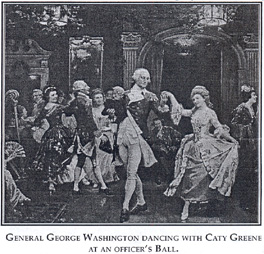
Nathaniel Greene is considered the second greatest (and for some, the greatest) commander in the American army. Catharine Littlefield married Nathaniel Greene in 1774 at the age of nineteen. When her husband marched off to war a year later, she was abruptly thrust into the role of head of household. Eager to be with her husband, she joined Gen. Greene at his military headquarters whenever possible. Over the course of the war (and shortly after), Catharine had five children. Conflicted between caring for her children and longing to be with her husband, Caty (as she was also called) settled on a compromise. To maintain a normal family life when conditions allowed, she brought her young children with her to camp. At other times, she left them in the care of family or friends. It was during these separations that Caty felt the war's effects most keenly on her family. She was a staple at winter quarters, and her presence had a positive effect not only on her husband but also on the other officers and the commander in chief himself - they were often dance partners.


Happy Mothers Day! 

Wednesday, April 26, 2017

Ramsour's Mill

Background


One of the least known but still crucial sites of the American Revolution was a small mill in North Carolina's Piedmont region. A modest backcountry mill, Ramsour's Mill, first played its part in the fight for independence during the summer of 1780. After Charleston, South Carolina fell in May 1780, General Charles Cornwallis was well on his way to dominating the South. Georgia and South Carolina were under British control, allowing the ambitious British general to turn his attention to North Carolina with an army of over 8,000. The southern strategy appeared to be working.


Lord Charles Cornwallis


Loyalists Gather


While Cornwallis rested his army in Charleston to prepare for his next move, two Loyalist leaders chose to act independently. The war for independence was, after all, a civil war, and these are often fought locally by the people who live there. So, Loyalists Lt. Colonel John Moore and Major Nicholas Welch decided to pursue their own goals by launching the first British attack on the North Carolina colony—their home turf. By June 13, 1780, they had successfully assembled a group of Loyal recruits at Jacob Ramsour’s Mill, near Clark’s Creek in Lincoln County, NC.


Patriot Response

However, General Griffith Rutherford, the shrewd and determined leader of the patriot forces in western North Carolina, had learned of the Loyalists gathering in Lincoln County. He immediately contacted patriot leaders, Colonel Francis Locke and Major Robert Wilson, and ordered them to assemble the militia to stop the Loyalists' assembly. To that end, 400 militia from Burke, Iredell, Mecklenburg, and Rowan Counties gathered at Mountain Creek on June 19. 

The recent British victory at Waxhaws boosted Tory morale, enabling Moore and Welch to collect around 1300 Loyalists - more than three times the number of local patriots. Recognizing that the Loyalists' numbers would only increase, Rutherford decided on a surprise attack against the Loyalist camp. A battle was about to unfold, pitting neighbor against neighbor.


Patriot mounted militia led the attack


Battle or Fratricide?

In the early hours of June 20, Locke led a militia band to Ramsour’s Mill to meet Adam Reep, a local patriot spy with intelligence on Loyalist troop location and strength. As the sun rose over Ramsour’s Mill, the rebel militia quietly moved through the early morning fog. The patriot cavalry launched a swift attack, aiming to surprise the Loyalists. Though initially repelled by the Loyalists' defenses, the rebel infantry advanced. The Tories were initially confused but were rallied by Moore and Welch to push back the patriot assault. 

The defenders held off the attackers at first, but soon rebel marksmen closed in, leading to close combat. Many on both sides were poorly armed. The chaos was intense, as this was a battle without uniforms. The Loyalists wore green pine twigs in their hats, while the patriots had white paper on theirs. The fighting was fierce—neighbor against neighbor, even brother against brother. It was as much personal as political, with each side viewing the other as a traitor. The battle lasted nearly two hours—a lengthy engagement for such a fight. Eventually, the Loyalists became disorganized, and many fled. When Colonel Rutherford arrived, the Loyalists requested a truce but demanded an immediate surrender. While negotiations took place, the remaining Loyalists fled, and about 50 were captured as prisoners.


The fighting was intense - and personal for many


The Result


The action at Ramsour's Mill cost seventy lives and left two hundred wounded. Most of the fallen, both patriots and Loyalists, were buried in a mass grave. The defeat so severely demoralized the Loyalists in that part of North Carolina that they never reorganized in that area again. As for the headstrong Colonel Moore, he and about 30 of his men were able to reach General Cornwallis, who was then at Camden. But Cornwallis, angered by Moore's rash actions and the defeat, threatened him with charges for disobeying orders.


Aftermath


Ramsour’s Mill deprived Cornwallis of Loyalist recruits when he finally invaded western North Carolina. More importantly, patriot morale received a significant boost from the unlikely victory. Additionally, the Loyalists' morale was so low that they never managed to properly recruit from that area again. This indirectly led to the chain of events that culminated in the patriot victory at King’s Mountain later that year. 

In a curious and ironic postscript, Ramsour's Mill played another role in the struggle for the South and Lord Cornwallis's ambitions. It was at Ramsour's Mill in January 1781 that Cornwallis paused his advance north to burn his wagons and excess baggage before resuming his futile pursuit of American General Nathanael Greene to the Dan River. 

This campaign exhausted Cornwallis's forces, and he eventually fell back under heavy pressure from ambushes and skirmishes initiated by the rebels who now sensed blood. Cornwallis finally faced Greene's resurgent army at Guilford Courthouse—a "victory" that proved costly and marked the beginning of the end for the Southern strategy.


Ramsour's Mill played a role in the fateful
race to the Dan of 1781


Tuesday, March 21, 2017

The First President

Who was John Hanson?

 The "Major Deegan Expressway" is a busy and famous road in the Bronx, named after someone nobody ever heard of. William Francis Deegan was a major in the Army  Engineers in WWI, a renowned civil engineer, and NY Democratic politico.  Deegan also helped found The American Legion.

Suburban Washington, DC, has its own version of the "Major Deegan." In Maryland, there is a road called the "John Hanson Highway." The John Hanson Highway is actually US Route 50 heading east from the District towards Annapolis. Just as in the Bronx, I am sure the thousands of drivers who transit that road each day have no idea who John Hanson was. They would be amazed to learn it was named after the nation's first president!


John Hanson Highway


Early Life

John Hanson was born in Mulberry Grove, Charles County, Maryland on 2 April 1721. He was the son of a  planter of English ancestry. His grandfather, also named John, came to Charles County, Maryland as an indentured servant around 1661. In 1744 Hanson married a wealthy landowner (Martha Washington was no the only wealthy colonial woman to marry a future president). Within the decade Hanson had expanded the holding to over 1,300 acres. Also like Washington, Hanson entered public life. In 1750 he was elected sheriff and seven years later was elected to a seat in the Maryland Assembly. By all accounts, he was a solid and efficient bureaucrat with a knack for finance.


Maryland Plantation


Political Strife

As friction between England and her colonies grew during the 1760s, Hanson identified with those who supported American grievances. Hanson publicly denounced the Stamp Act of 1765 and drew instructions for the first Maryland delegates attending the Stamp Act Congress in New York. In 1769, Hanson signed the Non-Importation Resolution adopted by Maryland to protest the Townshend Acts - a series of measures introduced into the English Parliament by Chancellor of the Exchequer Charles Townshend. The Townshend Acts of 1767 imposed duties on glass, lead, paints, paper, and tea imported into the colonies.


Move West

Hanson moved to Frederick County in the western part of Maryland in that same year. He took up life as a merchant. But he did not forgo politics. Instead, he became involved in the "extra-legal" political activities protesting British policy. In a word, he became a rebel. In 1774 Hanson chaired a town meeting to protest the Coercive Acts, the series of laws passed by the British Parliament to punish the colonies. Four of the acts were issued in direct response to the Boston Tea Party of December 1773. The following year, Hanson went on record declaring that armed force might be necessary to resist British tyranny. Those were serious words that clearly placed him at the center of the rebellion.


Coercive Acts were enacted in response to Boston's Tea Party


War Supplier

When armed conflict erupted in April 1775, Hanson used his fiscal expertise and organizational skills to help arm and equip soldiers of the Continental Army. As a result, soldiers from Frederick County were among the first soldiers to join General George Washington's army gathering at New York City. These were part of the famed First Maryland Regiment of the "Continental Line." Readers of the Yankee Doodle Spies series know that the main protagonist, Lieutenant Jeremiah Creed, was an officer leading a company from Frederick County as part of this esteemed outfit. The Marylanders, who made a gallant charge at the Battle of Long Island, were among the best equipped of Washington's soldiers - now we know it was thanks to one John Hanson.


Mark Maritato's  painting of the Maryland Line's gallantry on Long Island
(hangs in my office)


War Politician


Beginning in 1777, the people of Frederick sent Hanson back to the Maryland Assembly for five consecutive terms. In 1779 he was appointed a delegate to the Continental Congress. In Philadelphia, Hanson was appalled by the sloppy administration of the war and their wasteful spending. He was an early supporter of a stronger government in the form of the Articles of Confederation. Now known as a weak central form of government, the Articles had many advantages and were in fact more authoritative than the unstructured Congresses that preceded it.  Hanson delayed formal support until Virginia and other states gave up their claims to western lands. Once he accomplished that, Hanson became an ardent advocate and was elected as the first "President of the United States in Congress assembled" on 5 November 1781.


America's First President - John Hanson


Hanson's role was mostly ceremonial as under the Articles there was no executive. But he did oversee the day to day proceedings of the Congress. He corresponded with state governors, sent resolutions off to the various state assemblies, and helped orchestrate legislative functions.  Peace talks were initiated with Britain under Hanson. And he developed the structure of managing government through departments. Arguably, Hanson's most memorable war act was to accept the sword of General Charles Cornwallis from the victorious General Washington in November 1781.


Washington would present the sword Cornwallis surrendered
at Yorktown to President John Hanson


An Early Demise


Hanson was plagued by ill health and left his position after only one year as president when he resigned from office. John Hanson died on 15 November 1783, in Oxon County, Maryland, just ten days before the last British troops left New York City. Although not listed among the pantheon of "Founding Fathers," John Hanson can best be remembered as a highly trustworthy and efficient public servant and, technically, the nation's first president.


Statue of Hanson in Capitol's
 National Statuary Hall Collection


Sunday, February 12, 2017

Rodrigue Hortalez & Cie.


As I began my research into the American War for Independence to gain background and context for the Yankee Doodle Spies novels, I uncovered many things I had not known or even imagined existed. The struggle for independence was long and complex, featuring, in addition to traditional aspects of warfare, civil war, insurgency, guerrilla warfare, diplomacy, piracy, espionage, counterespionage, code-breaking, propaganda, spying, and covert operations.


A Secret War


Not widely known, the French began a covert operation to bolster the American rebels against the British crown. But some French secret activities began much earlier. The King of France, Louis XVI, and his ministers were smarting from the considerable losses of land suffered in the Seven Years' War, known as the French and Indian War in America. France lost all of her North American colonial possessions (except a few small islands off the maritime provinces) and had been militarily humiliated by the British. Shortly after the Treaty of Paris in 1763 was signed, French agents went to the American colonies to sow discord between the colonists and their masters. As the actual conflict drew closer, both the Americans and the British expected some sort of French intervention. The question was where, what, and how?


The French & Indian War cost France her
New World power and global prestige


The Minister


Any intervention would be directed by Charles Gravier, Comte de Vergennes, appointed foreign minister of France by Louis XVI in 1774. Vergennes hated the British, whom he considered France's natural enemy. With Vergennes at the helm of foreign policy, many believed France would be quick to provide aid following the actions at Lexington and Concord in April 1775. But Vergennes and the King moved deliberately. They anticipated another war (of revenge) against the British. They knew France was not yet ready, and they did not think the colonies could succeed. How to proceed?


Charles Gravier, Comte de Vergennes

The Playwright Spy


On the scene comes an unlikely figure: Pierre-Augustin Caron de Beaumarchais, a watchmaker, playwright (Marriage of Figaro, Barber of Seville, etc.), inventor, musician, politician, fugitive, spy, publisher, arms-dealer, and... revolutionary.  Something akin to the "world's most interesting man", Beaumarchais was well known at the highest circles of French society. Louis XVI was an amateur watchmaker and one-time student of Beaumarchais. 


John Wilkes


As America boiled with patriotic fervor and rebellion, Beaumarchais developed a passion for liberty and the colonists' cause. It is no small irony that many in the highly stratified, autocratic French society were also bedazzled by the ideals of the American cause. This included the king and Vergennes - although their bedazzlement was as much an opportunity for revenge as a love of liberty. Beaumarchais approached Vergennes with a proposal to support the Americans. 

At first, Vergennes demurred. He knew the king was not ready to commit to action that might be exposed prematurely. During the run-up to and early months of the American Revolution, Beaumarchais was a French agent in London. He had made numerous secret connections with Americans and British, particularly Arthur Lee and British radical politician John Wilkes. Beaumarchais penned a letter (via Vergennes) to the king in late 1775, proposing a scheme to deliver covert arms to the Americans via the West Indies in exchange for tobacco and other American produce. Louis XVI demurred again at first but soon agreed.


Pierre-Augustin Caron de Beaumarchais- the 
world's most interesting man in an age of
interesting men?

The Company


Arthur Lee
With the king's quiet approval, Vergennes instructed Caron de Beaumarchais to execute his scheme and set up a "proprietary" called Rodrigue Hortalez et Cie. This was a front company whose primary purpose was to protect France's role in aiding the American rebels. Beaumarchais, a master of intrigue, registered the company in Spain and ensured no paper trail could be traced to the French government or any other French public entity. Beaumarchais had "backers" for the company whose identities were kept secret. Beaumarchais engaged the sole American representative in Paris, Silas Deane of Connecticut. Secret correspondence across the Atlantic and into London and Spain set things in motion. Deane would eventually be joined by Arthur Lee and Benjamin Franklin, which would take things into intrigues best left for another time.


Silas Deane played a pivotal role that ended
in controversy and ignominy


The "Business"


When the king approved the operation, Vergennes granted Beaumarchais an initial one million livres (several million dollars) to purchase and ship weapons and other war materiel to the Continental Army. At the same time, Vergennes pressured Spain, which contributed the same amount. Spain chafed at British ascendancy but, suspicious of Americans' intentions in Louisiana, dragged its feet. The crafty and persistent Vergennes soon succeeded in pushing them along. The front company prospered. In its first year of "business," Rodrigue Hortalez et Cie shipped over 30,000 muskets, 100,000 rounds of shot, hundreds of cannons, tents, ordnance, and clothing through New England merchants with shipping connections to the Indies. These items were critical to continuing the war effort, as America, by design, had little industrial capacity. 

The neutral Dutch islands in the Caribbean, such as Sint Eustatius, became a hotbed of clandestine shipping. Experienced American smugglers would navigate around British naval pickets to make secret transactions: typically, tobacco for arms and equipment. France shipped surplus and old (if not obsolete) weapons from its fortresses and armories. The tobacco and goods received were to be sold for cash, which was used to finance the French armaments industry, procuring new weapons for the French armies and navies that would eventually fight Britain. Rodrigue Hortalez et Cie continued in business for two years.


Sint Eustatius was a major transit point for
the secret weapons-for-goods trade


The Covert War goes Overt


Franklin and Lee's arrival heated up the diplomatic situation as Franklin, surrounded by British agents, employed a masterful stratagem to woo the French public and ruling class. Yet the covert war had long been established by Deane and Beaumarchais. Now, however, Beaumarchais faded into the shadows, and Deane was soon recalled to America on corruption charges that were never proven. 

After the Continental Army soundly defeated the British at the Battle of Saratoga in October 1777, things changed dramatically. France entered into an alliance with the infant United States in early 1778, while a reluctant Spain finally declared war on Britain in 1779. Still suspicious of the Americans, Spain allied itself only with France. Regardless, much more aid was now shipped to the colonies, this time openly, in the bellies of warships and transports, rather than under cover of the covert and private enterprise that was Rodrigue Hortalez et Cie.


Benjamin Franklin waged a masterful subterfuge and
charm offensive as commissioner in Paris


The Legacy of Untidy Business


As the war's progress made Rodrigue Hortalez et Cie unnecessary, some "unfinished business" fell to the American Commission in Paris, which now included John Adams in place of Deane. The correspondence below offers a glimpse into the untidiness of wrapping up covert affairs... even in the time of the Yankee Doodle Spies...


From the American Commissioners

To Comte de Vergennes

Sir
By some of the last Ships from America, we received from Congress certain Powers and Instructions, which we think it necessary to lay before your Excellency, and which we have the Honor to do in this Letter.
We have the Honor to enclose to your Excellency a Copy of the Contract made between the Committee and Mr. Francy, a Copy of Mr. Francy's Powers, and a Copy of the list of Articles to be furnished, according to that Contract, that your Excellency, may have before you all the Papers relative to this Subject.
We are under a Necessity of applying to your Excellency upon this Occasion, and of requesting your Advice.
With Regard to what is passed, we know not who the Persons are, who constitute the House of Roderigue Hortalez & Company, but we have ever understood, and Congress has ever understood, and so have the People in America in general, that they were under Obligation to his Majestys good will, for the greatest part of the Merchandizes, and Warlike Stores heretofore furnished, under the Firm of Roderigue Hortalez & Company. We cannot discover that any written Contract was ever made between Congress or any Agent of theirs, and the House of Roderigue Hortalez & Co., nor do we know of any living Witness, or any other Evidence, whose Testimony can ascertain to us, who the Persons are that constitute the House of Roderigue Hortalez & Company, or what were the Terms upon which the Merchandises and Munitions of War were supplied, neither as to the Price, nor the Time or Conditions of Payment.
As we said before, we apprehend that the United States hold themselves under Obligation to his Majesty, for all these Supplies, and we are sure it is their Wish and their Determination to discharge the Obligation to his Majesty, as soon as providence shall put it in their Power. In the mean time, we are ready to settle and liquidate the Accounts according to our Instructions, at any time and in any Manner, which his Majesty, or your Excellency shall set out to us.
As the Contract for future Supplies is to be ratified, or not ratified by us, as we shall judge expeditious we must request your Excellencys Advice as a favor upon this Head, and whether it would be safe or prudent in us to ratify it, and in Congress to depend upon Supplies from this Quarter, because if we should depend upon their Resource for Supplies, and be disappointed, the Consequences would be fatal to our Country. 

We have the Honor to be
 with all Respect Your Excellencys
 most Obedient and very humble Servants

B Franklin
Arthur Lee
 John Adams


Monday, January 2, 2017

The Surgeon General

Tomorrow marks the anniversary of the Battle of Princeton, the culmination of a week of daring action that literally saved the American Revolution—at least until its next crisis. The battle featured a daring night march by Washington's army—pinned and shivering between the Assunpink Creek and the frozen Delaware River, awaiting possible annihilation by General Cornwallis and 5,000 British and Hessians hell-bent on revenge for the first battle of Trenton. 

Washington's men abandoned camp in the dark winter night. Tramping through frozen marshlands, they circled around the British, arriving several miles behind them and preparing to seize the British base at Princeton. Washington succeeded in one of the rare open-field engagements of the campaign, demonstrating decisiveness and personal bravery by leading his men across the snow-covered fields in a gallant charge. But the victory came at a great cost: two of his top generals fell that day. One of them was Hugh Mercer, the Scottish-born surgeon turned soldier.


Young Hugh Mercer


Early Life: Scalpel, Claymore, and Tomahawk


Mercer fought with the clans at Culloden


Mercer was born in Aberdeenshire, Scotland, in 1725, and earned a medical degree from the university of that name in 1744. Apparently a lover of hopeless (not lost) causes, the young Mercer joined the Jacobite army under Prince Charles Edward, known as the Pretender, until that struggle for freedom was crushed by the Duke of Cumberland's redcoats at Culloden on April 16, 1746. 

After a period in hiding, Mercer fled to America and settled in Pennsylvania, where he established his medical practice. At the outbreak of the French and Indian War in 1756, Mercer joined the colony's forces. Throughout the war, Pennsylvania's western region faced relentless Indian raids, encouraged by the French. Mercer began his service as part of Colonel John Armstrong's expedition against the Indians at Kittanning, where he was wounded. 

In 1758, he served as a lieutenant colonel in the siege of Fort Duquesne and was later given command there to secure the West. Around that time, he befriended a colonel named George Washington, who commanded the Virginia Regiment, which performed similar duties protecting Virginia's western frontier.


The British capture of Fort Duquesne

Colonial Life: Prosperity and Family


When the war ended in 1763, Mercer moved to Fredericksburg, Virginia, and reopened his medical practice. It makes one wonder if his connection with Washington influenced his decision to relocate to the Old Dominion. When Mercer arrived in Fredericksburg, it was a lively Scottish community. 

Fellow Scot John Paul Jones's brother farmed nearby, and Jones himself hoped to settle there permanently. He became a well-known figure and businessman in town, purchasing land and engaging in local trade. His medical practice brought him into contact with many prominent Virginians, including George Washington's mother, Mary Ball Washington, who became one of his patients. 

In Fredericksburg, Mercer married Isabella Gordon, started a family, and had five children. Later, he purchased George Washington's childhood home, Ferry Farm, with the hope of making it his permanent residence.


Mary Washington was a patient
of Mercer's (seen here as a younger woman)

Run up to War


Like many Virginians, Mercer supported the Patriot cause as the American Revolution approached. He joined the Fredericksburg Committee of Safety and, on April 25, was among the members of the Independent Company of Fredericksburg who wrote a letter to then-Colonel George Washington, expressing concern when the British removed gunpowder from the Williamsburg magazine. Because he was Scottish, the Virginia Convention skipped over him for command of the first Virginia regiments in 1775. 
However, he was appointed commander of all the minuteman companies in the four counties around Fredericksburg. Early in 1776, Mercer's military experience led the provincial congress to appoint him as colonel (commander) of the 3rd Virginia Continental Line. Future President James Monroe and future Supreme Court Justice John Marshall served under him.


James Monroe served under Mercer


From Surgeon to General


In June 1776, General George Washington, in urgent need of experienced commanders, persuaded the Continental Congress to appoint Mercer as a brigadier general. Mercer's experience and reputation led Washington to place him in command of the "Flying Camp' during the New York campaign. These were inexperienced militias requiring strong leadership and strategic training. The Flying Camp served as a special military reserve, but despite Mercer's efforts, it suffered from shortages of equipment and men and was disbanded by year's end. Mercer also oversaw the construction of Fort Lee, which overlooked the North River across from Fort Washington in Manhattan. 

During the darkest days of the war, Mercer played a key role in Washington's night march on Trenton on December 26, 1776. He helped plan and execute the crossing and led his brigade into Trenton from the west—driving the Hessians out of the town and into an orchard, where they were almost annihilated. Mercer was also instrumental in repulsing the British during the second Battle of Trenton on January 2, 1777. The next day, Washington's army advanced on the British garrison at Princeton, New Jersey. 

Mercer's brigade, consisting of 350 men, encountered Lieutenant Colonel Charles Mawhood's force—two British regiments and some dragoons, totaling about 1,200 men—near Stony Brook Bridge. A fierce firefight erupted in an orchard grove. The fiery Mercer refused to retreat despite the overwhelming odds and charged into battle. 

The better-trained British forces pushed his men back, causing them to break ranks. As Mercer attempted to rally his troops, his horse was shot from under him. He quickly got to his feet but was soon surrounded by British soldiers who mistook him for George Washington and ordered him to surrender. 

Outnumbered, Mercer drew his saber and fought fiercely. He was eventually knocked to the ground, bayoneted seven times, and left for dead. When Washington learned of the British attack and saw some of Mercer's men retreating, he personally entered the battle, famously rallying Mercer's men and forcing the British regiments to retreat.


Death of Hugh Mercer at Princeton

A Nation's Loss


After the battle, Mercer's body was taken to a nearby farmhouse where Washington's leading physician, Dr. Benjamin Rush, attended him. However, Mercer died of his wounds on January 12, 1777. His loss was a significant personal blow for Washington, but it was an even greater loss for the new nation, which would have benefited from his leadership both in peace and in war.


Mercer Statue at Fredericksburg


Saturday, December 10, 2016

Cold and Stalemate at Whitemarsh


This week marked the anniversary of Whitemarsh: the final part of the third year of the American fight for independence. For several cold winter days, rebels and redcoats marched and counter-marched as General George Washington aimed to lure British General Howe into an end-of-year disaster.


Background


General William Howe
General William Howe's Philadelphia campaign of 1777 was one of move, lose, move, lose for George Washington and the Continental Army. Despite that, Howe and the British high command remained frustrated because the rebel army and its general continued to remain a force they would need to reckon with if winter quarters were to be enjoyed in peace and comfort. 

Despite his failed surprise attack on Germantown on 4 October, Washington remained unbeaten. He maneuvered his forces from post to post, ultimately settling in at a place called Whitemarsh, about 13 miles northwest of Philadelphia. Both Howe and Washington knew that an unbeaten American force in the field remained a psychological as well as a real threat to British success. 

So in early December, Howe decided to make one last attempt to destroy Washington's army before the onset of winter and began preparations for the attack on the rebel forces rumored to be in the process of moving to a new camp. But Washington's intelligence network, led by Major John Clark, became aware of British plans to surprise the Americans, possibly through a Quaker housewife, Lydia Darragh. Because of the timely, accurate intelligence, regardless of the source, the Continental Army was ready.


Lydia Darragh was a Phila. nurse
and the housewife said to have warned
Washington of British plans

Ready for Action


Undaunted by weeks of retreat, Washington and his men prepared for battle. Washington faced pressure from Congress due to defeats at Brandywine and Germantown and aimed to make amends before the campaign ended. He always pictured a Breed's Hill-style fight where his troops would break British lines with heavy fire from fortified positions. For their part, his men were eager for a chance to vent their frustrations on the 'lobsters.' 

The Americans had ample time to strengthen their defenses, so despite being cold, exhausted, and hungry, they were ready to act and seek retribution. Washington positioned them on high ground—another Breed's Hill scenario seemed possible. Meanwhile, Howe planned to give the rebels the fight they craved. The British hoped for a swift, decisive victory over the struggling rebels before winter arrived, as he too faced troubles of his own.

And Vindication


A British Army capitulated at Saratoga in October—an army many believed Howe was obliged to help. Defeating Washington would be a sweet victory. Both Howe and Washington were overshadowed by the recent devastating British surrender at Saratoga. Howe for not doing more to support Gen. John Burgoyne, the defeated British commander, during the ill-fated invasion from Canada. Washington himself was criticized by some in Congress and the Army who questioned his leadership.


British surrender at Saratoga had
both Washington and Howe in its shadow

The Action


The British and Hessians left Philadelphia at midnight on a bitterly cold December 4th, with 14,000 troops. Howe moved his men in two columns. One, led by Lord Cornwallis, headed up Germantown Pike. The second, commanded by Hessian General Knyphausen, marched toward the American left. Just before dawn on December 5th, they arrived at Chestnut Hill, where they encountered about 15,000 Americans ready for action. 

Attempting to provoke a fight, Washington sent the Pennsylvania militia toward Howe's left. The militia was repelled after a short but intense fight. This led to days of maneuvering by Howe's forces, who attempted to find an opening in Washington's defenses through various feints and marches. The Continentals and militia responded well. Washington's men were prepared and managed to prevent any potential breakthrough. 

Frustrated, the British burned homes and farms, fueling resistance among a populace that was almost subdued by the British advance. Howe launched a final effort to turn the American left flank on December 7th. He advanced forces along Edge Hill, a ridge running parallel to the American lines. But the Americans, including militia and Virginia riflemen under Dan Morgan, responded. After intense fighting, the Americans were again pushed back, but the British retreated. 

This started a long day of small, sharp, yet inconclusive skirmishes throughout the wooded ridge, with no clear outcome. Frustrated at neither breaching the American defenses nor luring them into an open battle, Howe decided to withdraw. He led his army back to Philadelphia. Washington also felt frustrated, as his hope of luring Howe into a second Breed's Hill never materialized. The casualties for Whitemarsh were 90 Americans killed or wounded, and 60 British killed or wounded.


Howe at Whitemarsh


A Winter of Stalemate


Whitemarsh marked the end of the long and eventful campaigns of 1777. Howe and his army are secure in comfortable winter quarters in Philadelphia. A few days later, on December 11, Washington leads his army into the cold comfort of winter quarters at Valley Forge. The uneventful battle at Whitemarsh is unremarkable on its face. But in retrospect, the inconclusive series of skirmishes set the stage for the famous winter at Valley Forge that marked the birth of a professional American Army. As for Sir William Howe, his request for relief was approved, and he would leave the Army the following spring.


Stalemate at Whitemarsh was the last action
before George Washington led his army to
a place called Valley Forge