Followers

Sunday, July 28, 2013

How I spent my Summer Vacation - Part II

Let me say upfront this is the first summer that I have been able to go on two different trips - one north - one south. However, both took me to coastal beaches. And both took me back in time...at least notionally. Part two took me to North Carolina.  I briefly lived in North Carolina many years ago but my Army duties and other interests kept me from truly exploring the state.  This trip convinced me of the error of my ways. I stayed at Kill Devil Hills on the Outer Banks.  My place was within sight of the place where the Wright brothers changed the world forever and about twenty-five yards from the beach.


Driving down to the Banks took me through some notable places during the time of the Yankee Doodle Spies.  I took Highway 15 and then 17 instead of the interstate. The route took me through the Virginia Piedmont to Fredericksburg, which was an operating seaport during the 18th century. There begins a trip through the upper tidewater region. Mary Washington's last home, purchased for her by her son in 1772, is in Fredericksburg, Va.


American field guns at Yorktown


Highway 17 takes you through Gloucester, which is across the York River from the famous town of that name. Crossing the York River you find yourself at historic Yorktown. The National Park Service maintains a fabulous battlefield center there and the park extends into part of the town itself. As most know, a combined French-American force besieged General Cornwallis there and caused his surrender in 1781, forcing the British to begin negotiations with the rebels and the French.


My GPS routed me through Yorktown, Newport News, Smith Island, and finally to Portsmouth and meandered south. At that point, I left 17 for the more traditional (and traffic-laden) approach to the Banks. Had I stayed on 17 I would have passed near the Great Dismal Swamp, a hundred-mile square area of marsh connected by a series of small streams - all heavily wooded at the time of the Yankee Doodle Spies.  George Washington and many of his Virginia peers lost a bit of money in a venture aimed at developing the swamp as an inland waterway.

Great Dismal Swamp


Little of this has anything to do with the time of the Yankee Doodle Spies but geography often dictates history.  And so I expand on that idea a bit. The British government's main advantage over their rebellious colonies was the Royal Navy. They had the largest and best navy in the world and the Americans had none at the war's start. However, navies need ports to make them most effective - and North Carolina had few of note. To that end, the Outer Banks served as a more than 100-mile long barrier against British naval supremacy in North Carolina. This limited British operations from the sea and thus no naval actions of note took place there. Late in the war, when the British invaded North Carolina, they did so over land, and the series of events leading to Yorktown ensued.


Fort George marker 

But further, down the coast from the Banks, there was an attempt to maintain a coastal base at New Bern, Wilmington, and Bald Head Island, which guards the mouth of the Cape Fear River. The main British forts were Fort George (on Bald Head itself) and Fort Johnston. The British clung to these but never found a way to exploit them, thanks to aggressive patriot actions that continued throughout the war.

Saturday, July 13, 2013

How I Spent My Summer Vacation

New York - resort?


I took my annual summer resort vacation...in New York City! Now many folks wouldn't think of New York City as a resort and certainly not as a summer resort. But for most of its history, New York was precisely that - especially for the poor and middle class that make/made up so much of the city's populace. Why? Because they couldn't afford the time or the money to reach out to the numerous lakes in the mountains north of town or the expansive beaches of eastern Long Island. Nope, hundreds of thousands made do with the likes of the Bronx's Orchard Beach and City Island. The trolley and later the subway brought droves to Brooklyn's Coney Island, Manhattan Beach, Plum Beach, and Brighton Beach. Sheepshead Bay (it looks like a sheep's head from the air) offers deep-sea fishing at a reasonable price. And the prime resort area remains the Rockaways.  Queens's seven mile-plus stretch of sand from Far Rockaway to Rockaway Point with views of New Jersey's Atlantic Highlands provides some of the finest beaches on the east coast.


Some work - some play


Although I was in Rockaway, this year my resort activity was somewhat curtailed.  I was under a deadline to get the edited manuscript of The Cavalier Spy reviewed and back to the publisher (done). So my summer fun in the sun was restricted to a one day visit to the beach. However, I took advantage of a special deal set up by NYC as a result of Hurricane Sandy.  Because of Sandy's impact on mass transit in the Rockaways, the city contracted a fast boat to go from Beach 108th Street and Jamaica Bay around the end of the Rockaways and up New York bay to lower  Manhattan. Readers of The Patriot Spy know Manhattan was called The Island of New York during the time of the American Revolution. The trip takes an average of 38 minutes each way for the round trip cost of $4! Like that, badabing, you are staring up at the lofty buildings of New York's financial district.  So what the heck does this have to do with the American Revolution? Well, the boat ride passed many of the critical points of the British invasion of New York back in the summer of 1776.


Sailing into the past


British cross the harbor towards Gravesend Bay


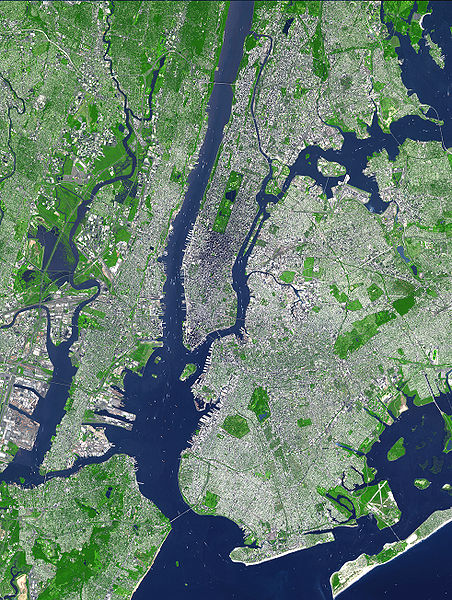
As the boat eased out of Jamaica Bay and turned into New York's impressive lower harbor, I could look to the southwest and see Sandy Hook, New Jersey. But back in 1776, the Sandy Hook included a sand bar that blocked the lower harbor, preventing large British warships from crossing over it except during extreme high tide. A few minutes later we were approaching the Verrazano Narrows. The British went through the narrows and landed an army of twenty-four thousand or so on Staten Island, then a Tory stronghold. After recovering for a few weeks they launched barges and longboats across the narrows and landed troops at Gravesend Bay. This was on my right (starboard side) just before I reached the narrows, not far from today's Fort Hamilton. The few American defenders there ran off at the sight of the British. We continued on another ten minutes with Bayonne on our port and Bay Ridge, then Red Hook, on our starboard. Near Red Hook is the Gowanus Canal: the remnant of the Gowanus Creek that played such a critical role in Washington's defenses on Long Island. The boat soon approached Governor's Island, where the Royal Governors resided during colonial times.  The last  Royal Governor of colonial New York, nasty William Tryon, evacuated a year earlier but returned in 1776 with the British armada.


The Sea Streak sails from the Rockaway peninsula on the lower right and up
the harbor to the lower extreme of Manhattan. Note the narrows and
 Governors Island. The Sandy Hook is just off the bottom of the photo,


The final heading


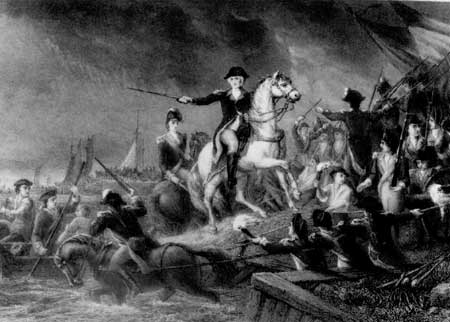
The Gloucester Regiment evacuates Washington's army from its defenses
near the Heights of Brooklyn
Passing the narrow channel between Governor's Island and Brooklyn, the boat entered the waters of the lower East River. To our starboard front lay Brooklyn Heights, just south of the famed Brooklyn Bridge. This was the location of Washington's headquarters during the battle for Long Island, and the point from which the Gloucester seamen evacuated the beleaguered army on a stormy night with the British front lines not more than a few hundred yards distant! The crossing from Brooklyn to New York was considerably wider than it is today, as the Manhattan's expansive use of landfill has narrowed the river by almost a quarter-mile.


The (old) City of New York


We arrived at lower New York, which during the time of the Yankee Doodle Spies extended not too far beyond today's Wall Street. We landed in the lower central portion of this image of early colonial New York. Note how the city abruptly ends at the Wall Street, it extended past Chambers Street by the mid-1700s.


Pearl Street was a contemporary thoroughfare about a half-mile north of where we landed. It probably looked little different from this image from the Dutch era, although the docks and buildings would be more extensive as the city had grown. I will do a future blog on some of the revolutionary war era sites that still remain in the city.  Of course, the march of history (not progress) has limited them to only a few.

Dutch-style buildings still dominated New York during the
time of the Yankee Doodle Spies


I

Wednesday, July 3, 2013

Espionage: Born on the 4th of July


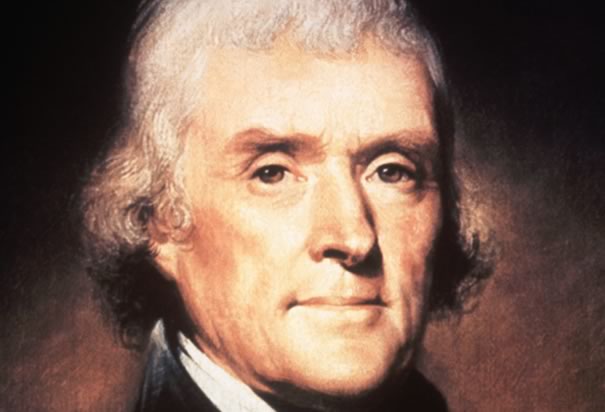
Thomas Jefferson
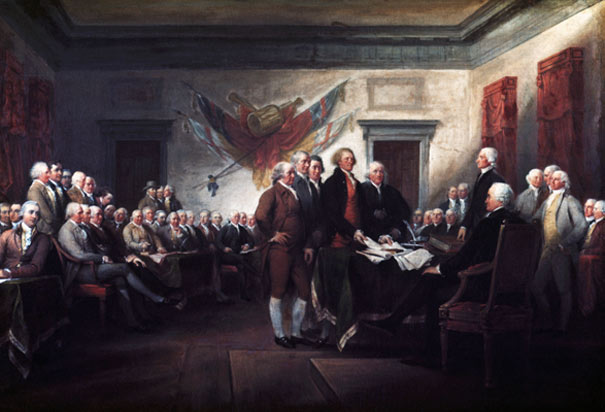
The birth of our nation is rightly celebrated on the 4th of July, although the actual signing was not on the fourth and Thomas Jefferson drafted what is perhaps the most famous document in the world between the 21st and 28th of June, 1776.  But, as of the 4th of July, the British colonies in North America were no longer fighting for their rights as Englishmen, but for their independence as a sovereign nation.


What has this to do with espionage and the Yankee Doodle Spies?  Well, everything. The Yankee Doodle Spies are stories of action and espionage during the American Revolution. Counterintelligence plays no small role in the stories and its prime purpose is to root out spies to be prosecuted for treason.  Espionage is a legal term for treason acted out by passing a nation's secrets to a foreign power.  So, you have to have a nation to have treason, and by extension, you have to have a nation to have espionage.


Intelligence gathering was a little known but widespread activity by both sides throughout the eight year war that was the American Revolution. One famous (or infamous) spy during the war was Doctor Benjamin Church.  In the environs of Boston, this chief medical officer for the rebel army passed secrets to the British high command through his mistress in Boston.  His mistress betrayed him. Exposed and convicted at court martial - he could not be found guilty of treason (espionage) because as British subjects, the rebels came under British law and treason (espionage) could only be committed against the King.  The irony was rich!


Church was nonetheless kept under arrest for some years and finally exchanged in 1778.  He died when the ship he was returning to England in was lost in a storm at sea.


Had Church been identified after July 4th 1776, however, he would have been traitor to a nation and thus guilty of treason (espionage).  The states had committees for detecting spies, but these were informal and poorly coordinated efforts that often confused misplaced loyalty with treason.  As Americans celebrate the birth of our nation with the usual parades, fireworks and barbecues, we should keep in mind that the Declaration of Independence, which birthed the world's first modern republic and set the precedent that ideas can challenge dynasties...created the political and military conditions for a counterintelligence service that could ultimately bring charges of espionage against traitors to the Glorious Cause.

Signing the Declaration of Independence


Saturday, June 15, 2013

Founding Fathers - The Most Famous Duo

The Franklins


A Promising Beginning


The most famous father-son duo of the American Revolution is the Franklins: famed scientist, publisher, philosopher, and diplomat Benjamin Franklin and his son, William Franklin. As with everything about Franklin, this tale is complex and twisted, evoking the tragedy of a war that was as much a civil conflict as a revolution. William lived in his father's shadow, who was arguably the most celebrated and renowned man of his age - a truly international celebrity. William played a pivotal role in some of Franklin's most famous exploits (the electricity experiment, for instance) but received little to no credit or recognition. Living under the shadow of a famous father had both advantages and disadvantages. The often frugal Ben Franklin paid for William to attend the prestigious Inns at Court, where he studied law. This launched him into a career that, had the British won the war, would have marked him as one of the Empire's premier men.


Founding Father Benjamin Franklin


The Bastard Prodigy


William was illegitimate and may have been the child of Ben’s long-suffering wife, Deborah Read, prior to their marriage. Benjamin acknowledged his son after he had been married to Deborah for seven years, the legally allotted time before bastards could be legitimized. The recognition of William’s parentage was kept secret at that time. After completing his studies at the Inns of Court, William returned to America in 1762 with Downes, a wealthy heiress to a sugar plantation fortune in Barbados. However, the elder Franklin was displeased with this choice, as he had another bride in mind for William. Disagreement over William’s marriage further strained an already troubled relationship. Before the rebellion escalated into a revolution, the two Franklins were partners in politics, publishing, grand real estate schemes in the Illinois country, and conflicts with Indians on the Pennsylvania frontier. However, William was very much the junior partner, dependent on his father for income even after his appointment as governor. William’s salary was often delayed for as much as three years.


Royal Governor of New Jersey William Franklin


The King's Servants?


While in England, William developed close relationships with government ministers, leading to his appointment as Royal Governor of New Jersey in 1762. This prestigious appointment came at an unfortunate time. Just as William assumed his new role, a newspaper hostile to the Franklin family revealed the younger Franklin’s illegitimacy. At the very moment William became one of the most significant political figures in colonial America, the scandal of his illegitimacy erupted on both sides of the Atlantic. Meanwhile, Ben Franklin began his journey from loyal conciliator to ardent rebel. His dealings with the British as the colonies' representative in London made him realize that Americans would always be viewed as second-class citizens. Called before the Council on a trumped-up charge, his treatment resulted in a definitive break, and Franklin became the elder statesman of the American Revolution from that time on.


Proprietary House - NJ Governor's Mansion


A Loyal Prisoner


But William continued to act as George III’s loyal subject. As Royal Governor and supporter of the British constitution, he urged conciliation on both sides. As the war escalated, William engaged in what was inaccurately labeled as treasonous correspondence with members of Parliament and the King’s ministers. His letters provided information on American troop movements and included pleas for reasonableness from the crown. William was arrested by order of the Continental Congress but refused to give his “parole” or word that he would cease his counter-revolutionary activities. Over a two-year period beginning in 1776, William was confined under increasingly horrific conditions. Ben refused to intercede for him. He finally left Litchfield, Connecticut, under terrible conditions. While most upper-class prisoners would stay at Moses Seymour's house, Franklin was thrown into the common jail, in a dungeon-like cell filled with excrement. 


Franklin was confined in a common prison like this


During his incarceration, William’s wife had become seriously ill. Her serious condition even prompted George Washington to plead for her husband’s freedom to save her life. However, William spent eight months in Litchfield jail before he was exchanged for a POW held by the British. The once robust and handsome Franklin emerged toothless, emaciated, and destitute; his health ruined and his hair gone. Washington’s fears about William’s wife were validated. Shortly before her husband’s release, Elizabeth Downes Franklin died at the age of 43. William believed his wife’s death was caused by their long separation and his ill-treatment while imprisoned.


Family Feud outlives Political Peace


After the war, the Franklins' relationship remained strained, and they never reconciled. Like so many Loyalists—perhaps around 100,000—William went into exile. In 1785, just before Benjamin’s final return to America, William sought reconciliation during a meeting in France. Benjamin, at 79, obese and suffering from debilitating gout and kidney stones, rejected his son. Franklin bequeathed the majority of his fortune to his grandson William Temple Franklin while demanding payment for loans his son had repaid years earlier. William suppressed his anger and transferred all of his extensive property in America, including his mansion in New Jersey. After his release in 1778, the ex-governor moved to London, where he rented a modest home. He passed away in 1813.


William Temple Franklin


Thursday, June 13, 2013

Founding Fathers Part Two  - Another Palmetto Duo


Father:  Slave Trader and Political Leader


Henry Laurens was one of the wealthiest and influential of the South Carolina planter class.  Laurens became a political leader during the Revolutionary War. He also happened to be the largest slave trader in the colonies too.  In the 1750s alone, his Charleston firm oversaw the sale of more than 8,000 African slaves. When Laurens succeeded John Hancock as President of the Congress he became an important political ally of George Washington and the two maintained close correspondence throughout some of the darkest days of the war. The elder Laurens was someone who Washington could trust would work the sometimes feckless and indecisive Congress.  His support for the Indispensable Man is a little-noted but critical sidebar that led to Washington's continued leadership of a Cause often thought lost but never forsaken.

                                                                               
                                                                         Henry Laurens
                                                                

An Idealistic Son


His son John Laurens was born in Charleston on October 28, 1754. The younger Laurens traveled to London in 1771 for schooling before moving to Geneva, Switzerland, in May 1772. Laurens returned to London to study law in the Middle Temple at the Inns of Court. He returned to an America at war with its motherland and was appointed to the staff of George Washington. Laurens was perhaps the most idealistic and forward-thinking of the First Patriots. While on Washington’s staff he became very close friends with Alexander Hamilton and (along with his father in Congress) played a key role in countering a movement against the commander in chief, which included his winning a duel with one of Washington’s adversaries. He showed reckless courage at the battles of Brandywine, Germantown in which he was wounded, and Monmouth, where his horse was shot out from under him. Lafayette praised his courage and marveled that he had not fallen in the battle. Laurens was an idealist who believed that the republican principals the Americans were fighting for were hypocritical if they continued to utilize slave labor. Strongly influenced by the growing abolitionist literature that circulated in England while he was studying, Laurens encouraged those around him, including Washington, to consider freeing their slaves. The responses that Laurens received were mixed. Some, such as the Marquis de Lafayette, eventually came to the same conclusion. Others, such as Washington, remained hesitant, fearing the economic and social upheaval such a measure would cause.


                                                                      John Laurens

After the British shifted military operations to the South, Laurens proposed that South Carolina arm slaves and grant them freedom in return for their military service. In March 1779 Congress approved his idea and commissioned him a lieutenant colonel. Elected to the South Carolina House of Representatives, Laurens introduced his black regiment plan but met overwhelming defeat. His belief that blacks shared a similar nature with whites and could aspire to freedom in a republican society would set Laurens apart from most prominent southerners in the Revolutionary period. When the British threatened Charleston in May 1779, Laurens opposed Governor John Rutledge’s plan to surrender the city. Later that year he commanded an infantry column in the failed assault on Savannah. Laurens was captured when Charleston finally surrendered to the British in May 1780 but was soon exchanged.


Siege of Charleston

A Youthful Diplomat


Because of his integrity and devotion to duty (and his French fluency), Congress appointed Laurens special minister to France. He arrived in France in March 1781 and quickly obtained a loan from the Netherlands to buy more military supplies and French assurances of active military support. Laurens served once more under Washington at Yorktown where the young prodigy represented the American army in negotiating the British surrender.


Clandestine Warfare and an Untimely Death


Returning south (and losing a final plea for a black regiment) Laurens served under General Nathaniel Greene in the always vicious southern theater. He operated a local spy network that gathered intelligence on British activities around Charleston. To the everlasting loss of his country and his state, Laurens was killed on August 27, 1782, during a meaningless skirmish on the Combahee River.


Sunday, June 9, 2013

Founding Fathers & Sons

Who’s your Daddy? 


I apologize for using a clichéd phrase to introduce this blog, but the topic is anything but dull. During the American War for Independence, many father-son pairs served together, especially in local militia units that appeared and disappeared with the shifting tides of conflict. Some, however, fought at the highest levels of the Revolution. With Father’s Day coming up, I thought it would be worthwhile to highlight a few of these extraordinary duos. To keep things brief, I’ll be sharing these stories in three separate blogs this week, so stay tuned!


Part One

A Pair of Irishmen from the Palmetto State


This pair of First Patriots hails from South Carolina, originally from Ireland. Jonas Lynch fought alongside the Irish in their brave yet doomed stand against William of Orange's forces. The final resistance to William's mercenary army surrendered after the siege of Wexford in 1691. Many fled to France, hoping to support the cause under the French king. Unlike many Irish expelled from their homeland following the defeat in the Irish wars, Jonas Lynch made his way to America. He became a successful planter. His son, Thomas, was born in Berkeley County in 1727.


Thomas Lynch Sr. also worked as a planter and owned extensive rice fields along the Santee River and other waterways, as well as a vast estate known as Hopsewee Plantation on the North Santee River. He became the second-wealthiest man in the colony. Lynch was also a leading statesman, serving in the South Carolina Colonial Legislature and representing South Carolina in the Stamp Act Congress of 1765, where he headed the committee that drafted the petition to the House of Commons and served as a delegate to both the first and second Continental Congresses. Lynch Sr. likely signed the Declaration of Independence, representing South Carolina. Sadly, he suffered a massive stroke early in 1776. With his father incapacitated, the South Carolina Assembly appointed his son, Thomas Lynch Jr., to succeed him. 


Thomas Lynch Jr. was born in 1747 at his family's Hopeswee Plantation. Unlike his father, he had access to a top-tier education, attending prestigious schools in America before going to Eton and Cambridge, where he studied law in London. He returned to America, married well, and took up planting like his father. As the son of one of the most passionate revolutionaries and influential men in the colony, Lynch Jr. naturally became very interested in politics and enjoyed strong support from the voters. 


Thomas Lynch Junior


During the years 1774-76, while his father served in the Continental Congress, Thomas Jr. contributed on the home front by attending the first and second provincial congresses, the first State legislature, and serving on the State constitutional committee. In 1775, the younger Lynch took a captaincy in the First South Carolina Regiment of Continentals. This upset his father, who hoped to influence a higher rank for his son. Unfortunately, young Captain Lynch contracted bilious fever, an intestinal ailment, while on recruiting duties in North Carolina. Incapacitated, he had to give up his early military career. 


Triumph and Tragedy


However, when Thomas Sr.’s condition in Philadelphia became critical in the spring of 1776, South Carolina’s Assembly sent Thomas Jr. to the Continental Congress. Despite his own serious health issues, the younger Lynch dutifully traveled to Philadelphia, where he stayed throughout the summer. During that revolutionary season, it was the younger Lynch, not his father, who voted for and signed the Declaration of Independence. The Lynches were the only father-son pair to serve together in the Continental Congress at the same time.  


However, personal tragedy followed political triumph, and more blows were yet to come to the father and son, the First Patriots. Both Lynches’ health worsened, and by the end of the year, they headed homeward. Thomas Sr. never made it back. En route, in Annapolis, MD, a second stroke took the life of the elder Lynch. Thomas Jr. returned home a broken man—physically and emotionally. 

Late in 1779, he and his wife went to France in an effort to regain his health. They sailed for the Dutch island of St. Eustatius in the West Indies to find a ship back across the ocean, but a storm struck, and their ship was lost at sea. This was common during the age of sail, but the tragedy is not just personal (Thomas Jr. left no male heirs). The loss of the father and son was a blow to the young nation, which could have benefited from the talents and dedication of the Lynches of South Carolina.


The Harbor at Saint Eustatius


Thursday, May 23, 2013

A Yankee Doodle Memorial

This is Memorial Day weekend.  For most Americans, just another reason to have a party, go to ball games or watch the Indianapolis 500 or Preakness.

But for some, especially those who have a military connection, Memorial Day is truly something special because it is the one day that commemorates those who have fallen in the service of their country. Memorial Day was promulgated on 5 May 1868 by General John Logan, the Commander of the Grand Army of the Republic, a Civil War veterans group made up of northern vets -sort of the American Legion/VFW of its day. To honor Civil War fallen, flowers were placed on the graves of Union and Confederate dead on 30 May although most southern sympathizers clung to separate holidays to commemorate their fallen. This changed after World War 1 when veterans of both regions who had served side by side began to be honored as well.


General John A. Logan


The trauma of the Civil War, followed by that of the Great War brought industrial age carnage to new heights and the need for some sense of spiritual closure for those fallen in massed attacks such as those at Gettysburg, Cold Harbor, or the Marne and the Meuse-Argonne offensives.  To honor them, huge cemeteries and memorials span the nation and the battlefields of Europe and Asia honoring the hundreds of thousands of fallen. By "modern" standards casualties during the War for Independence were laughable and most soldiers died from sickness and starvation while in service to their nation.


But our First Patriots cherished and honored their fallen no less. And after the war, the need to honor those who gave all for an idea sanctified both the idea and those whose sacrifice enabled it.  Here are just a few examples:
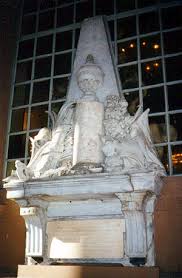

General Montgomery Memorial
at St. Paul's
The first commemoration was ordered by the Continental Congress in 1776 to honor General Richard Montgomery, who fell during the American assault on Quebec, Canada. Our first fallen general's monument was designed and built under the supervision of Benjamin Franklin by one of France's best artists, King Louis XVI's personal sculptor, Jean Jacques Caffieri. Shipped to America upon completion, it rested in Edenton, NC.  Although Congress originally intended to place it in Philadelphia, it ultimately ended up in
New York City, where, in 1788, it was installed under the direction of France's Pierre Charles L'Enfant (who later designed Washington, DC)  beneath the portico of St. Paul's Chapel, which served as George Washington's church during his time in New York as the United States' first president in 1789, and where it remains to this day. Montgomery's body, which was originally interred on the site of his death in Quebec, was moved to St. Paul's in 1818.


Those who read my earlier blogs also know that I began the Yankee Doodle Spies idea, and particularly The Patriot Spy because as a boy I was inspired by the Maryland Monument in Brooklyn's Prospect Park (scroll down to read of it). But an important and little known monument was erected at the site of the Brooklyn Navy Yard.  Why? Because there the remains of perhaps as many as 15,000 First Patriots were interred there.  These were prisoners of war, the victims of the notorious British prison ships anchored as "hulks," that is de-masted sailing ships, docked in an area called Wallabout Bay.  These First Patriots later became known as the "Prison Ship Martyrs."


Unveiling Prison Ship Memorial at Ft Greene Park 1908


For years after the war, the bones of Martyrs would wash up on shore and finally  a monument was erected near the site of the hulks at the famed Brooklyn Navy Yard at a place called Vinegar Hill.  In the mid 19th century a stone crypt was erected at nearby Fort Greene Park and the bones were interred there. Fort Greene was one of several forts erected by Washington to defend Brooklyn from the British in 1776 (you can read about that in The Patriot Spy). In the late 19th century the martyrs' remains were once again moved to a new Fort Greene monument  - a tall (148 foot) obelisk that looked down on Brooklyn. When President Taft dedicated it in 1908, it was one of the finest structures in the nation and a fitting final resting place for the Prison Ship Martyrs.
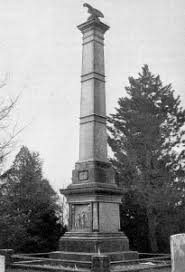


General Wooster Monument

One of my recent blogs was on Connecticut's General David Wooster who was killed in the fighting that followed the British/Loyalist raid on the arsenal at Danbury, CT. On June 17, 1777, Congress voted that a
suitable monument should be erected in his memory, but measures were never inaugurated to execute the resolution. His grave was not identified until 1854 when the Connecticut legislature laid the cornerstone of a monument. Today, a monument 30 feet high marks his final resting place at Mount Moriah in Danbury. Coincidentally, Wooster fought at Quebec as Montgomery's second in command and took much unjust blame for the campaign and its result.


Many argue that Philadelphia, our nation's first capital, marks the spiritual, political, and geographic center of the American War for Independence and in 1954 an impressive monument was built to commemorate those who fell in the war. The Tomb of the Unknown Revolutionary War Soldier is  located in
Philadelphia's Washington Square. It honors the thousands of soldiers who died during the American Revolutionary War, but especially those who were buried in mass graves in that park.
The actual  plaque upon the tomb of the Unknown Soldier reads: "Beneath this stone rests a soldier of Washington's army who died to give you liberty."

Tomb of the Unknown Revolutionary War Soldier
Philadelphia

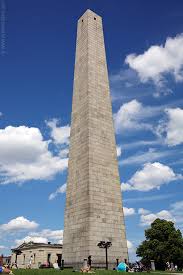
Bunker Hill Monument
Boston
If Philadelphia was the heart of the new nation, Boston was the heart and soul of the rebellion that forged the nation. The entire area is a virtual monument to the American Revolution but I'll single out one for this piece - the Bunker Hill Monument. The battle of Bunker Hill (which took place on Breed's Hill) is legendary, and for years General Washington (vainly) sought to replicate the scenario of entrenched Americans mowing down disciplined British troops who calmly marched into a hale of rebel lead. The first monument on the site was an 18-foot wooden pillar with a gilt urn erected in 1794 by King Solomon's Lodge of Masons to honor fallen patriot and mason, Dr. Joseph Warren. In 1823, a group of prominent citizens formed the Bunker Hill Monument Association to construct a more permanent and significant monument to commemorate the famous battle. The existing monument was finally completed in 1842 and dedicated on June 17, 1843, in a major national ceremony. The exhibit lodge was built in the late nineteenth century to house a statue of Dr. Warren.


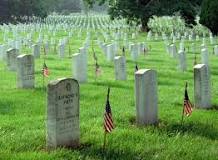
So this weekend and throughout the year, we should remember all Americans who died in their nation's service. But we should especially recollect those who died to establish the nation and the idea of a free and independent people. Wherever and however you decide to celebrate the occasion, take a moment to think of those who had no Arlington - the fallen at Saratoga, Brandywine, Brooklyn, Harlem, Paoli, Bennington, Germantown, Charleston, King's Mountain, Guilford Court House, Valley Forge, Yorktown, and hundreds of battlefields fields so small only the local patriots know of them. Give them a roaring "Huzzah" for duty well done.
Arlington