Followers

Sunday, November 10, 2013

First Patriots, First Veterans

In the Beginning


Society of the Cincinnati Crest
Before the Veterans of Foreign Wars, before the American Legion, and even before the Grand Army of the Republic, there was... the Society of the Cincinnati. The Society of the Cincinnati is America's oldest patriotic organization, founded in 1783 by officers of the Continental Army and their French allies who fought together in the American Revolution. Its mission is to promote knowledge and appreciation of American independence and to foster fellowship among its members. During the 18th century, Republican Rome was often seen as the model for an ideal society. So, not surprisingly, the Society was named after Lucius Quinctius Cincinnatus, who left his farm to serve as Roman Consul and held the title Magister Populi (with temporary powers similar to those of a modern-day dictator). He took lawful dictatorial control of Rome to lead the war effort. Once the battle was won, he returned power to the Senate and went back to tending his fields.

A Band of Brothers


Henry Knox
The Society's Founder
The idea of forming a society of officers originated with Major General Henry Knox, the chief of Artillery for the Continental Army. He viewed it as a way to strengthen the bonds among the army's officers, the "band of brothers," many of whom endured eight years of hardship during a struggle often considered hopeless. As the commissioners in Paris worked to set the terms of the peace treaty, Washington's main army stayed north of New York as a safeguard against a last-minute surprise attack by the British. The Continental Army was still poorly equipped, fed, and paid, and unrest among soldiers and officers grew. Therefore, the idea of the Society was to help unite the officers with each other and with the new nation.


A Society Formed


The first meeting of the Society took place in May 1783 during a dinner at the Verplanck House in Fishkill, New York. It was chaired by Lieutenant Colonel Alexander Hamilton, arguably one of the most organized men of his era! The members agreed to stay in contact after the war. Membership was generally restricted to officers who had served at least three years in the Continental Army or Navy; it included officers of the French Army and Navy, with membership passing to their eldest male heirs. Notably, members of the much larger state militia forces were not eligible to join, which later caused tension and opposition towards the Society. Officers in the Continental Line who died during the war were also eligible to be recorded as members.

First Patriot Controversy 


During its founding and the period immediately afterward, the Society faced distrust from many Americans, especially those who became the core of what would later be Thomas Jefferson's Republican Party. It was seen as the beginning of an aristocratic class aiming to make George Washington a king or dictator. The fact that members had to be direct male descendants of Continental Army officers did not impress most Americans. George Washington himself was aware of this and hesitated to take an active role in the organization that chose him as its president. Therefore, Henry Knox often stepped in when needed. Nonetheless, Washington served as the first President General of the Society of the Cincinnati from December 1783 until his death in 1799. His support for the Society's interests, along with his reputation, helped establish it during its early years. His backing and advice against aristocratic appearances were vital when there was strong opposition to the Society. Washington's leadership kept the Society stable and provided guidance during the first sixteen years of its existence.


The Society Today


Today, the society is a nonprofit organization dedicated to educating people about our nation's founding and promoting an appreciation of the principles of the American Revolution. Headquartered at the impressive Anderson House in Washington, DC, the society operates a small museum and library. It hosts a variety of public educational events, including lectures and book signings, concerts, themed wine tastings, and children's programs. These events explore aspects of the American Revolution, the society's history, and Anderson House, serving as an important part of its educational mission.

Anderson House 


Sunday, October 27, 2013

The Musket

The Shot Heard Round the World


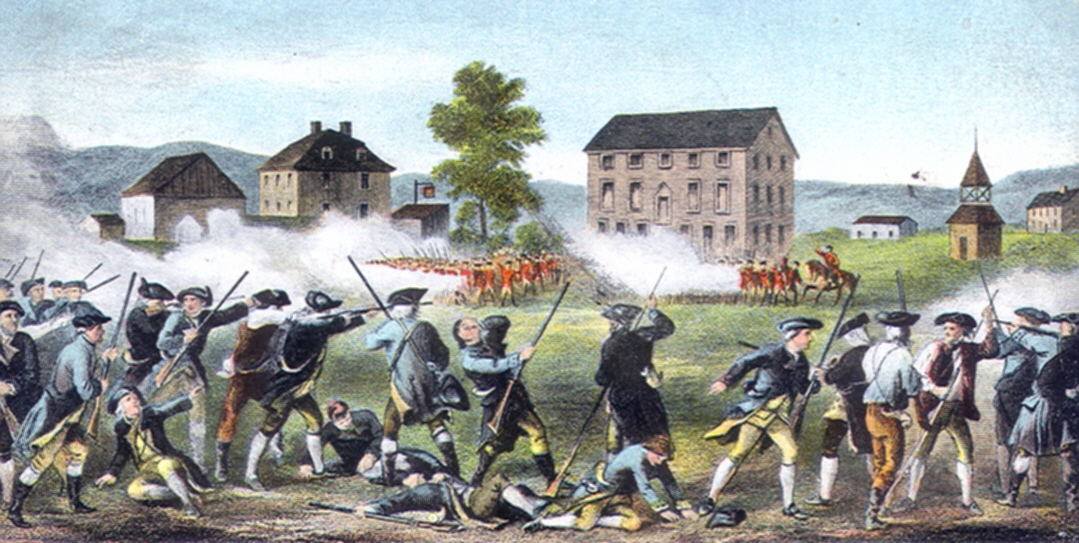
The weapon most closely associated with the American Revolution, that is, the times of the Yankee Doodle Spies is the musket. Regardless of who fired the first shot at Lexington Green in 1775, it most certainly came from the barrel of a smoothbore musket. The musket is an icon in American lore and its use during the struggle for independence (as well as before and after) has repercussions that continue right into today's politics and headlines.  Throughout history, certain peoples, certain cultures, certain societies have been linked to a specific weapon: the Romans carved an empire with the short sword from Iberia; the Mongols swept across Eurasia with the composite bow; Islam spread through the Middle East and North Africa on the edge of the scimitar.  And then there was the English longbow. The ubiquitous use of this simple yet elegant weapon not only presented English kings victories over more powerful opponents, it helped shape the status of the yeoman and thus helped forge a fledgling middle class of citizen warriors, in England. Ironically, the citizen warrior, transplanted to America would overturn a regime bolstered by paid professionals and hired mercenaries.


First Firefight: Lexington


What They Fired


Fast forward to colonial America. The culture of the longbow was forged into the consciousness of the Britons who settled America. Instead of a six-foot stave flinging yard-long arrows the settlers of the new world relied on the smoothbore musket using the French style flintlock firing mechanism.  These were at once simple, yet complex weapons. By the second half of the 18th Century, the most advanced flintlock muskets were made by the French but the English quickly followed their lead in design.  Then, as today, ease of manufacture and cost were factors affecting what type of weapon would be supplied en masse to troops in the field. In America manufacturing was restricted. The colonies were seen as sources of raw materials, not needed to compete with English shops and mills.  But America had plenty of gunsmiths and a burgeoning gun industry was in place at the time of the revolution.  But the exigencies of war required masses of weapons as the older model muskets from the French and Indian wars wore out or became obsolete. Where the British had a robust supply chain, America relied on weapons smuggled from offshore or captured on the field of battle. Add the German muskets to the mix and one begins to see a war that featured a variety of weapons. When the French and Dutch entered the war, America's supply of quality European weapons of all types, but especially muskets, improved greatly. And Americans did make their own line of weapons, often from European parts.


The Minute Man relied on his musket


A Gun for All Seasons


I don't have the time to delve into the multiple types of weapons used so I'll profile two of the most noted.   The British began the war still using the Long Land Service musket, sometimes referred to as the Brown Bess. It had a barrel length of 46 inches, weighed over 11 pounds, had a caliber of .753 inches, and fired a 490-grain ball charged by a 124-grain powder charge (although some of the powder was used to ignite the charge described below).  Its overall length was 62 inches. This presented a clumsy and but reliable weapon.  But by the  1770s, the British began replacing this with the Short Land Service musket of similar construction and technology (sic) but shorter a 39-inch barrel and a smaller charge. It had better balance than the Long musket although it was only a few ounces lighter.  The French had several muskets in use during the time of the revolution, many made at the famed Charleville works - all 60 inches in overall length. They were 1773, 1774, and 1777 muskets.  Each weighed around 9 pounds and had a barrel length of 44 3/4 inches. The caliber was .69 and which, like the latter version of the Brown Bess, were carried by French infantrymen through and beyond the Napoleonic Wars. There were many, many types of muskets used besides these and I haven't accounted for carbines, fusils, naval muskets, and rifles.  More on all these later.

Muskets were the basic weapon of both sides


How They Fired


The weapon was simple but the firing process complicated.  Normally, the powder and ball (a lead bullet that ranged from a half to three-quarter inch in caliber), combined in a paper cartridge. The shooter began the process by biting off a piece of the powder end of the cartridge and pouring some of the black powder into the flintlock's firing pan. He then rams the ball and powder cartridge (powder side first) down the barrel, brings the weapon to his shoulder and pulls the trigger hoping that the hammer's flint, striking the firing pan's frizzen (steel plate) would actually spark and ignite the powder causing an explosion of the charge in the barrel and propelling the projectile downrange (so to speak). Now, there were numerous other variables that could complicate an effective and accurate shot: like putting the hammer into full cock, following the rigid manual of arms (when with a trained body of men), weather conditions, powder build-up, smoke, and, oh yes, enemy fire. Theoretically, a well-trained soldier could fire five such shots a minute.  In reality, only two or three were achieved in the heat of battle. Accuracy was not a factor for the British who drilled their men to fire in volleys at masses of the enemy.  But it was for the Americans, who had fewer resources and made every attempt to make each shot count. The British did however have light infantry units and Loyalists who tended to fight more like the rebels. How accurate could they be? A trained marksman could theoretically hit a target at 75 yards but the British line infantryman was trained to point his barrel at the enemy without aiming - the volley would take care of that for him! 


Saturday, October 12, 2013

Loyal to a Fault?

A House Divided


The American Revolution was as much a civil war as a rebellion. Yes, the colonies rebelled against the king and parliament's laws, but not everyone joined the rebellion. Most who did initially fought to defend their rights as Britons. Many others (some say most) stayed indifferent. Although it lacked grand capitals or palaces like in Europe, America in 1775 was thriving. 

The Atlantic coast was a network of small cities and towns, with many well-maintained farms between them. In the south, many (but not all) of these were cash-crop plantations. Trade was expanding, and merchants were making money. People were prosperous and healthier than in Europe, thanks to the economy, a better diet, and less crowded living conditions. In 1775, the American colonies likely had the best standard of living in the world. Many viewed this prosperity as a direct result of America's position in the British empire and saw no reason to risk it all. Then came the taxes to fund the war against the French.


Who are these people?


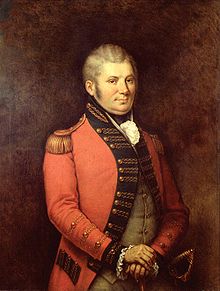
John Graves Simcoe

The Loyalists (and initially many patriots) saw themselves primarily as British subjects loyal to their King. Politically, they were Tories. For many, this almost ended any debate about America's status and shifted the focus to how best to preserve certain British liberties. Many Loyalist leaders, like Joseph Galloway of Pennsylvania, passionately pushed for a political solution to the conflicts. They wanted Americans to keep their rights and gain self-rule within the British Empire. 

One can only imagine the emotions swirling as their fellow countrymen, Whigs (the patriots), gradually but surely decided on a full split. Imagine that sickening feeling of watching your country, your world, slip away from you. Still, few Loyalists thought the outcome would be anything but the King victorious. That made the ending an even more bitter pill to swallow. 

Some pundits have observed that at the start of the war, loyalty was divided roughly 30-30-30: one-third rebel, one-third loyal, and one-third neutral. I believe these figures fluctuated with the changing fortunes of the war and the proximity of the British Army. However, many so-called neutrals, in my view, were not truly neutral. This provides a good starting point, but the situation was more complex. Certain regions, like the Mid-Atlantic, tended to have more Loyalists than areas like New England. The South was more evenly divided, as the brutal fighting there shows. As the war went on and France joined on America's side, Loyalists made up between 15 and 20% of the 2.1 million white inhabitants in the colonies.


Why Remain Loyal?

For the Loyalist, it was all about loyalty. I know, it sounds clichéd, but those who remained loyal throughout the eight-year war were men and women with a worldview that supported an ordered state, the foundation of which was a monarch reinforced by royalty, the nobility, and the upper classes. Loyalists were content with the world they lived in and did not welcome the upheaval caused by rebellion. They looked down on the extremism shown by the patriots.


Local Loyalist Militia


The Loyalists took pride in Britain's superior form of government, characterized by representation in two houses of Parliament and a constitutional monarch as the head of state. They also valued the sense of order that came with the class system. The British had defeated the hated French in the Seven Years' War and in the French and Indian War in America. The "empire" had not yet reached its peak (which would happen around 80 years later), but the King indeed ruled over a growing global empire built on mercantile trade. Trade from which they and all "good Britons" profited. Who could argue? And who would give that up? Who indeed...


What did they Contribute?


The Loyalists were both a blessing and a burden to the British generals leading the war in America. In some ways, they served only as a placebo. British authorities were constantly reassured by key Loyalist figures that most Americans supported the King and were, at worst, neutral, making them easier to win over. As a result, little genuine effort was made to win the hearts and minds of the Americans. In some respects, the idea that loyalty could be coerced was mistaken; this approach assumed the rebellion could be defeated solely through British strength. Loyalists eagerly played their parts, forming regular units similar to the patriot Continental Line and maintaining various local Loyalist militias.


Cowboys Capture a Patriot


In the guerrilla conflicts known as the "Cowboy versus Skinner" fights, the Cowboys were involved. Loyalist spies and sympathizers were omnipresent, ready to inform a British commander about the positions of the hated rebels. Combined with the world's most powerful army and navy, this should have made suppressing the rebellion quick and straightforward. In terms of numbers, Loyalists under arms were substantial. Throughout the war, an average of 10,000 Loyalists served in well-organized and well-equipped "regular" units called Provincials, who were equipped and organized similarly to British regulars but typically wore green jackets. This does not include numerous Loyalist militia groups, which fluctuated in response to the ebb and flow of the conflict.

Loyalist Provincial Infantryman


George Washington would have traded all of Mount Vernon for that number in the Continental Line. According to most accounts, Loyalists of all kinds fought valiantly. Despite lacking as many top-tier leaders as the rebels, they still had some very talented ones, such as Colonel John Graves Simcoe (Queen's Rangers), General Cortland Skinner (New Jersey Volunteers), General Oliver Delancey (Volunteer Corps), and Colonel John Hamilton (North Carolina Volunteers). In certain theaters, especially in the South, Loyalist irregulars were considered even more effective fighters than Loyalist regulars.


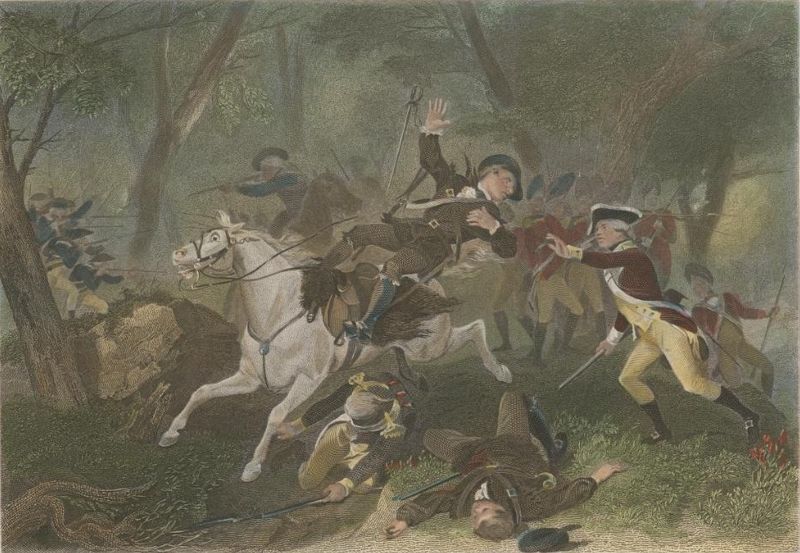
Loyalists fought ferociously but vainly in most battles
especially at King's Mountain


What was their Vision?


Loyalist plans for America's future focused on some form of local representation within the British Empire. In the early days of the political struggles, before open rebellion, that was the overwhelmingly popular view in all the colonies. But after Lexington and Concord, the slippery slope became even more treacherous as the British made mistake after mistake. When the scales tipped toward rebellion, the Loyalists had to improvise both politically and militarily.


Tarleton's American Legion: Loyalists in Action


However, they never had a solid plan or a clear strategy. Why would they need one? They were, after all, Britons. They possessed overwhelming power — the King, his wealth, and his military might. I believe that was ultimately their downfall.

Over-reliance on British authorities, both military and civil, made the Loyalists complacent and even dependent. Since losing to the rebels seemed unthinkable, developing a thorough Loyalist alternative never truly materialized. It certainly wasn't clearly communicated to the public. Conversely, as the war progressed, the British grew increasingly less confident in Loyalist political and military support. By the end of the war, the British saw the Loyalists as a nuisance, and the Loyalists grew resentful of their benefactors.


What was their Fate?


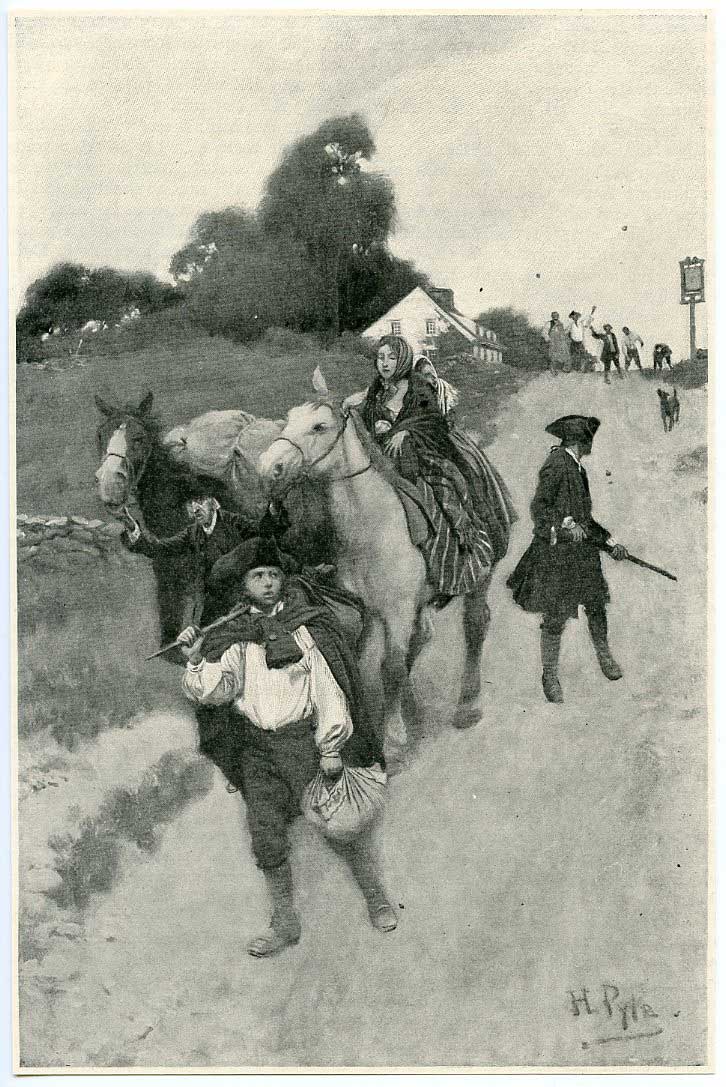
I plan future deep dives into the Loyalist cause but obviously - they lost. They lost big time:  land, slaves, homes, families, and pride. With bitter and despondent hearts, some 80,000 or so left the 13 colonies for "British" lands such as Canada, East Florida, the West Indies, and Great Britain itself. Their struggle continued as the now largely impoverished diaspora was treated poorly by its one-time benefactor.


Loyalist refugees flee to
Canada (most went by ship)

Sunday, September 22, 2013

How they Fought

Mongol Warriors 

Myth


Most wars have more than their share of urban legend, mythology, and plain old disinformation. Sometimes it is deliberate.  For example, the Mongols encouraged and spread myths about the size of their armies,  The results:  just the idea they were coming caused many cities, kingdoms, and peoples to surrender without a struggle. Always the best way to win wars. I'll use the myth busters theme to debunk or discuss some of the popular myths of the American Revolution of which there were not a few. After all, the 18th century in general is a misunderstood period of history - calling it the Age of Reason comes to mind as one myth.  Reason has been around since man walked the earth. It is how he reasons that has changed with the advent of the printed word and literacy that expanded in the 1700s.

Soldiers


Thought I would begin with some musings on how the armies fought during the war. Here the myth centers around the indomitable and indefatigable American patriot using his frontier skills against an unimaginative and drone-like British soldier. The patriot is most usually a "Minuteman," citizen soldiers expert with the
famed long rifle picking off stupid redcoats and oxen-like Hessians. Yes, there really were Minutemen (in Massachusetts), and the militia was the mainstay of the Cause. When they performed well, things generally went well. But their performance (and reliability in terms of sticking around) was sketchy throughout the war. Perhaps we'll go into the why in a future blog but the fact is the militia, in a pitched battle, had a poor record.

Tactics


This leads to the myth of the war being an irregular conflict. The military leadership of the Americans, beginning with General Washington, attempted in almost every case to fight a "Euro" style of war. In the 18th century that meant either a war of "posts," attacking or besieging strong points, or attempting to defend the same. If a war of "posts" was not waged, then a war of maneuver and the open battle was desired. Washington favored the latter. Remember, most of the American senior leadership had fought in the French and Indian War as British soldiers.  They studied and learned British tactics, techniques, and procedures. Although Washington never received the British Army commission he sought, he fought with them in Braddock's failed campaign against Fort Duquesne, and later organized the Virginia militia along British lines. Conversely, the British learned a lot about woodland warfare during the French and Indian War. Their flank companies, light infantry, and grenadiers were adept at irregular fighting and as the war progressed, the line units adapted as best they could. In addition to European -style volley fire, both sides resorted to individually aimed fire, depending on the tactical situation, terrain, etc.

                                                        British infantry fighting in forest


Leaders


Battle of Camden
Several Senior American officers had been British regulars in the Seven Years War.  Charles Lee, a former British officer, became Washington's second in command.  Horatio Gates became commander of the Northern Department where he won laurels at Saratoga, and the Southern Department where he was disgraced at Camden.
So the American ideal was to fight the British Army as a "regular" field army and not a "rabble in arms."  The American counter to the British regulars and Hessian mercenary was the Continental.


The Continental


Sunday, September 8, 2013

The Boat

Fans of the fabulous German naval flick Das Boot should not necessarily be disappointed by my little bait-and-switch. As I write this blog, it is the anniversary of the first submarine (sort of) attack in the American Revolution.


Development of a Secret Weapon


David Bushnell
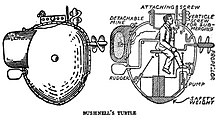
The history of weapons development in Connecticut is long. The Nutmeg State has been a center of weapons development from colonial times through modern times. Think Colt, Norden, etc. In the early 1770s, a Yale man named David Bushnell began developing underwater explosives. When the war with Britain erupted, he turned his efforts toward a delivery system. He moved his work to Old Saybrook, Connecticut, where he developed a submersible boat that could attach one of his underwater charges to a ship. Bushnell named his boat the Turtle, although it looked more like a shellfish. The Turtle measured 10 feet by 3 and 6 feet tall. Letting water into a bilge tank lowered the Turtle into the water. It climbed when a hand pump evacuated the water. Crude hand-cranked propellers moved the boat. The Turtle held a crew of one and could operate underwater for thirty minutes at three miles an hour.


Diagram of the Boat


In the summer of 1776, the British invaded New York and seized western Long Island (see my highly acclaimed novel, The Patriot Spy), so Bushnell's boat was moved back to Connecticut. The Americans, driven from post to post by superior British soldiers, weapons, and discipline, were even more outmatched by the Royal Navy. Desperate times called for desperate measures.       


British landing at Staten Island
                             

The Black Operation


In a secret operation (the term "black op" had not yet been coined), approved by General George Washington, an expedition aboard the Turtle was launched in New York Harbor. An hour before midnight on September 6, Sergeant Ezra Lee began his daunting mission: to navigate the untested Turtle through hazardous waters in an attack on British Admiral Richard Howe's flagship, HMS Eagle. We know Howe from earlier posts. Black Dick was the brother of William Howe, the British commander in chief in North America. Taking out his ship (and possibly him) would be what we today call an asymmetrical attack

The Turtle takes on the Eagle


The Eagle was moored near Governors Island, just off the southern tip of Manhattan. Yankee rowboats towed the Turtle from the Battery to within striking distance of the British ships at anchor. Lee struggled to navigate for over two hours, and his chances seemed bleak. Then suddenly, the river's tidal currents subsided. Lee, against all odds, reached the Eagle! He tried to fix an explosive charge to the hull, but he failed. The Turtle's boring device struck metal - likely a plate connected to the ship's rudder. Tired and struggling to stay afloat and breathe, the undaunted Sergeant Lee tried once more to pierce the hull. However, he was unable to keep the Turtle beneath the ship.


Treachery


Unknown to Sergeant Lee (or George Washington), a spy had alerted the British to the possibility of an unconventional attack. Expecting subterfuge, alert British soldiers on Governors Island spotted the submarine and rowed out to investigate in the dark waters. Rather than risk capture or an unwanted explosion, Lee cut loose the "torpedo," a specially designed explosive device intended to sink the Eagle. The torpedo floated half-submerged toward the approaching British boat. Fearing the worst, the British turned their longboat around and made straight for Governor's Island. Sergeant Lee, meanwhile, pedaled madly toward the safety of The Battery. Fortunately for the British, the torpedo was caught in the strong currents at the confluence of the North (Hudson) and East rivers and exploded, sending plumes of wood and water high into the dark September sky. But fearful of another such attack, the British ships pulled anchor and moved to the upper bay

A spy may have alerted the British


Both Ezra Lee and David Bushnell went on to serve in other battles and campaigns. Sergeant Lee served in several pitched battles: Trenton, Brandywine, and Monmouth. Bushnell led several other "mining" operations along the Delaware River and served at Yorktown. His torpedoes wreaked havoc near Philadelphia.


Bushnell also received a medal from the commander in chief after the war. Many "black operations" were only grudgingly recognized by Washington, and all of them were acknowledged after the conflict. His Excellency understood that secrecy must be maintained before, during, and after covert operations. Bushnell moved to Georgia after the war, where he died. After the war, Lee returned to Connecticut. Remarkably, both men lived into the third decade of the next century.

What Gives?


Most of the account of the attack comes from Ezra Lee's report. Of the events of the night of September 7th, 1776, the British logs are strangely silent. They record no rebel attack nor any explosions in the vicinity of the Eagle. So what gives? Did this actually happen? It seems implausible that Lee (along with Bushnell) would concoct a tale of failure...or would he? 

Another attack was tried a month later with similarly disappointing results. It is axiomatic that proponents of a program zealously pursue it, sometimes fudging figures or achievements to maintain support. Or did the British keep the attack secret to protect their spy? Would they forgo the obvious propaganda value of exposing a foiled attack? Were they hesitant because they were unsure that future attacks might succeed? Then there is the matter of historiography: some British naval historians assert that the Turtle could not have sustained itself and navigated as the Americans claimed. So they believe it was a hoax. If so, this would not be the last hoax operation in America's military history. Maybe the hoax was on them.


Another rendition of the Boat


Sunday, August 25, 2013

The Red Lion Inn

Most Americans are familiar with the American Revolution in New York. Still, even fewer are aware of the war on Long Island, which in 1776 encompassed the area on Long Island today known as Brooklyn. Sadly, those who actually live in the "How Sweet it Is" borough (also known as Kings County) may know the least.  History is ultimately about people and places, yet most Americans know little of their local history. I confess to sometimes falling into that category.  I blame the localities, not the schools, for failing to properly celebrate themselves.  Okay - rant over. Time to discuss a place, specifically a building, that was center stage for a few hours during the largest battle in the American War for Independence.


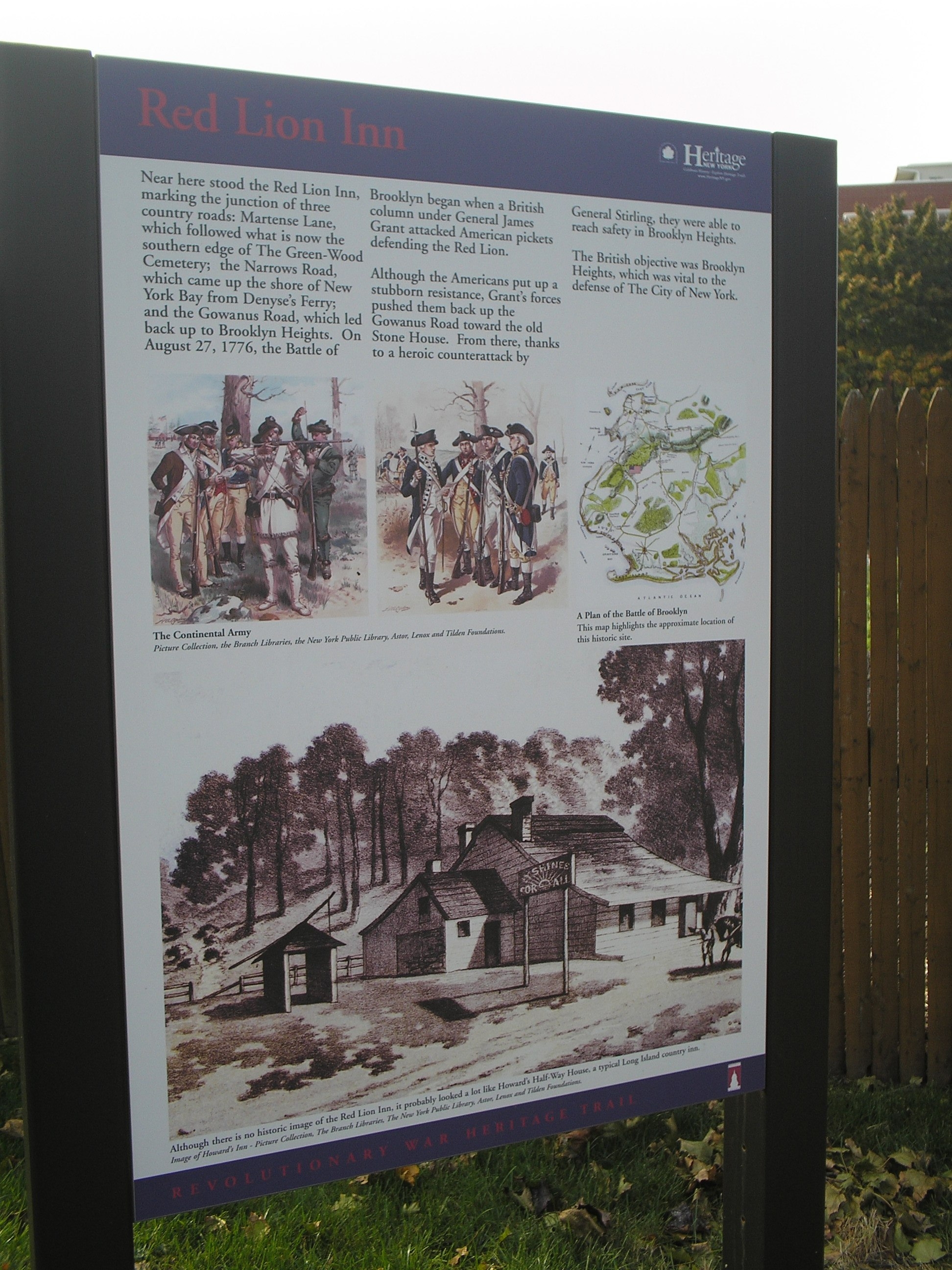
There is no existing image of the Red Lion Inn.
The building itself is Howard's Tavern located at the Jamaica Pass
Both were half-way houses.


The Tavern


The Red Lion Inn was named after the tavern where English King Henry V rested after defeating the French at the Battle of Agincourt. It is fitting that the first action in the first major British victory of the American Revolution took place near the inn. The Red Lion Inn was located at the junction of three country roads: Martense Lane, which followed what is now the southern edge of Green-Wood Cemetery; the Narrows Road, which came up the shore of New York Bay from Denny’s Ferry; and the Gowanus Road, which led back up to Brooklyn Heights. This area is roughly 39th Street and 3rd Ave. in Brooklyn, although other accounts place it on 4th and 40th. I refer to Mark M. Boatner's "Landmarks of the American Revolution" as my guide. Boatner states that many battle markers in Brooklyn are imprecise, and I agree. You can read an earlier blog of mine about my personal visit to that part of Brooklyn a few years ago.


The passes and the British flank march around the Americans.
The Red Lion lay along the Flatbush (western-most)
pass on the left


The Action 


Gen James Grant
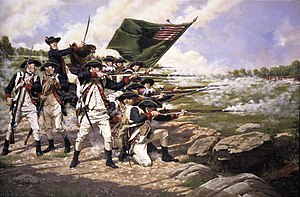
On August 27, 1776, the Battle of Brooklyn started when a British column led by General James Grant attacked American pickets defending near the Red Lion Inn. Some accounts say the British were foraging for melons when they startled a rebel picket. It was in this, the westernmost pass, that American Major General William Alexander, a Jersey native also known as "Lord Stirling," stood with the largest force defending the Heights of Guan. The British commander was General James Grant, a Scotsman known for his stout heart and physique. Grant hated rebels and urged his men forward with a ferocity rarely seen from the British. His column of about five thousand professionals rolled into the pass, thirsting for action. But Lord Stirling managed to organize some of the Americans into a line of battle on a piece of high ground just off the Gowanus Road. He was joined by a two-gun artillery battery that covered the road. Grant's troops formed into battle lines—creating maximum volley fire at the front—and advanced up the road. This was perhaps the first open-field battle of the war. Stirling held a strong position, and the initial British assault was repelled by American musket fire and cannon shots. Grant then brought up some of his guns and bombarded the American position. His goal was to pin the Americans while a larger part of his forces completed their envelopment. Later, Grant sent a force to the left of the road, but Stirling countered with a detachment that stopped the British.


Lord Stirling


The  Finale


From 7 to 11 a.m., the Americans resisted stubbornly, but eventually, Grant’s forces pushed them back up the Gowanus Road toward the old Stone House. From there, thanks to a heroic counterattack by Lord Stirling, the remaining Americans managed to reach safety in Brooklyn Heights, the British objective, which was crucial for defending The City of New York. Stirling led 400 men from the Maryland and Delaware Continental Line in several frontal assaults on the British troops who had outflanked the defenders and now blocked their way. All but nine were killed, wounded, or captured in the fight. From those Heights, George Washington watched one-third of his force get wiped out. This is the pivotal event in my novel, The Patriot Spy.


Delaware Regiment on Long Island


A Factor?


The Red Lion Inn was not a factor in the battle, unlike the Old Stone House. However, it served as an important landmark. During a time when maps were scarce and often inaccurate, this was significant. Orders frequently referenced landmarks such as bridges, mills, taverns, or farms. Consequently, accounts from both sides mentioned "the Red Lion" or "the Red Lyon" to describe their locations during certain phases of the battle. One might imagine a sign hanging out front showing a red lion, since many taverns used visuals at a time when most men could not read.


Marker at Greenwood Cemetery commemorating
action near the Red Lion Inn (note: Howard's Tavern is the visual)

Saturday, August 10, 2013

How(e) did he lose?

Okay, sue me. I’m the king of bad puns. But today, August 10th, is Lord Howe's birthday, so let's move on to the main topic. With a formidable professional army, paid German mercenaries (the world's better fighters), a large Loyalist following, real money, and the best navy in the world—how could Lord William Howe lose his job and set a trend that led to an impasse and eventual defeat by the pitiful rebels in America? Howe took command of British forces in Boston in 1775, replacing General Gage, whose failures included Concord and Bunker Hill. Howe's leadership shaped British actions from then until his recall in early 1778. When his reinforcements arrived, he commanded the largest force England ever sent to America during the trying times that tested men's hearts.


William Howe


Let's examine William, the 5th Viscount Howe, before discussing his death. We can begin with his background. William Howe was born on August 10, 1729, to the 2nd Viscount Howe and Charlotte Von Keilmansegg, daughter of the Countess of Leinster and Darlington. This connection helped launch him and his two brothers into notable military careers. But it gets better—his grandmother was the illegitimate daughter of King George I, making him a cousin to George III. Whether illegitimate or not, connections—including land and titles—carried significant weight in Georgian England. Howe and his brothers served their kinsman, King George II, during the Seven Years’ War (the French and Indian War). 

William rose to command the 58th Regiment of Foot as a lieutenant colonel. To say he served bravely and effectively is an understatement. At the siege of Louisbourg in Nova Scotia, he led an amphibious landing that earned him praise. Howe's greatest achievement in the war (though not his last) was leading a force of elite light infantry up a steep, narrow trail that climbed the cliffs overlooking the St. Lawrence River. His bold move under the cover of darkness surprised the French and helped General Wolfe's army defeat the Marquis de Montcalm on the Plains of Abraham outside Quebec. This victory ultimately placed French Canada under British rule. Later in the war, Howe achieved further successes in Canada, France, and Cuba.


 Howe's brother George, a general, died during the French and Indian War, and William took his seat in Parliament in 1757. His politics were, as they said back then, "Whiggish." The Whig party, while not as liberal as today, supported limits on the King's authority. He was sympathetic to many American grievances and kept that sympathy throughout the American War for Independence. When he assumed command of the British forces besieged in Boston, Howe was promoted to lieutenant general in January 1776. 

Howe was a thorough planner and understood tactical, operational, and strategic warfare better than most of his peers. He was well helped by his equally wise brother, Admiral Richard Howe. Richard, called "Black Dick" by Royal Navy sailors because of his dark complexion, was a daring and charismatic leader. With more reinforcements on the way, the Howes started a strategy to isolate New England from the other colonies instead of trying to conquer it. A large naval maneuver moved his forces to Newport, Rhode Island, and from there launched an "envelopment from the sea" on New York, through Staten Island and Long Island. This campaign served as the background for my novel, The Patriot Spy.


The Howe brothers organized multiple amphibious landings, sieges, and sweeping flanking maneuvers under cover of darkness, and they won several pitched battles. Truly, a masterwork of combined arms warfare in 18th-century style! Howe eventually took New York and pushed Washington's army across the Jerseys in a blitzkrieg-like manner. 

Howe liked Americans (but not rebels), so in the Jerseys, Howe's whiggish tendencies led him to attempt a clumsy form of rehabilitation that, had it succeeded, might have ended the war. But it didn't, and his grand maneuvers, successful assaults, and (not so) hot pursuits ultimately failed. To top it off, Howe's decision to move south in his own campaign against the rebel capital at Philadelphia sealed General John Burgoyne's fate at Saratoga in 1777, which proved to be the turning point (sorta) in the war.


Howe liked Americans so much he took one as his mistress. Mrs. Elizabeth Loring was the beautiful young wife of Loyalist schemer Joshua Loring, who traded his wife's charms for a position as Commissary for Prisons, a post that offered Loring opportunities for graft at the expense of his charges. The starvation and disease that plagued American prisoners throughout the war attested to that fact. Howe's interest in his amiable companion led to accusations that she was causing him to linger so long that victory might slip away from the grasp of the victorious British. Many ribald poems and ditties were crafted by citizens and soldiers to celebrate the affair and poke fun at Howe.

One such ditty went...

Sir William he,
snug as a flea,
Lay all this time a snoring,
Nor dreamed of harm
as he lay warm,
In bed with Mrs. Loring.


And another...

Awake, arouse, Sir Billy, 
There's forage on the plain. 
Ah, leave your little filly, 
And open the campaign.


So where did Howe fail? Simply put, he was not a closer—except, it seems, in bed. He also lacked the respect of his two main subordinates, Charles Cornwallis and Henry Clinton. Howe sometimes moved at a sluggish pace. The blitz across New Jersey was led by the vanguard under General Cornwallis. Throughout Howe's campaigns, Cornwallis and Clinton often chafed and complained that Howe was missing decisive follow-up. 

Howe's slow approach repeatedly allowed George Washington's forces to escape. Confident of victory, Howe preferred a steady, methodical approach, hoping to reconcile the rebels. Although he outmaneuvered and outfought Washington from New York to Philadelphia, he never managed to defeat him completely. Washington endured two harsh winters, fearing Howe would attack his weakened Continental Army, but he ultimately escaped.


Henry Clinton


The surrender of Burgoyne's army sent shockwaves from Horse Guards to Hampton Court. Parliament erupted in reaction. Maintaining professional armies was expensive, and the Royal Treasury had its limits. Sensing the pressure, Howe resigned as the winter of 1777-78 drew to a close. His occupation of Philadelphia offered no strategic benefit to the British war effort, and Lord George Germain, the Minister for the Colonies, accepted his resignation. With Charles Cornwallis back in England to care for a sick wife, General Henry Clinton was set to take command.


The story ends in a strange way. Howe was sent off with a wild and costly farewell party called the "Mischianza." This was a Bacchanalia-like mixture of music, plays, exotic costumes, and women dressed in elaborate outfits. The event concluded with a grand revue featuring fireworks and plenty of food, drink, and merrymaking. The organizer was Major John Andre, who would later become known for recruiting the spy, Benedict Arnold. Many British officers attending the Mischianza thought it was an over-the-top display of luxury during a wartime period of hardship. Sir William Howe went back to England and held a series of pretty unremarkable positions until he died in 1814.