Followers

Sunday, May 31, 2015

The Liberty Pole

Liberty Pole as Symbol


For many colonists, the patriot cause in fighting for independence from Great Britain represented liberty. Patriots believed that representation in government, economic freedom, and personal liberties defined true freedom. However, this view was not shared by everyone. The fight for American liberty involved an ideological struggle between neighbors and brothers, and in some regions, just as many people loyal to the King as there were patriots. Many doubted which side was right or wrong. These individuals were undecided at first. 

Unfortunately, just as today, some people were indifferent, and many shifted their loyalties from patriot to Loyalist depending on who controlled the area. Not everyone believed the best way to achieve individual freedom was to establish a new government. Many colonists thought that, as Englishmen, the King would protect their rights, and anything else was considered treason. To some, the Liberty Pole symbolized freedom; to others, it represented treason. Stark differences.

Liberty Tree: Boston
But the Liberty Pole actually started as a Liberty Tree. The original Liberty Tree was a large elm tree in the South End of Boston. Angry Boston citizens first used it around 1765 as a rallying point during the Stamp Act crisis, when the British Parliament was threatening a tax on paper goods like legal documents and newspapers. 

The Sons of Liberty, an organization founded in Boston by Samuel Adams to protest British taxes, saw their membership grow quickly across the colonies. As the movement spread from Boston, the Sons of Liberty continued the practice of gathering under a large tree, which was present in many village greens, and these came to be called Liberty Trees. 

Their goal was to shape public opinion and coordinate patriotic actions against Britain. In towns without a sufficiently large tree, patriots sometimes erected tall poles to symbolize a Liberty Tree. These became known as Liberty Poles. Most Liberty Poles were set up in town squares, the centers of civic life, often as tall as 100 feet. These squares served not only as gathering places but also as symbols of resistance to British rule.


Erecting a Liberty Pole G, Goshen, New York


In New York City, where some of the earliest battles of the Revolutionary War eventually took place, there was an ongoing fight over the Liberty Pole. In May 1766, when news spread that the Stamp Act had been repealed, the Sons of Liberty celebrated by erecting a Liberty Pole. It became a rallying point for large meetings and a symbol of the American struggle. In June, two regiments of British soldiers arrived in New York City and were housed in the upper barracks. These troops cut down the liberty pole on August 10th. A second and third pole were erected and also taken down. A fourth pole was raised and encased in iron to prevent it from being cut down again.


First Liberty Pole in New York City

Liberty Pole as Place


And that place would be New Jersey, in a time long ago: before the Sopranos, Bridgegate, or even the Turnpike. In present-day Englewood, New Jersey, there stands a pole erected in 1964. It is believed to be at or near the site of an earlier pole erected almost 200 years earlier to celebrate the repeal of the Stamp Act. This event was more than symbolic, as it served as a catalyst for further action in the defense of liberty in the Hackensack Valley, a hub of political agitation and warfare. The "English Neighborhood" (which included today's City of Englewood) in New Jersey was part of the larger Patriot and Loyalist conflict in the state. Even the name, "English Neighborhood," reveals the division among the people in the valley. The Dutch settlers named it to highlight its position as the settlement closest to the foreign English in Manhattan, then called the Island of New York.

Even before the fighting started, neighbors disagreed on issues of religion and government. The spot in the "English Neighborhood," known to all the colonists (including George Washington) as Liberty Pole, would become a key symbol of liberty. But on November 20th, 1776, the Liberty Pole witnessed a time of great despair. The valley was a strategic crossroads connecting New York City, Long Island, the west, the Hudson Highlands, and the south. 

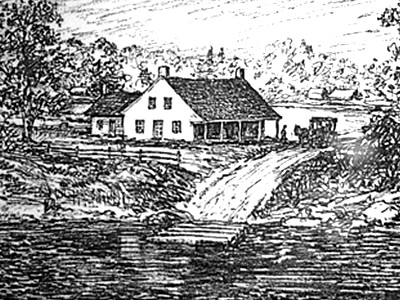
Along with the waters of the Hackensack, the Kings Highway ran north-south before turning west. At this junction stood a tavern that became the focus of much social, economic, and political activity. In 1776, the inn’s owner, a passionate patriot, followed the example of the Liberty Boys in New York by erecting a Liberty Pole topped with a gold Liberty Cap to celebrate the repeal of the Stamp Act. Known as the Liberty Pole Tavern, the inn was a center of activity, and the surrounding area was also called Liberty Pole.


Watching the Hudson from Fort Lee


Although no major battles occurred here, events crucial to the American cause took place in Englewood. On the night of November 20, 1776, British General Lord Cornwallis crossed the Hudson River with nine thousand men to what is now Alpine, aiming to capture the rebel forces at Fort Lee, commanded by Nathaniel Greene. General Washington, aware of the plan, led his army from Fort Lee down the King's Highway to the Liberty Pole Tavern, then veered onto what is now Teaneck Road toward New Bridge, where he managed to cross the Hackensack River. 

By summer 1776, the fight for independence with real armies pushed closer to the English Neighborhood. The British drove George Washington's army from Long Island and lower New York across the North (Hudson) River. For a time, Washington made his headquarters in Hackensack, trying to organize a defense against a British attack up the Hudson River. He ordered the arming of forts on both sides of the river, Fort Washington and Fort Lee. On November 16, 1776, the British captured Fort Washington in upper Manhattan, leaving Fort Lee unsupported and allowing the Royal Navy free movement up and down the river. The fall of Fort Lee as a defensive outpost was imminent. 

Washington realized he would be vulnerable to a British attack and faced the decision to move his declining force of 2,000 men across the Hackensack—by ferry or via the one bridge located in River Edge at New Bridge. During this crisis, Washington was criticized, and his army’s morale was low. Recognizing Washington's predicament, British Commander Lord Howe permitted Lord Charles Cornwallis to launch an amphibious attack on New Jersey, just miles north of Fort Lee. 

They moved on the night of November 19, 1776. The next day, Washington learned of the British invasion and quickly rode to Liberty Pole. There, he planned to meet General Greene, the commander of Fort Lee, and his men, who were evacuating the fort. The British were about 2 miles away in Tenafly. Most of the soldiers marched together (down what is now Grand Avenue in Leonia) until reaching Liberty Pole and Washington. Amid the chaos of the retreat, some soldiers were ordered to secure the


Cornwallis moves across the North River (Hudson)  to the Jerseys


As the exhausted American army withdrew from the Jerseys, the area around Liberty Pole entered a different kind of warfare—one that symbolized the fight for independence even more than the pitched battles described in most accounts. It became a war of political intrigue, espionage, sabotage, and small skirmishes. Raids were carried out. Loyalties were questioned, as many of the Dutch were at best ambivalent about the struggle. Spies operated and were caught. Chaos and disorder spread throughout the area around Liberty Pole. 

The conflict simmered continuously, flaring up into brief, fierce bursts of action whenever the armies returned. Liberty Pole became the site of a notable skirmish later in the war. In 1779, a tired but resilient band of troops under the famed General "Light-Horse Harry" Lee courageously defended against Tory attacks as a Patriot force returned from a successful raid on the Paulhus Hook, what is now Jersey City. The raid on the Hook was only partly successful, but Lee's boldness and his successful retreat across the Hackensack River earned praise from General Washington and gratitude from Congress.


Light Horse Harry Lee's rear guard fought
bravely at Liberty Pole


In 1780, Washington’s Army was in the Hudson Highlands, and the forward lines around Tappan drew the attention of spies from both sides, Tory bands, militias, Continentals foraging, and various bandits. A British pardon lured American deserters from the Highlands, giving British intelligence a wealth of information. In one recorded act of reprisal, a raiding party of American militia marched down the valley to Liberty Pole and captured several deserters. These examples illustrate the type of fighting that took place around the pole and throughout the valley during the long fight for America's independence.


Sunday, May 10, 2015

Mother of Her Country?

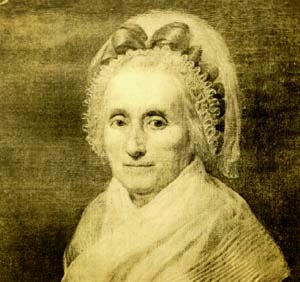
Mary Ball

Happy Mother's Day


I was not going to write a blog for Mother's Day, but I thought at the last minute a small piece on George Washington's mother would be in order. The lady, born Mary Ball in 1708 or 1709 in Lancaster County, Virginia, is a fitting subject. She was the only child of Joseph Ball and his second wife, Mary Johnson.  Joseph Ball was a leader in the militia and a ranking justice on the Lancaster County court, making him a member of the gentry class.  He was also elected to the House of Burgesses in 1695 and served until 1702.  Mary Johnson was a young widow who caught the eye of Joseph Ball.  At the time of their meeting, she was most likely a housekeeper for the Ball family.


Mary's Early Life


Mary had good prospects of being born into Virginia-landed folk. For the first few years of Mary’s life, she was raised at her father’s plantation, “Epping Forest.”  But life would turn on her at an early age. Her father died when she was three years old and left Mary three slaves, fifteen cattle, a good feather bed, and 400 acres of land up the Rappahannock River. Mary's mother remarried Captain Richard Hues, and they moved to Cherry Point on the Potomac River.  When Hues died, he left all of his assets to his wife and her children. But Mary Hues herself died when Mary Ball was twelve. Mary was then placed under the guardianship of Colonel George Eskridge, a lawyer, under the terms of her mother's will. Although under
Colonel George ESkridge
Eskridge's guidance, Mary continued to live at Cherry Point with her sister Elizabeth Bonum, not with her guardian.  Mary had three horses and numerous acres of land by age eighteen. As part of the landed gentry, she learned social graces and to ride, handle a boat, and shoot. Clearly, her streak of independence was forged during this period. When John, her half-brother, died in 1721, Mary also received 600 acres in his will.  At age 14, Mary had acquired over 1000 acres to her name. She was a prime marriage prospect for any up-and-coming man.


Marriage: Better Late than Never?


Mary married Augustine Washington, of Pope's Creek, Westmoreland County, on March 6, 1731. Augustine was a widower with three children. He was also a leader in the area of iron mining enterprises. In fact, he mined the land adjacent to Mary's. Eskridge's sister in law, Jane Butler, was Augustine's first wife. When she died suddenly, Eskridge recommended that Mary be Augustine’s second wife, due to her immense wealth and assets. Augustine and Mary were married in 1731 at Yeocomico Church in Westmoreland County.  Augustine and his company gained Mary’s land and mined the 600 acres in Stafford County.


Augustine Washington
Mary Ball Washington


Mary and Augustine moved to his family home called Pope’s Creek Plantation, also located in Westmorland County.  Mary was twenty-two when she married Augustine.   Twenty-two was considered somewhat old for a woman (unless a widow) to marry during this time period.  Because there is a nine-year period of Mary’s life for which historians have little or no information, it is unclear why Mary wed at an older age.   In 1732, Mary gave birth to her first child, George, named after George Eskridge, at Pope’s Creek Plantation. Although the circumstances of her life were somewhat typical in that age of early deaths and many remarriages, Mary Ball Washington's would stand out from all others in Virginia: she gave birth to " the man of his age."


A Complex Woman and Mother


Virginia has several places
Dedicated to Mary Washington

I shall save a recounting of Washington's upbringing by his mother, and his very unusual relationship with her. For now, it can be said that Mary was a strong-willed person. Stubborn to the point of ornery. She loved her son to a fault. But she did not coddle him. As she aged, her personality grew more flinty, and although Washington loved her dearly, he stayed clear of her, especially during his time of ascent and the struggles of the times. I may save the second part of this tale for... Sigmund Freud's birthday...


Mother of Her Country?


Still, in the spirit of Mother's Day, we will close with a quote from Mary Ball Washington about the Revolution's success, and her son George, in 1784. Since Washington was the man of his age, his mother was, despite her traits, the mother of her age. And since a mother's greatest joy is to dote on their children, her understated compliment is telling: "I am not surprised at what George has done, for he was always a good boy."

The Mother of Her Country?

Sunday, April 19, 2015

Sloop o' War

Hoist up the Sloop...


Apologies to the Beach Boys, but unfortunately, too many folks know the term "Sloop" from the great song "Sloop John B," which was actually first recorded by the Kingston Trio. However, "Sloop B." was originally a West Indies folk song, "The John B. Sails." Since the last Yankee Doodle Spies post had a naval theme, I thought I'd continue that theme, as April is the month when the great American naval legend John Paul Jones launched his renowned raids against Great Britain. And he set out in a sloop. I will save a detailed analysis of naval vessels for another time and will focus on the sloop. During the time of the Yankee Doodle Spies, "sloop" was more of a general term for a sailing ship of a certain size, rather than a specific type of vessel.


All kinds of Ships


The battleships of the Age of Sail were "rated ships" with square masts carrying more than 20 guns, and the most heavily armed carried over 100. There were six rates of these ships. The first and second rates were the largest battleships of the period, boasting ninety or more guns. 

However, most rated ships, or men-of-war, during the American Revolution were third rates, equipped with 64 to 84 guns. All of these ships were designed to fight in a line of battle, exchanging broadsides with the enemy line until one side surrendered. Lower rates of ships also existed, with the best known being frigates—the battlecruisers of their day—with around 28 to 40 guns. 

In the type of war fought by the upstart Americans, many non-rated ships proved to be the most practical to employ, especially at the beginning of the American War for Independence. While I won't detail all the types of cannon used, suffice it to say that the weapons were generally rated based on the weight of the iron ball shot fired. 

The larger weights ranged around 48 pounds, while middle weights included 32, 24, and 18-pounders. Smaller guns were 12 and 6-pounders. There were even smaller weights—around a pound—mainly swivel guns carried by most ships, which were not included in the ship's armament rankings. Yes, the larger-rated ships typically carried more of the larger caliber guns.


Ships of the Line were the
battleships of the age


Sloop O' War


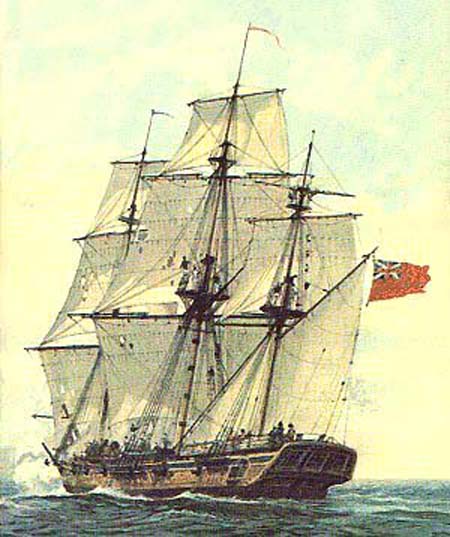
The modern definition of a sloop is a one-masted sailboat with a fore-and-aft mainsail and a jib. However, during the time of the Yankee Doodle Spies, a sloop of war was described as a small, square-rigged sailing warship with two or three masts. Sloops were the next class below the rated ships. This loosely defined group of ships carried between 8 and 20 guns. They could be ship-rigged or brig-rigged, meaning they could have anywhere from one to three masts. 


There was no standard classification for sloops, making exact categorization difficult. A nautical dictionary from that period, Blanckey's Naval Expositor, shows how flexible the definition of a sloop of war could be: "Sloops are sailed and masted as men's fancies freed them, sometimes with one mast, with two and three, with Bermudoes, Shoulder of Mutton, Lugg, and Smack sails; they are in figure either square or round and stern'd."


British Sloop O' War 1776


How They Fought

The war for American Independence at sea saw few large-scale battles between Continental and British ships. While the major battles in the later part of the eight-year conflict between the French and British were decisive for our victory, America's navy was small and limited. When Congress authorized a navy, the largest class built consisted of frigates, which were at the lower end of the rated ships. Therefore, most engagements involved sloops from the nascent fleet and American privateers. 

Most fights took the form of raids, one-on-one encounters, and, of course, the seizure of merchant vessels. Sloops were especially suited for all these tasks because they were fast, maneuverable, and carried just enough armament to get the job done. Besides, these small engagements held symbolic value in terms of propaganda, often influencing sentiments in America, Britain, and France. Now, let's take a look at the life of a sloop of war through the eyes of two of the war's most famous.


USS Enterprise


Neither from the Star Fleet nor the Pacific Fleet, the first Enterprise originally belonged to the British and cruised on Lake Champlain to supply their posts in Canada. After the capture of Fort Ticonderoga by the Americans on May 10, 1775, it became the object of desire in the mind of Benedict Arnold, who realized he would not have control of Lake Champlain until its capture. 

He learned it was stationed at a small British garrison at St. John’s on the Richelieu in Canada and set out from Skenesborough (Whitehall, New York) in the commandeered sloop Liberty for that place on May 14, 1775. He surprised and captured the British garrison on May 18, took possession of the 70-ton sloop, and sailed it south to Crown Point. Arnold named it Enterprise and outfitted it with twelve long 4-pound carriage guns and ten swivels. Around August 1, 1775, Captain James Smith was sent by the New York Provincial Congress to General Philip Schuyler and ordered to take command of “the sloop Enterprise."


USS Enterprise


USS Ranger 

Ranger, originally called Hampshire, was launched on May 10, 1777, by James Hackett, a master shipbuilder, at the shipyard of John Langdon on what is now Badger's Island in Kittery, Maine. Captain John Paul Jones was in command. Readers might recall that Kittery was mentioned in my last post. It set sail for France on November 1, 1777, carrying dispatches about General Burgoyne's surrender to the commissioners in Paris. During the voyage, Ranger captured two British prizes. Ranger arrived at Nantes, France, on December 2. 

On February 14, 1778, Ranger received an official salute to the new American flag, the "Stars and Stripes," from the French fleet at Quiberon Bay. On April 10, 1778, Ranger sailed from Brest toward the Irish Sea, and four days later, she captured a prize between the Scilly Isles and Cape Clear. On April 17, she took another prize and sent it back to France. Captain Jones led a daring raid on the British port of Whitehaven on April 23, spiking the guns of the fortress and burning the ships in the harbor. Sailing across the bay to St. Mary's Isle, Scotland, Jones planned to seize the Earl of Selkirk and hold him hostage to secure better treatment for American prisoners of war. 

However, the scheme failed. Several Royal Navy cruisers were hunting for Ranger, and Captain Jones sailed across the North Channel to Carrickfergus, Ireland, to lure out HMS Drake, a 14-gun ship, for a fight. Drake slowly emerged against the wind and tide, and after an hour of battle, the battered Drake surrendered, resulting in three Americans and five British killed in the fight. After making temporary repairs and putting a prize crew on DrakeRanger continued along the west coast of Ireland, capturing a storeship, and arrived at Brest with her prizes on May 8.


USS Ranger


John Paul Jones relinquished command of Ranger to take control of the refurbished prize, Bonhomme Richard. He left his first officer, Lieutenant Simpson, in command. Ranger departed Brest on August 21 and arrived in Portsmouth, New Hampshire, on October 15, with three prizes captured in the Atlantic. The sloop set sail from Portsmouth on February 24, 1779, and joined the Continental Navy ships Queen of France and Warren in harassing British shipping in the North Atlantic. Seven prizes were seized in early April and safely brought into port for sale. 

On June 18, Ranger set out again with Providence and Queen of France, capturing two Jamaican ships in July and nine more vessels off the Grand Banks of Newfoundland. Of the 11 prizes, three were recaptured, but the remaining eight, along with their cargoes, were worth over a million dollars when sold in Boston. These attacks on British merchantmen by Ranger and other sloops of war greatly contributed to funding U.S. efforts and undermining British mercantile interests, ultimately pressuring Parliament to respond. However, Ranger's fate would be disgraceful.


Siege of Charleston


On November 23rd, Ranger was ordered to Commodore Whipple's squadron, arriving in Charleston on December 23rd to support the garrison under British siege. On January 24, 1780, Ranger and Providence captured three transports loaded with supplies during a brief cruise along the coast near Tybee, Georgia. The British assault force was also found in the area. Ranger and Providence returned to Charleston with this news. 

Soon after, the British launched their final push. Although the channel and harbor layout made naval operations and support difficult, Ranger positioned herself in the Cooper River and was captured when the city fell on May 12, 1780. USS Ranger was then taken into the British Royal Navy and became HMS Halifax. But she was decommissioned the following year. This was a bit of an anticlimax for the famed and brave sloop of war.


Sloop o War USS Providence


Sunday, March 29, 2015

Machias Bay Melee

The Bay


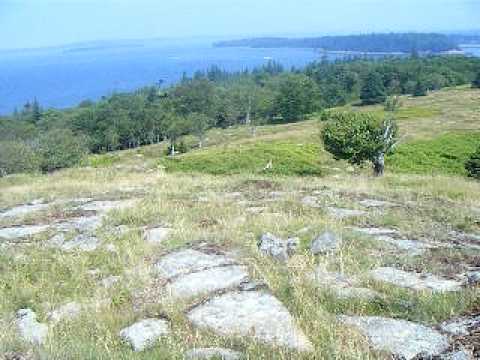
Machias Bay


One might think I'd prefer to write about Galway Bay or Bantry Bay (or even Sheepshead Bay), but too much water separates Ireland from the world of the Yankee Doodle Spies. Still, you might feel as if you're in Galway, with the stunning beauty of Machias Bay and its surrounding areas in beautiful coastal Maine. Near the eastern end of the Maine coast, the town of Machias started as a trading post for the French and English in the 17th century. By 1763, it had become an American settlement and seaport.


The spirit of independence and freedom ran strong in Machias. The first Liberty Pole in Maine was raised there. Machias also claims the title of "Birthplace of the American Navy." While that might be disputed by folks in Whitehall, New York, I digress. One of the first naval battles of the American War for Independence happened in a part of Machias Bay, and locals still refer to that battle as the "Lexington of the Sea."

The  Battle


On June 2, 1775, the British schooner Margaretta, with four guns, escorted two sloops, Polly and Unity, into the port to gather lumber for British troops in Boston. Margaretta was commanded by Midshipman James Moore. The sloops belonged to Loyalist merchant Ichabod Jones, who had a contract to supply the British. A few weeks earlier, the battles at Lexington and Concord had ignited the rebellion into a full-scale war. 

Although far from those battles, the call to action resonated along the coast, and tiny Machias was no exception. Eager for action, some local boys decided to confront the so-called lobster navy. Additionally, Jones, the shrewd merchant, was unpopular with the locals even before declaring himself a Loyalist. They devised a plan to seize the ships while Midshipman Moore and his crew were at church. However, their attempt failed, and the three ships managed to escape into the bay.


Machias Bay


However, two leaders from Machias, Jeremiah O'Brien and Joseph Wheaton, assembled a makeshift force of local seamen. They quickly armed a local ship and seized one of Jones's vessels as well. O'Brien pursued Moore across the bay. On June 11th, he captured the Unity. The following day, he secured the larger Margaretta. This small-scale engagement, known as the Battle of Machias, resulted in a total of seven casualties. Moore himself was mortally wounded. 

For his part in the attacks, O'Brien took command of the Unity and transferred the four guns from Margaretta onto it. He also renamed Unity to Machias Liberty. A few weeks later, the British schooner Diligent, along with a tender (presumably to haul away lumber), entered Machias Bay. O'Brien launched an attack on the Diligent and captured her along with the tender. Now, O'Brien commanded a fleet of two small ships, which became the nucleus of the Massachusetts (not the Continental) Navy. The seamen from Machias went on to capture more British vessels during the war. They also repelled a large British force that tried to take control of the town in 1777. Privateers and others operating out of Machias remained a persistent thorn in the side of the British Navy throughout the war.


O'Brien closes on Margaretta


The Fort


To defend the port, the people of Machias built a small fort overlooking the bay. Built in 1775, it was meant to protect the Machias River and nearby communities. The British destroyed it later that year. But the Patriots rebuilt it in 1777, and it helped protect the harbor for the rest of the war, as well as during the War of 1812 and the Civil War. At first, the small fort was called Fort Machias, but it was later renamed Fort O'Brien.


 Fort O'Brien is a park today

The Architect


And what about the architect behind this little-known First Victory? Captain Jeremiah O'Brien came from the seaport of Kittery (full disclosure, the only place in Maine I've had the chance to visit). He moved with his family to Machias in 1765. O'Brien had five brothers: Gideon, John, William, Dennis, and Joseph. They all fought alongside him during the Battle of Machias and beyond. 

The resourceful O'Brien led naval attacks on British shipping for the rest of the war. During the prolonged struggle, he was captured by the British multiple times but always managed to escape and get back to sea. He survived the war and later served as the Customs Collector at the port of Machias. It seems unlikely that much contraband ever slipped past him. For his achievements, the US Navy has named five ships in his honor over the years.


DD USS O'Brien


Saturday, February 28, 2015

The Knights Templar


Oh, What a Knight!


I am pleased to share that The Patriot Spy, the first book in the Yankee Doodle Spies series, has been submitted for an award in the Best History category by the Knights Templar! Although it is a historical novel, The Patriot Spy accurately depicts the events during the British invasion of Staten Island, Long Island, and New York Island in the summer of 1776. It accomplishes this by incorporating fictional plots and characters into the story of the campaign and the people involved. I am truly honored by this recognition.


Patriot Spy First Edition Cover


Who are these Knights?


For many years, when I heard Templar, I thought of Roger Moore’s old TV series, The Saint. Moore played a mysterious figure involved in crime, espionage, and other mayhem—like Jeremiah Creed. Like many religious orders from the Middle Ages, the Knights Templar are shrouded in mystery, myth, and misunderstanding. That makes them all the more fascinating. Or one could imagine the villainous Knight Templar Sir Brian de Bois-Guilbert in Sir Walter Scott’s grand historical novel, Ivanhoe. More recently, I got hooked on the Arn movie/mini-series, loosely based on a devout Swedish noble unfairly banished to serve as a Templar knight in the Latin Kingdom of Palestine.


Long ago, in a far-off Galaxy


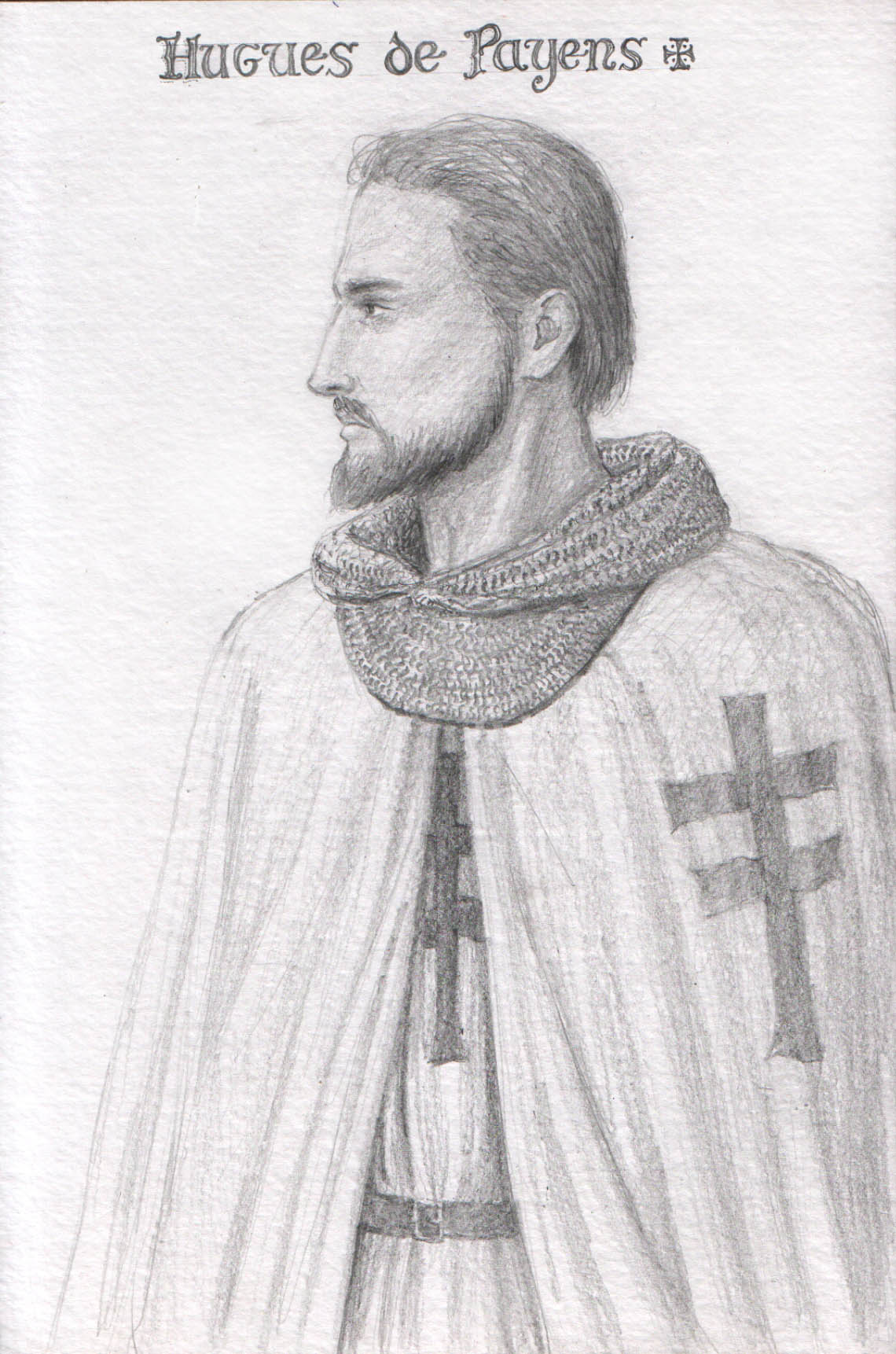
Hugues de Pavens
The Middle East might as well have been a distant galaxy for most Europeans in the twelfth century. Time and space had different meanings back then, when few peasants left the farm where they were born, and very few of the upper classes left the shire. Then, there was a call to action, and an entire continent seemed to turn east. 

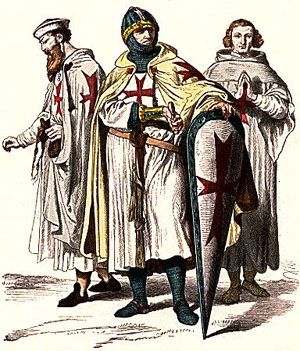
The Templars were founded in the Holy Land in 1119. It began with a small, idealistic group of knights led by Hugues de Payens, who offered their services to protect pilgrims traveling to the Holy Places. They organized themselves into a religious community, sworn to protect Christian pilgrims visiting Jerusalem and the holy sites. They were called the Poor Knights of Christ of the Temple of Solomon, or simply the Knights of the Temple. 

The original purpose of the crusades was just that—protecting pilgrims and holy sites from the depredations of the Seljuk Turks, whose conquest of Palestine from the Arabs resulted in taxes and hostilities against Christians.


It then took a very different turn. After capturing Jerusalem in 1099, the Crusaders aimed to establish a permanent presence to protect their conquests. The original Templars played a small role initially, but they served as an inspiring symbol for Europe’s Christians. They used the al-Aqsa Mosque as their base of operations, which was believed to be the site of Solomon’s Temple. Important to their movement, they gained papal recognition as a military order in 1129 from Pope Honorius II. Hugues de Payens was appointed as the first Master of the Temple. 

It was the great monk Bernard de Clairvaux who understood the historical importance when he wrote in "De laude novae militae" (“In Praise of a New Knighthood”) that a new kind of order had been formed, made up of laymen who combined knightly and monastic life. These soldier monks vowed to fight to protect Christian interests. They took the usual monastic vows of poverty, chastity, and obedience, but also made a fourth key promise—to defend the holy places from the infidel. Over time, the order expanded its reach and soon gained lands in Europe to recruit men and gather funds.


Follow the Money


And in the end, it mostly came down to money. Wars cost money, and the Templars went about raising it in ways that were unique for Christians of that era. Some of their European houses operated as financial hubs, loaning money and collecting fees. This served as an early form of international banking in medieval Europe, long before modern banks and finance systems. The Templars' military strength and extensive network offered a safe place for kings and nobles to store their wealth, with London and Paris becoming the primary centers. Over time, this created a dependence on the Order that, in the years that followed, would cause some in power to grow resentful.


Military, religious, and financial power became
hallmarks of the Order


Faith and Power


The Order reported only to the Pope. This, along with their increasing wealth, enabled the Templars to build an effective fighting force, a naval fleet, and a system of fortresses in Palestine and Syria. The Templars helped finance the Reconquista against the Saracens in Spain, supported by the secular Spanish and Portuguese. 

By the 13th century, the Order numbered 7000 members, including knights, sergeants-at-arms, non-military sergeants, brothers, and priests. Their network comprised around 870 castles, preceptories, and convents spread throughout most of Christian Europe, Palestine, and Syria. Due to their bravery, discipline, and resolve, they bore much of the burden in defending the Latin Kingdoms. In fact, they were called “lions in battle.”  

During the Crusades, thousands of Templars sacrificed their lives in battles like Cresson, Hattin, La Forbie, and Mansurah. However, Jerusalem was eventually lost to Saladin in 1187. When the Latin kingdoms fell again to the Arabs, the Order’s military importance declined as their retreat followed the retreat of Christendom, first to Cyprus and then even further west.


There is no denying the courage and devotion of the Templars in battle


A Rapid Descent


By the fourteenth century, the Crusading era and its spirit were nearly gone. With its decline, secular rulers in Europe started to assert their power against the growing influence of the Pope—at least in terms of authority for now. A transnational entity like the Order, one of the world’s earliest non-governmental organizations (NGOs), threatened this secular rise. 

More importantly, the Order held the wealth that secular kings needed to fund their armies and control their vassals. Philip IV of France was the first king to challenge the Order’s power. On Oct. 12, 1307, the order’s Grand Master, Jacques de Molay, was in Paris to attend the funeral of Catherine, wife of Charles of Valois, brother of King Philip IV, "the Fair," of France.

De Molay was surprised when Philip's agents arrested him on Friday, October 13, 1307. Meanwhile, Philip also launched nationwide raids on Templar properties and arrested hundreds of the Order’s members. The travesty of justice that would follow gives rise to the modern myth of bad luck on Friday the 13th. 

Philip charged that the Templars were no longer dedicated to defending the Holy Land but were apostates. He accused them of denying Christ, desecrating crucifixes, and engaging in indecent acts such as male kissing and compulsory sodomy. Furthermore, his agents accused them of worshiping idols. At first, people outside France disbelieved the charges against the Order. 

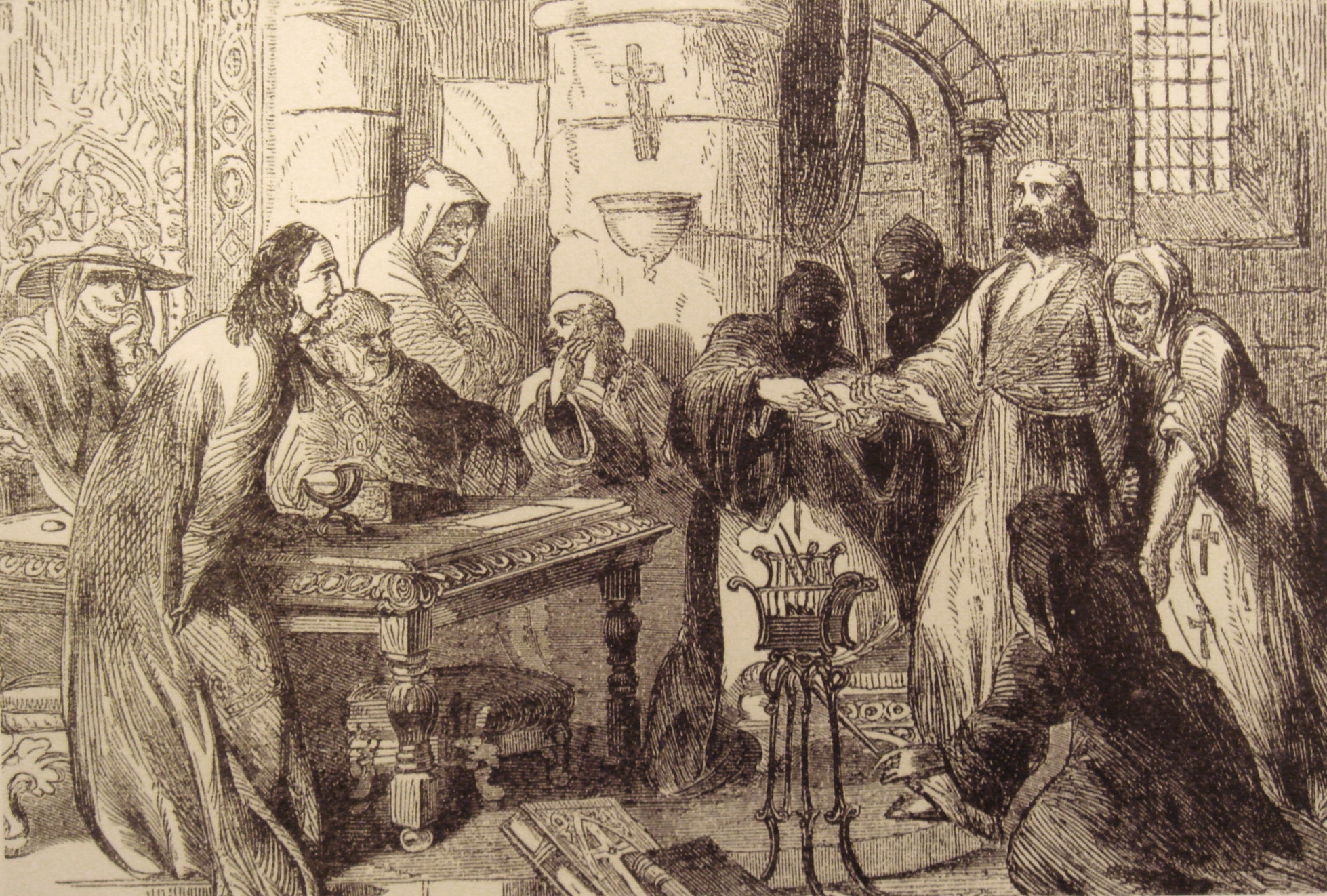
The Pope himself was outraged. After all, the Order operated under his authority, and he was unaware of the charges. Yet, at first glance, the allegations seemed justified. Under heinous torture and threats, many Templars confessed to some of the alleged misdeeds.


Trial? Or something else? de Molay under investigation... and worse


De Molay himself was compelled to make public admissions under the watchful eye of selected theologians. The Pope attempted to take control of the trial but was unsuccessful. A desperate defense of the Order by two of its priest-lawyers also failed. The Pope did not believe the accusations, especially regarding a “secret protocol” that called for many of the heinous acts listed in the charges. However, the forced confessions left him with little options to act. 

Notably, in those pre-waterboarding days, interrogations involved all kinds of brutal torture and mutilation. Predictably, most caved into their tormentors' demands. Under pressure, at the Council of Vienna in 1312, the pontiff suppressed the order but did not hold it criminally liable. 

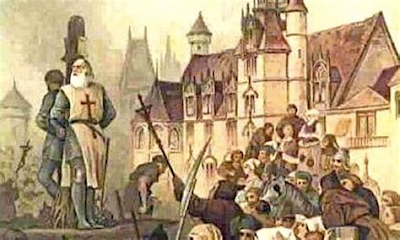
Nearly two centuries of service to the Christian faith were thrown to the wind in a swirl of hysteria and conspiracy. After recanting their confessions (asserting no crimes occurred), De Molay and Geoffrey of Charney, the preceptor of Normandy, were burned to death for heresy two years later in Paris. They were followed by about 50 other members who recanted but were condemned as “relapsed heretics” and executed. Few historians today dispute that the charges by Phillip were concocted and the confessions obtained by torture.


Execution of De Molay

Loss and legend: those Boogie Knights


The property and wealth of the order were seized by secular authorities or handed over to other orders, except for those members of the Order who resided in Portugal. The King of Portugal uniquely offered the knights his protection. Those knights not executed by Philip were merged into other orders. Philip’s outrageous acts might have ended the Order and relegated it to history, but… the Templars’ dramatic demise fueled the rumor mill. 

One legend claims that in 1314, Templar knowledge was secretly passed on to future generations. This led to the belief that the Order continued "underground" in the years that followed, with various theories and speculations. Some believed they had chapters in Scotland, America (before Columbus), aided in forming what is now known as Switzerland, and were responsible for the birth of Freemasonry, among other ideas. The Templars and the mystery surrounding them became perfect material for novelists, filmmakers, and even some historians. 

For example, Sir Walter Scott, an early English-language historical novelist, set the template for fiction and drama with his 1819 novel Ivanhoe. In his version of the myth, the villainous Templar Sir Brian de Bois-Guilbert and his order drifted away from their original purpose. Many other novels linked evil deeds and secret plots to the Templars. This was followed by numerous books, periodicals, films, and TV shows exploring the myth. Even computer games tapped into the legacy and mystery. 

Throughout it all, many conspiracy stories emerged, and even the Nazis became involved in some. Sadly, over time, many have accepted such embellishments as fact. Who doesn't love conspiracy theories wrapped in the mists of history? However, there’s no solid evidence that the Order survived in the form it once held at its peak.


The Modern Knights Templar


Today, the spirit of the Poor Knights of Christ of the Temple of Solomon is carried on by dedicated men of faith and action in the form of the Sovereign Military Order of the Temple of Jerusalem. This ecumenical Christian and chivalric charitable order does not claim a direct lineage to the original Knights of the Temple. However, they have adopted two of the original Templar missions: protecting Christians at risk, especially in the Holy Land and the Middle East, and ensuring the road to Jerusalem remains open to all. They show devotion to God by promoting love and respect. Their efforts include fostering understanding among all religions, helping pilgrims, and maintaining the Christian presence in the Holy Land.


They also work to protect the poor and sick, promote justice, and defend free speech. (The original order’s demise was based on a travesty of justice and suppression of free speech). They uphold the ideals of chivalry and preserve the monuments, archives, and history of the Knights Templar. In the United States, the order is organized into Priories, Preceptories, and Commanderies across many states and the District of Columbia. I am honored that the Priory of St. Patrick (Hudson Valley) in New York submitted The Patriot Spy for the 2015 History Book Award.


The US order is affiliated with the international order, the Ordo Supremus Militaris Templi Hierosolymitani (The Sovereign Military Order of the Temple of Jerusalem). It is the only international Templar order recognized by the United Nations as a non-governmental organization with special consultative status. From the way things look today, the order still has a lot of work ahead.


Saturday, February 7, 2015

The Bravest Son of Liberty?

A Boy from Jamaica


Colonial Jamaica, Long Island was verdant farmland


Jamaica, Long Island, that is. Brigadier General Marinus Willett may well be one of the greatest and most accomplished New Yorkers ever. He was a descendant of Thomas Willett, who arrived in New York on the ship The Lion in 1632. The elder Willett served as the first English Mayor of New York City after New Amsterdam fell to the British in 1664. Marinus' father was Edward Willett, a farmer who lived in Jamaica, Long Island (now Queens). It's hard to believe that the mean streets people see on the way to JFK Airport once were some of the lushest farmland in America. But Edward was a man of letters and business—he made his living as a school teacher and a tavern keeper.


Soldier of the King


Marinus Willett: Citizen Soldier


As with many American leaders of the Revolutionary War, young Marinus first gained experience fighting for the King as a Loyal and dedicated subject. He served in the militia during the French and Indian War, where he was commissioned as a Subaltern in a New York regiment led by Oliver DeLancey Sr. DeLancey was among the wealthiest New Yorkers, and his family would remain staunchly Loyal a generation later. The regiment participated in General James Abercrombie's 1758 expedition to Fort Ticonderoga. Later, Marinus Willett served with the regiment as part of John Bradstreet's forces at the Battle of Fort Frontenac. He fell ill during the campaign and remained at Fort Stanwix until he recovered. While there, he assisted in upgrading the fort, which, as his career later developed, seems almost providential.

Son of Liberty


New York, not Boston style. Willett settled in New York City after the war, and although he worked as a cabinetmaker, he took an interest in politics as tensions with Britain began to simmer. He became the community organizer of his time, which is to say, a rabble-rouser and street brawler. After the news of Lexington and Concord, he helped plan a raid on the old arsenal in New York and took weapons for the cause. On June 6, 1775, the British decided to evacuate New York City. Willett led an effort that prevented the soldiers from taking spare arms with them. On July 20, 1775, he and other members of the Sons of Liberty procured a sloop and captured a British storehouse at Turtle Bay. This cove on the East River was named by Dutch settlers because of its resemblance to a knife. The word "Deutal" (Turtle) is Dutch for "knife." Ironically, Turtle Bay is near where the British landed when they recaptured Manhattan a year later.

Patriot Soldier

Clearly, Marinus Willett proved himself during wartime, as many of our military legends have. He began as a captain in the 1st New York Regiment, and almost right away, the regiment participated in General Richard Montgomery's invasion of Canada in 1775, one of the most brutal episodes of the entire war. He fought at the Battle of Quebec in December of that year and temporarily commanded Fort St. John during the American occupation. However, he returned to New York City with the regiment when enlistments expired, arriving in March. During the British offensive to retake the city in 1776, he had lost a captain's commission in the 4th New York Regiment (possibly in a card game) but continued to serve as a militiaman. 


Colonel Marinus Willett during
the War for Independence


But experience and connections do matter, especially during wartime. In November 1776, he was appointed Lieutenant Colonel of the 3rd New York Regiment, commanded by Peter Gansevoort. He spent the winter recruiting before leading the regiment north. In March 1777, he took command of Fort Constitution in the New York Highlands, where he successfully attacked a blockhouse and burned a British force of one hundred soldiers. Later that year, he helped MacDougall defend Peekskill against a British raid, before being assigned to Fort Stanwix on the Mohawk River.


Drums Along the Mohawk


Stanwix was the anchor of a line of American defenses stretching from Albany to Oneida Lake. This was the western frontier with the Iroquois and a strategic position guarding the portage between Oneida Lake and the Mohawk River. General Washington recognized its importance and had the old French and Indian War post rebuilt and garrisoned. Willett worked tirelessly to prepare Fort Stanwix (also known as Fort Schuyler) for the inevitable attack. It arrived in the form of a British force led by Colonel Barry St. Leger, who laid siege to Stanwix on August 3, 1777. St. Leger made the customary demand for surrender.  


Herkimer was wounded at Oriskany


But Willet refused. The defenders hoisted a makeshift Stars and Stripes in defiance of the more than one thousand British, Loyalists, and Iroquois. Word arrived on the fifth that General Nicholas Herkimer and the Tryon County Militia were marching to relieve the fort. On August 6th, the defenders made a sortie to distract the besiegers, with the signal being the sound of three guns. But when Willett led his troops out of the fort, they found the enemy camp deserted. The force of Loyalists and Indians had gone east to Oriskany, where they ambushed Herkimer. The British Regulars, Loyalists, and Indian Allies returned from that vicious ambush under the cypress trees to find Willet had ransacked and looted their camp of supplies and munitions with his sortie. Willett was later presented with a sword from the Continental Congress for this exploit.

Fort Stanwix


Still, the besiegers kept demanding Willet surrender. Willet personally met with the emissaries. But when he learned of Herkimer's defeat at Oriskany, he decided to slip out on his own and seek help from Fort Dayton further down the Mohawk Valley. There, he discovered that Major General Schuyler had already sent a second relief force under Benedict Arnold's command. Willett then traveled to Albany, where he met with Arnold, and afterward returned to Fort Dayton with Arnold's army. On the return trip, Willett stopped to visit Herkimer. Almost two weeks after the Battle of Oriskany, Herkimer had his leg amputated on August 19th but appeared in good spirits. However, the next day, Herkimer died from infection and blood loss.

Countering Espionage?


In a surprising connection to Yankee Doodle Spies, Willett appears to have played a small role in counterespionage efforts. On August 20th, he served as a judge at Loyalist Captain Walter Butler’s trial. Butler was the son of John Butler, who commanded Butler’s Rangers, a prominent Loyalist unit both feared and despised by Patriots on the New York frontier. Continental Army troops had captured the younger Butler while he was trying to recruit rangers at Shoemaker Tavern in German Flatts, New York. Butler was tried as a spy. Willett's court found him guilty and sentenced him to death. The condemned Butler was sent to Albany to await execution, but after a few months, he escaped and returned to Canada.

Back to the Continental Army, then back to New York's Frontier, then...


Willett seemed to be everywhere at times. In June 1778, he was granted leave from the Northern Department to join Washington's Main Continental Army, which was preparing to attack General Clinton's British forces moving from Philadelphia to New York. There, he served as an aide to General Charles Scott and participated in the Battle of Monmouth. Scott's Brigade was part of the vanguard in that epic clash.

By the summer of 1779, Willett had rejoined the 3rd New York Regiment during the Sullivan Campaign against the Iroquois. This campaign was a brutal, destructive effort that foreshadowed later Indian warfare. Willett later spent some time in the New York Highlands before returning to the main army at Morristown. In January, he took part in a raid on Staten Island.

In early 1780, he was appointed commander of the 5th New York Regiment, a unit severely weakened by battles in the New York Highlands. An enthusiastic advocate, he became involved in voicing grievances on behalf of unpaid troops. He also found time for leisure.

In 1780, while based at Fort Plain, New York, he met and had an affair with an attractive widow named Mrs. Seeber. The affair resulted in the birth of a son, Marinus Willett Seeber. Willett openly acknowledged the boy's paternity, supporting him and ensuring he received an education.

In January 1781, Willett returned home as the New York Line was reduced to just two regiments. By April, he was back as a colonel of the New York militia, engaging in numerous actions. His regiment defended the Mohawk Valley and the areas around Albany. That summer, he led the militia in the Battle of Sharon Springs, attacking Indians and Loyalists. 

In October, he commanded the militia at the Battle of Johnstown. Afterward, he pursued the retreating enemy through an increasingly cold month. A forced march in snowshoes during a heavy snowstorm brought Willett's militia close to the Loyalists, who escaped under cover of the swirling snow. Ironically, the 

Post War: Politico Peacemaker Peace Officer


I might need to write another blog about Marinus Willett's post-war adventures. His later career is hard to believe. At the end of the war, Willett helped establish the Society of the Cincinnati, a controversial order of former American and French officers from the Revolution. He opened a store on Water Street in New York City. 

In 1793, his first wife, Mary, died. He soon remarried. His new wife, Susannah Vardle, was “active” in New York society, but her vivacity proved more than he could handle, and they divorced in 1797. In post-war politics, Willett became an Anti-Federalist under George Clinton and served in the New York State Assembly. He served as Sheriff of New York County (also known as Manhattan) for several years and helped put down Shay's Rebellion in 1787. 

By 1788, he was again aligned with Clinton in fighting against the Constitution—yes, that Constitution. When it finally passed, he continued working with others to repeal or amend it. Despite his anti-Federalist stance, Willett was sent by President Washington to persuade the Creeks to come to New York (then the nation's capital). This led to the Treaty of New York, the first of many treaties that would not bode well for the Indians. He later served again as sheriff of New York County. 

When war broke out against the Indians in the Northwest Territory (1792), Willett was offered a general's commission. He declined, telling President Washington that he did not support war with the Indians. Willett also turned down a later offer to serve as a peace envoy to them. It’s only possible to speculate that his experiences during Sullivan’s campaign influenced his views on America’s Indian policies.


Creek Indian Leaders in New York City


Going Strong in the New Century


So strong was his character that in 1799, Willett married young Margaret Bancker. He was 59, and she was only 24, but they had four children—three sons and a daughter. Willett, the former Liberty Boy, believed in grassroots democracy. During one particularly hot gubernatorial race, he actually fought a duel with a member of the opposing party—fortunately, neither was hurt. 

At the turn of the new century, he played a role in building some of the fortifications protecting New York City. In 1808, he replaced populist DeWitt Clinton as Mayor of New York City, becoming its 48th mayor, and in 1811, he ran unsuccessfully for Lieutenant Governor of New York. He supported the War of 1812, but now, in his 70s, he only gave patriotic speeches to support it.  


De Witt Clinton


In 1824, he served as a presidential elector during the bitter election that elected John Quincy Adams as president. The highly accomplished Marinus Willett died at his home on August 22, 1830, a few weeks after suffering a stroke. Ironically, this was exactly 53 years after the lifting of the siege of Fort Stanwix. 

The ninety-year-old First Patriot was laid to rest in the churchyard of Trinity Church, at the corner of Broadway and Wall Street in New York City. His funeral was attended by 10,000 mourners — about 5% of the city’s population at that time. Not too bad for a cabinet maker from Jamaica.


Marinus Willett in later life

Sunday, January 11, 2015

Somerset Court House

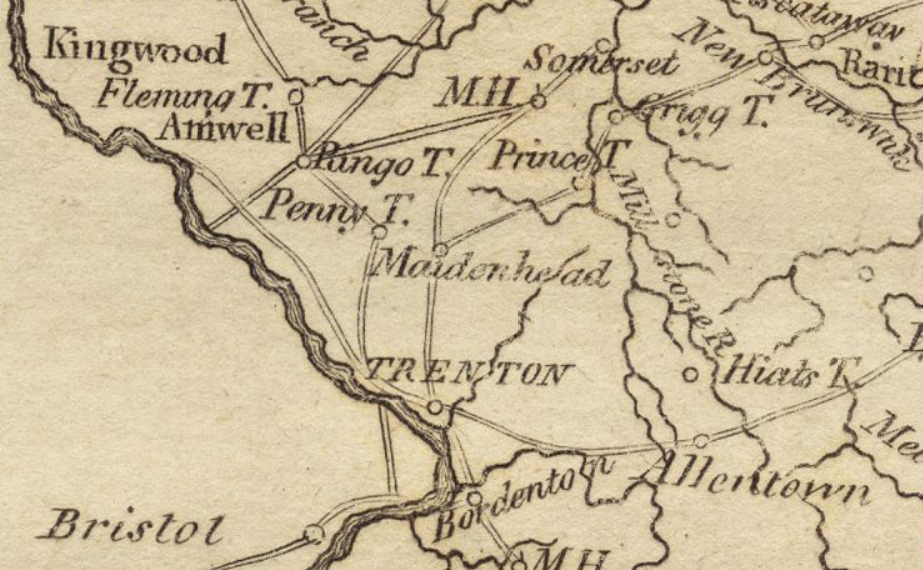
The area around Somerset Court House in central New Jersey saw an extraordinary amount of Revolutionary War military activity. Reason: it was on the main approach between north Jersey and Princeton, and between Princeton and New Brunswick, a British stronghold in Jersey. Not unexpectedly, the militia around Somerset Court House, now Millstone, New Jersey, saw action on several occasions. Somerset lay in that "middle area" between the British and American outposts, which had some quite vicious but little-celebrated fighting. Besides being in a strategic crossroads, the area around Somerset Court House was full of thriving farms with an abundance of crops and animals. During the winter in particular the ground was often frequented by British foraging parties from nearby New Brunswick.


Background


After General Washington took Trenton for the second time and fought past the British under General Cornwallis at  Princeton on January 3, 1777, he faced being caught between Cornwallis and the main the British Army around New Brunswick. But Washington's troops were exhausted after weeks of marching and fighting in extreme weather with inadequate food and clothing. So His Excellency decided to send his beleaguered regiments up the Millstone River valley toward Morristown, which could provide suitable and secure winter quarters. Morristown was protected by the Watchung Mountains, which could be strongly fortified at the passes to stop a British attack.


New Jersey was a battleground


 After the rebels fought at Princeton, Washington moved north to Somerset Court House. The advanced guard, part of the Delaware Line, came upon the village of Stone Brook (seat of Somerset Court House)  15 miles up the valley from Princeton, arriving around at twilight. However, the British had already evacuated supplies desperately needed by the Patriots. And the Americans were simply to exhausted to pursue. But within a few weeks, the winter war for forage between both sides would be in full swing and the area around Somerset was one of the prime battlegrounds of that campaign.


The Forage War Begins


At the urging of General William Maxwell, New Jersey Militia General Philemon Dickinson, and others, Washington ordered his Continental regiments and the local  New Jersey militia to engage  British outposts, patrols, couriers, and most especially forage parties Washington wanted to contain, harass and tire the British and Loyalists so they couldn't (or wouldn't) leave the main bases at New Brunswick and Amboy without sending considerable forces of say 1500 to 2000 men. The militia responded to this call with enthusiasm. Thus began a series of actions in the middle of what was normally the quiet time in 18th-century warfare. But warfare in North America, especially the war for independence took a different turn.


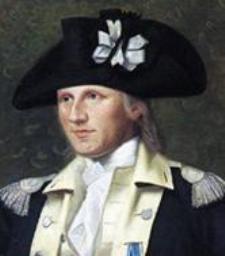
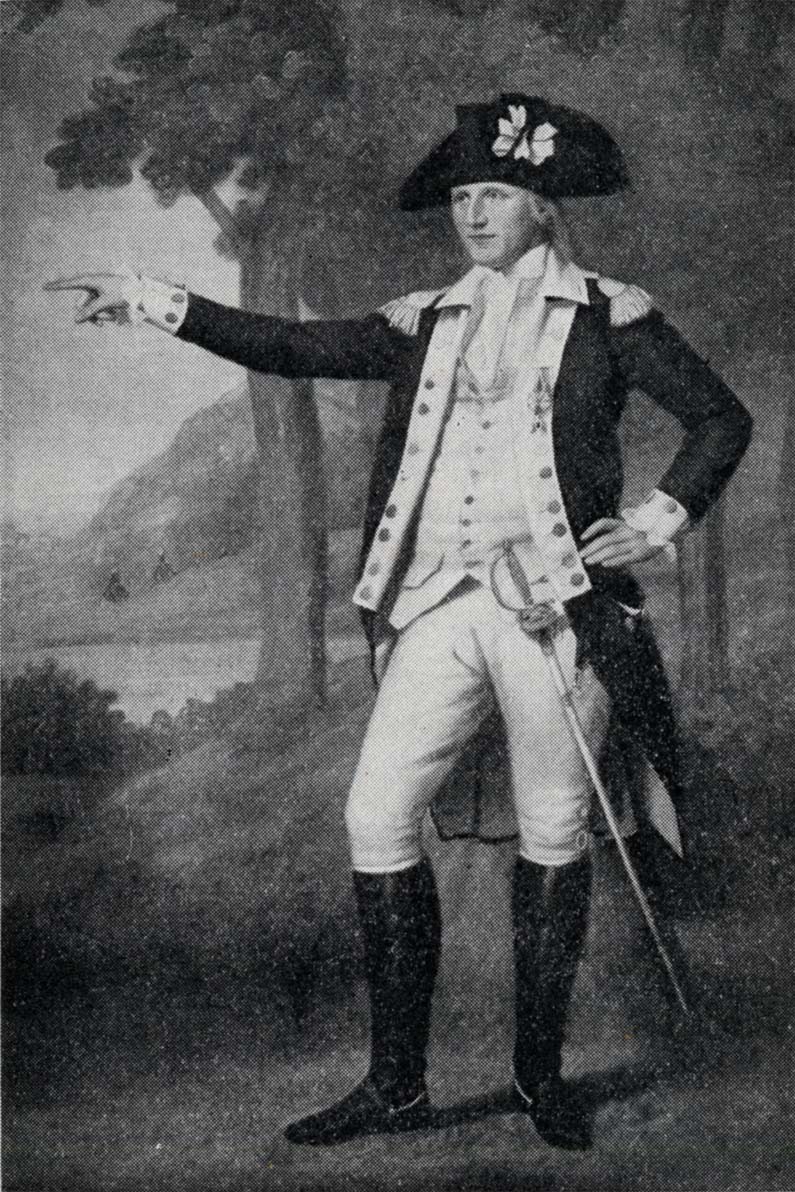
Militia General Philemon Dickinson


Battle of Millstone or Van Nest's Mill


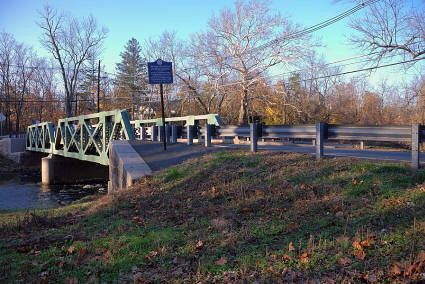
On January 20th, 1777, British Lieutenant Colonel Abercromby, with 500 men and several cannon, went on a foraging party towards Hillsborough. American militia patrols spotted them and sent word back to  General Dickinson that "the enemy were out plundering." Dickinson had around 400 men in hand plus a company of 40 or so Pennsylvania Continental Riflemen under the command of Captain Durkee from the Wyoming Valley. The British were posted at a bridge over the Millstone River, near Abraham Van Nest's mill, about two miles from Somerset Court House. The Millstone ran into the nearby Raritan River. Abercromby had placed three field pieces on a hill, about 50 yards from the bridge to prevent any rebel forces from crossing there. The rivers were covered with a crust of ice and the water beneath, about waist high by most accounts, and of course ice cold.


Millstone River Today

The Action


Seeing the bridge crossing protected,  Dickinson ordered his men downriver (towards the Raritan), where they broke through the ice and waded into the cold waters that reached well above their knees. Dickinson divided his forces, sending one force to meet the front of the British wagon train, while a second moved to flank them. One wing of the American attack successfully surprised the British wagon train in the lane near Van Nest's Mill, cutting it off before it reached the main road and the bridge toward New Brunswick. Well-placed fire struck horses from the first wagon, halting the train,  Panicked, the wagon drivers scattered. This caused the British to beat a hasty retreat to the bridge, leaving their booty behind. But when the pursuing militiamen reached the bridge, the Hessian rearguard fired grapeshot from its artillery to cover the retreat. After an exchange of fire across the river, the British withdrew. As was the case with most such actions, the actual combat was brief. The British taking the brunt of causalities and lost around a dozen prisoners and twice that in killed and wounded. The British admitted that the rebel surprise attack "occasion'd such disorder Amongst the Waggon Drivers that 42 Waggons were left behind." They also lost 104 horses, 115 head of cattle, and about 60 or 70 sheep. Valuable livestock denied the enemy in winter quarters and most needed by the always deprived rebels.


Militias defeat Regulars: How Could this Happen?


This was no major battle or great victory. Yet it proved significant. Stalwart and determined, these once disparaged New Jersey militiamen had gained confidence and were less in awe of redcoats and Hessians due to American successes Princeton and Trenton. Even before Trenton, exaggerated reports of enemy depredations across the Jerseys began to stir the fires of revenge and retribution in many (but not all).  This was not the only instance when anger fired up the militia into ferocity against enemy regulars and Loyalists. In fact, it would become a growing theme throughout the remainder of the war. So in many ways, the action at this place called Somerset Court House was a harbinger of greater things to come.