Followers

Saturday, January 19, 2013

Blast from the Past


Several "open sources" reported a dangerous and historic discovery made in Central Park the week before last.

New York City Parks workers found a live cannonball loaded in a cannon. The artillery piece, dating back to the Revolutionary War, was one of two cannons stored at the park’s Ramble shed near the 79th Street transverse, a road that crosses the park from east to west. Preservation workers from the Central Park Conservancy called the police after opening the capped cannon for cleaning. The police discovered over 800 grams of black powder, along with cotton wadding and a cannonball. More importantly, the powder was still capable of firing!

                                                                                       
                                             Revolutionary War cannon found in Central Park

The cannon, donated to the park around the time of the Civil War, was on public display for over 125 years until 1996, when the Conservancy decided to bring it inside to protect it from vandalism. So, a loaded cannon sat amidst joggers, school kids, picnickers, and lovers (not to mention assorted hookers, pimps, junkies, and muggers). It’s amazing that loaded ordnance could have gone unnoticed for so long. However, the gun posed little real threat, as it was already over 90 years old and is believed to have come from a sunken British vessel in the East River. Additionally, it was capped with concrete.


The Patriot Spy recounts the British invasion of Long Island (modern-day Brooklyn) and then the Island of New York (modern-day Manhattan)... The gun appears to be a small-caliber (6 or 12-pound) carronade. During the Revolutionary War, guns like these would have mostly been used to arm British merchant ships, not frigates as the New York papers speculate.

Carronades (named after the British Carron ironworks that developed them) were short-barreled guns used on merchant ships for defense. More economical and easier to operate than high-velocity "long guns," the carronade's lower muzzle velocity gave it a better "smashing" ability. The carronade's shot could devastate its target, tearing the ship's gunwale and masts into much larger chunks and splinters that were as deadly to the enemy as the munition itself. Additionally, because they required less run-out space, they needed a smaller crew, and more carronades could be mounted in the same space as long guns. They could also be brought back into battery for the next shot more quickly than traditional guns, giving carronades a faster rate of fire.


Carronades had a higher trajectory than long guns
Why merchant ships? The carronade sat high in its gun carriage, making it more difficult to smash the hull at the waterline. However, the deck line and the masts were easy targets. Merchant vessels typically only needed to smash masts, yardarms, and rigging to reduce the sail power of their pursuer—usually an American privateer—and then make their escape. It wasn't until 1791 that the Royal Navy started mounting these devastating little weapons on the men o' war. And not just on frigates: schooners, brigs, and even ships of the line (large sailing battleships with 60 or more guns). The concentrated close-range fire of the carronade proved deadly to French, Spanish—and sometimes American—ships during the numerous naval battles and duels that took place from 1792 until 1814.


Merchant vessel fleeing privateers


However, during the time of Yankee Doodle Spies, the carronade was viewed as a defensive weapon suitable for merchant ships. One can wonder whether any of the American privateers mounted these guns. They probably did once they captured a British merchant prize. The importance of merchant shipping and privateers during the Yankee Doodle Spies era is often overlooked in popular histories, but I will discuss in a future blog how vital, even decisive, that aspect of the War for Independence truly was.


Heading east from Mc Gowans Pass - today

With this recent discovery, Central Park once again links itself to the War for Independence and the Yankee Doodle Spies. Not far from where the mysterious gun was found near McGowan's Pass—a crucial approach to the Heights of Harlem that played a significant role during the British invasion of Manhattan. And a key setting in...The Patriot Spy.


Saturday, January 5, 2013

Wassail!

Today is Twelfth Night, that most curious of all winter holidays, consigned to the mists of time. In my last post, I mentioned that Christmas in colonial times was a quiet, understated event and that the Christmas celebrations as we know them became popular in the early to mid-19th century. So...were our founding fathers and mothers a bunch of stiffs?

 On the contrary, the holiday they celebrated most raucously (especially in Virginia, Maryland, and around Philadelphia) was Twelfth Night, the night of the twelfth day of Christmas and the day before the Epiphany. During the American Revolution, it was the major winter celebration.


Twelfth Night is the trifecta of holidays, sitting at the convergence of Christmas, the Epiphany, and the Winter Solstice. Though originally rooted in pagan fertility rites, the annual practice of an extended Winter Solstice festival of feasting, family gatherings, and public gaiety was later grafted into the emerging Christian culture of Europe. Burning the Yule Log during the twelve days was part of this and continued into colonial times. Clearly a throwback to the pagan holidays of the Roman Saturnalia and Celtic traditions, I believe Twelfth Night manifests the human condition - one that necessarily embraces the new (Christianity) while holding onto nostalgic vestiges of the old (pagan and Celtic).


                                              The pagan Yule log was adapted to Christianity


Twelfth Night was widely celebrated in colonial Williamsburg, Philadelphia, and the Delaware Valley. George and Martha Washington celebrated it as a day-long event with many friends and family in attendance. Events included the famed costume ball, where the high-born dressed as low-born and the low-born dressed as high-born, and where men could dress as women and women as men. In Philadelphia, the upper classes (mostly staid Quakers) simply dressed in finery and listened to chamber music while feasting, but in many places, the more raucous aspects of the old pagan traditions included all kinds of drinking and carrying on. Sometimes special cakes or loaves of bread were baked with a hidden bean or a metal cast figure of the infant Jesus. Whoever was served the piece of cake or bread with the hidden token became the King or Queen of the Twelfth Night Ball.


Twelfth Night at Colonial Williamsburg


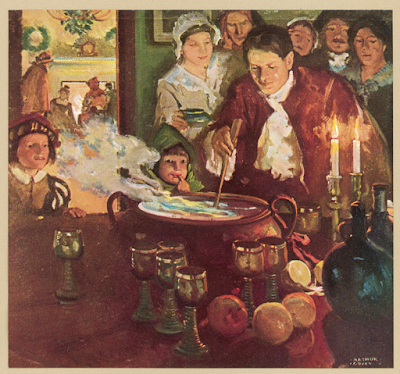
Twelfth Night involved baking all sorts of tasty winter treats, such as cakes, pies, and tarts. The presentation of the food was a key form of entertainment. In the days before, most foods could not be preserved, so baking was no mean feat. Did I mention that raucous drinking (at least among non-Quakers) was a big part of Twelfth Night? In earlier times in England and Ireland, the drink of Twelfth Night was Wassail - a mix of mead, ale, and spices that would give even Captain Morgan a headache. In some traditions, the Wassail was spread over the cold winter fields to signify a fertile harvest in the spring. It was also poured onto trees, another connection to pagan traditions. 


Enjoying the Wassail Bowl


In colonial and early American times, the Christmas season, capped by the celebration of Twelfth Night, was associated with romance and was a favorite time for weddings. Twelfth Night balls offered young, single people the chance to meet and interact freely, and, hopefully, to find a mate. These parties, usually featuring dancing, some form of masking, and card and dice games, facilitated this goal. Indeed, some balls were designed exclusively for the young. One famous colonial romance led to a marriage scheduled for Epiphany, the day after Twelfth Night. George Washington and his bride, Martha Dandridge Custis, married on January 6, 1759.


The wedding of George and Martha


Saturday, December 22, 2012

Silent Night...Silent Might

Christmas celebrations in colonial America were much more staid than those we know today. December 25th in colonial America was just another day unless it fell on a Sunday, in which case it was just another Sunday. America's celebration of Christmas as a very special holiday began with the large wave of German immigrants in the early 1800s. Germans always held Christmas as the most special of days. Christmas's role in the English-speaking world peaked during the Victorian era. Victoria's consort, Albert, brought many Christmas traditions with him, and later Charles Dickens and other novelists popularized the season. Of course, Santa Claus is derived from Sant Niklaus, a Dutch character based on the original Saint Nicholas, a Roman bishop in what is today Turkey. Full disclosure: the original Saint Nicholas is buried in my grandparents' home city of Bari, Italy.

As Christmas approached in December 1776, the fortunes of the American rebellion had plummeted. The British juggernaut advanced into the Jerseys (back then, New Jersey was sometimes referred to as East and West Jersey). Lord Charles Cornwallis led the invading vanguard of some 5,000 British and Hessian troops in pursuit of Washington's dwindling army. Washington abandoned Fort Lee and maneuvered to Hackensack, where he checked the British only briefly before retreating without pause through Newark, New Brunswick, Princeton, and Trenton. On the 8th of December, Cornwallis and his scouts reached the east bank of the Delaware just in time to watch Washington and his personal escort depart on the last boat.


Herssian Grenadier


The patriot cause was at its nadir. Panic had set in, especially in Philadelphia. Lord Howe had issued a proclamation offering amnesty to any rebels willing to swear an oath to the King. Some had begun to accept it. Worse still, many of Washington's best troops had enlistments expiring, with little likelihood that replacements would arrive. Fearful of a British assault on the capital, the Continental Congress fled and turned governance over to the military. To stall the British, Washington had all the serviceable boats along a 70-mile stretch of the Delaware confiscated. The British advance had to await their engineers to plan a crossing. Fortunately, Lord Howe had decided he had all but whipped the rebels and ordered his army into winter quarters, with brigade-sized garrisons at Brunswick, Trenton, Princeton, Bordentown, and Cherry Hill. The remainder took quarters on Staten Island or Manhattan.


Gathering Boats was Critical


But morale across the colonies remained dismal. The end seemed in sight, as Howe assumed. The December 23rd edition of Thomas Paine's pamphlet "The Crisis" inspired many Americans. A desperate Washington gambled on a winter strike against the rebels before many of his best regiments dissolved. He had the pamphlet read to his troops and conceived a plan for a Christmas thrust in three divisions to take the enemy garrisons at Trenton and Bordentown. At first, demoralized by the British advance, New Jersey militia units began probing and harassing the British garrisons, isolating them in their posts. Then General John Sullivan arrived with a division from the Hudson Highlands. These reinforcements gave Washington the strength he needed to complete his plan.


Dramatic portrait - Washington crossed over
in the dark of a December night


On the night of December 25, Washington made his famous crossing at McConkey's Ferry and marched nine miles along the Delaware to Trenton. Divisions under Generals Cadwallader and Ewing (mostly Pennsylvania and New Jersey units) were to cross near Bordentown and link up with Washington, but worsening weather and rapidly forming ice floes prevented them from crossing. Nevertheless, Washington struck with just over 2,000 men just after dawn, even as a mix of rain and snow descended on them.


Overrunning the Hessian guns at Trenton

So what's the Christmas connection? The German garrison, a brigade under the command of the renowned Hessian Colonel Johann Gottlieb von Rall, was caught unprepared. Germans celebrate two days of Christmas, and Washington struck between them. Indeed, the Germans themselves had been worn out by the rigors of the campaign, and the Jersey militia had played a part in tiring them and causing a "hunker down" effect. But Rall never expected the onslaught that caught them in the weary hours of their holiest of days. Rall fell mortally wounded while rallying his battalions, and soon after the garrison surrendered more than one thousand men. The battle did not last an hour. The stunning victory saved the American cause, which was all but finished.


Sunday, December 2, 2012

Oh yeah...baby!

Austin
Yeah....baby! You really have to say that with an Austin Powers voice for full effect!  But the fictional character that spoofed the fictional spy James Bond tongue- in-cheekily referred to himself as an "international man of mystery." And as an "international man of mystery," Austin would have felt at home with the International Thriller Writers.

Who are these people?


 Who they are may be the mystery...but not after you read this post!  The International Thriller Writers (let's call them ITW) is an honorary society of authors, both fiction and nonfiction, who write books broadly classified as “thrillers.” This would include (but isn't limited to) such subjects as murder mystery, detective, suspense, horror, supernatural, action, espionage, true crime, war, adventure, and myriad similar subject areas. Clive Cussler, Sandra Brown, Kathy Reichs, David Morrel, Mark Bowden, James Rollins, and Andrew Peterson, among so many notables,  are all members.

Just what do they do?


Their mission is... “To bestow recognition and promote the thriller genre at an innovative and superior level for and through our Active members; to provide opportunities for mentoring, education and collegiality among thriller authors and industry professionals; and to grant awards for excellence in the thriller genre.”
ITW Mission Statement

How do they do that?


Whether you are a fan of the TV show by that name or not, you might be interested in knowing that ITW has designed numerous, effective programs and events which promote debut and midlist writers and their work, sometimes in partnership with bestselling authors. In addition, ITW promotes literacy, gives money to worthy organizations, supports libraries, and advances the genre. Finally, it brings together almost a thousand writers, readers, publishers,  editors, and agents at its annual conference, ThrillerFest, as well as at CraftFest, a writing workshop program, and AgentFest, where aspiring authors can meet and pitch top literary agents.

What else do they do?


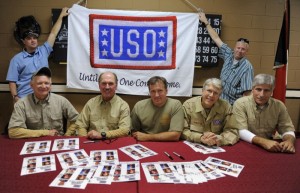
 One really great activity is "Operation Thriller," a partnership with the USO.  For the first time ever, the USO brought writers together with the troops." Operation Thriller" brings together some of today's greatest thriller writers to meet with American military members at home and abroad. The first such tour started in 2010 with visits to Walter Reed and Bethesda Navy Medical Center where the writers listened awe-struck at the tales of valor and strength displayed by the Wounded Warriors.  The group followed up with visits to our troops in Kuwait and Iraq.

Operation Thriller

What does any of this have to do with Yankee Doodle Spies?


Actually, this has a lot to do with Yankee Doodle Spies.   I have just been informed that The Patriot Spy was recently submitted to compete for ITW's Best New Novel for 2013! Now I didn't specifically write The Patriot Spy as an international thriller...but the plot twists and tense action do make for plenty of thrills. While the characters include Irish, Dutch, Scots, Germans who make for an international cast set upon the canvass of America's most international locale - New York.

Action scene and the original cover of The Patriot Spy

Thursday, November 22, 2012

A Yankee Doodle Thanksgiving!

Americans have a lot to be thankful for...


Despite budget woes, the global war on or from terrorists, the loss of jobs and industries, America has actually faced worse...much worse...

The American Revolution was an eight-year war that tore at the political, social, and economic fabric of the  British colonies. From this bitter struggle emerged a new nation founded on liberties that came from an all-knowing and almighty creator who we call God.  It is to the Creator, to Providence, to God, that this day is dedicated.  The founders knew that their unlikely quest for liberty could not succeed without God's blessing. For that, they saw fit to give thanks, even before the outcome was clear...
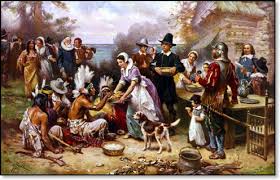

The first, but not last, Thanksgiving

Thanksgiving during the Revolution 


Because they saw the cause as intrinsically connected to God, the Continental Congress appointed thanksgiving days each year and requested that each state celebrate it in its own way.  By 1777, the war hung in the balance as Lord Howe bypassed "The Jerseys"  with a strategic landing at Head of Elk, defeated Washington at the Battle of Brandywine, and soon occupied the American capital. The Congress had evacuated  Philadelphia and transplanted itself to York, Pennsylvania.
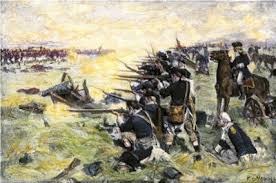


The loss at Brandywine sealed Philadelphia's fate


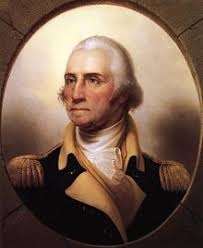
General Washington
The founders had every reason to despair and turn their back on God but instead, they turned to Him in thanks.  Besides, a great victory had been bequeathed to them when a large British invasion force surrendered at Saratoga, New York.  Capitalizing on this, the commander in chief of the Continental Army, Lieutenant General George Washington, proclaimed a Thanksgiving in December 1777.
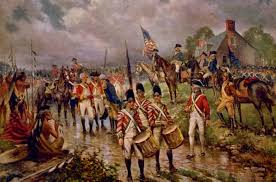
The British surrender at Saratoga


A month earlier,  the Continental Congress now in exile at York had issued the First National Proclamation of Thanksgiving in 1777. They called on Delegate Sam Adams to write the first draft, which Congress then adapted into the final version:

"FOR AS MUCH as it is the indispensable Duty of all Men to adore the superintending Providence of Almighty God; to acknowledge with Gratitude their Obligation to him for Benefits received, and to implore such farther Blessings as they stand in Need of: And it having pleased him in his abundant Mercy, not only to continue to us the innumerable Bounties of his common Providence; but also to smile upon us in the Prosecution of a just and necessary War, for the Defense and Establishment of our unalienable Rights and Liberties; particularly in that he hath been pleased, in so great a Measure, to prosper the Means used for the Support of our Troops, and to crown our Arms with most signal success:
It is therefore recommended to the legislative or executive Powers of these UNITED STATES to set apart THURSDAY, the eighteenth Day of December next, for SOLEMN THANKSGIVING and PRAISE: That at one Time and with one Voice, the good People may express the grateful Feelings of their Hearts, and consecrate themselves to the Service of their Divine Benefactor; and that, together with their sincere Acknowledgments and Offerings, they may join the penitent Confession of their manifold Sins, whereby they had forfeited every Favor; and their humble and earnest Supplication that it may please GOD through the Merits of JESUS CHRIST, mercifully to forgive and blot them out of Remembrance; That it may please him graciously to afford his Blessing on the Governments of these States respectively, and prosper the public Council of the whole: To inspire our Commanders, both by Land and Sea, and all under them, with that Wisdom and Fortitude which may render them fit Instruments, under the Providence of Almighty GOD, to secure for these United States, the greatest of all human Blessings, INDEPENDENCE and PEACE: That it may please him, to prosper the Trade and Manufactures of the People, and the Labor of the Husbandman, that our Land may yield its Increase: To take Schools and Seminaries of Education, so necessary for cultivating the Principles of true Liberty, Virtue and Piety, under his nurturing Hand; and to prosper the Means of Religion, for the promotion and enlargement of that Kingdom, which consisteth "in Righteousness, Peace and Joy in the Holy Ghost.
And it is further recommended, That servile Labor, and such Recreation, as, though at other Times innocent, may be unbecoming the Purpose of this Appointment, be omitted on so solemn an Occasion."


                                                  Original Thanksgiving Proclamation


Saturday, November 17, 2012

Edgar? Is that you?

Apologies to Joan Rivers.  But I am pleased to report that The Patriot Spy has been submitted for a 2013 Edgar Award!

"What the heck is an Edgar?" 


 A reasonable question.  The Edgar Awards are presented each year by The Mystery Writers of America for achievement in mystery writing. The Edgars are the most prestigious awards in this very popular genre.  The Patriot Spy was submitted in the Best First Novel category.  Personally, I know it is my best first novel because it is my only first novel!  Now we just have to convince the judges.


Founded in 1945, Mystery Writers of America is a storied organization that strives to improve the genre of mystery writing by connecting authors and fans.  To do this, it works with libraries and vendors, and at the chapter level, it sponsors symposiums and events.  Authors, publishers, and fans come together to celebrate the power of the mystery and its special hold on the reading public.  There are eleven Mystery Writers of America chapters throughout the country.  It has its headquarters in New York.


                                                        Edgar Allen Poe was the dean of 
                                                    American mystery and thriller writers


Why "Edgar?" 


The name Edgar is in honor of the literary legend, Edgar Allen Poe.  Poe is among the most famous 19th Century American writers and is considered the father of mystery writing with his seminal work, "Murders in the Rue Morgue."  Poe was born in Boston in 1809.  His grandfather, David Poe, served with distinction in the Revolutionary War and is said to have been a friend of the Marquis De Lafayette and was known to George Washington himself.  There - I managed to make a Poe connection to the Yankee Doodle Spies!

West Point mid 19th Century

Edgar's Life


 Poe's parents were actors.  They died when he was a boy and Richmond tobacco merchant John Allan and his wife adopted him. They sent him to the University of Virginia but gambling debts and drinking led him to leave.  He enlisted in the US Army and served with some distinction in the Field Artillery where he rose to the rank of Sergeant Major.  The military life soon wore him down and strange as it may seem Poe sought a commission at the US Military Academy at West Point as a means of escape.  Poe did well there until he decided the Academy did not suit him.  He could not resign however without John Allan's approval (declined). So he broke numerous regulations, mostly absenting himself from classes (what we call "cutting") until he was, at last, he stood before a court-martial and dismissed in March 1831.

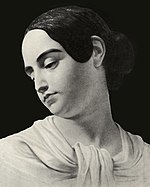
After leaving West Point, he dedicated himself to writing full time. As with many writers, he moved about the country, living variously in New York City, Baltimore, Philadelphia, and Richmond. While in Baltimore he stayed with family and fell in love with and married his 14-year-old cousin Virginia Clemm, who was the love of his life (or maybe he just didn't like saying good-bye).


Virginia Clemm Poe


By 1836 he had returned to Richmond where he worked as a literary critic of some notoriety.  In his professional life, he had worked on the editorial staff of the Southern Literary Messenger of Richmond,  the New York Quarterly Review, and  Graham's Magazine at Philadelphia. It enabled him in 1843 to have a magazine of his own, the Stylus. His dissolute ways estranged him to many and ruined his magazine's prospects.   After his young wife Virginia died in 1847, Poe maintained a pretty continuous downward spiral of drinking bouts, confrontations, and impecunity that overshadowed his inspired body of work.

His Work


In late 1830 Poe published Tales of the Grotesque and Arabesque, a collection of stories. It contained several of his most spine-tingling tales, including "The Fall of the House of Usher," "Ligeia" and "William Wilson." Poe launched the new genre of detective fiction with 1841's "The Murders in the Rue Morgue." A writer on the rise, he won a literary prize in 1843 for "The Gold Bug," a suspenseful tale of secret codes and hunting treasure.  Although best known for short stories steeped in mystery, Poe's most famous and profitable work was a poem, "The Raven." I believe a film by that name was Jack Nicolson's first feature role.  Poe also published a work of poems called, well, "Poems." He released it right after leaving the Academy and dedicated to his fellow cadets, who famously each gave him a dollar and twenty-five to fund the work.  For whatever reason, my favorite Poe short story is "The Cask of Amontillado."

More Edgar Connections


I lived many years in the Bronx and visited the Poe Cottage at Kingsbridge Road and The Grand Concourse. Here Poe lived for a time with his bride Virginia, who speculation credits as the inspiration for the poem Anabel Lee, a ballad of love and death. 

"It was many and many a year ago,
   In a kingdom by the sea,
That a maiden there lived whom you may know
   By the name of Annabel Lee;
And this maiden she lived with no other thought
   Than to love and be loved by me."

                                                                            
                                                                    Poe Cottage, Bronx, NY


While in the Army, I often went on temporary duty to Richmond, Virginia and several times stayed at Linden Row Inn, a street of row houses now turned into an upscale but small and elegant hotel. Returning from a five-year trip to England, the Allans (including Edgar) lived with Mr. Allan’s business partner, Charles Ellis in his house on Linden Row.  Edgar Allan Poe played with the Ellis children in the gardens that had the famous Linden trees. Local legend has it that the enchanted garden is the one that Poe mentions in his famous poem “To Helen.” Poe may have also  courted another life-long love, Elmira Royster, in the garden where the Linden Row Inn now stands.

                                                                            
                                                                The Linden Rowe Inn

His Death


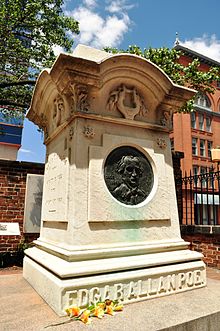
Poe was found lying in a gutter in Baltimore ranting incoherently.  Taken to Washington College Hospital he died on October 7th, 1849. Many legends have circulated as to the causes and situation involving his death but the truth is we will never know the full circumstances of Edgar's demise.  He lives on in his work and the many places that claim his presence during a life and death  punctuated by the simple word from his most famous work, the poem, The Raven:

 "Nevermore!"
Poe grave and monument in Baltimore


Friday, November 9, 2012

The Cortelyou House

The House

This edition of the Yankee Doodle Spies highlights the Vechte-Cortelyou House in Brooklyn, New York, the site of the high-water mark of the Battle of Long Island.

"Here on the 27th of August, 1776, Two hundred and fifty out of four hundred brave Maryland soldiers, under the command of Lord STIRLING, were killed in combat with British troops under CORNWALLIS."
...Inscription on a plaque commemorating the action near the Vechte-Cortelyou House, now called the Old Stone House.


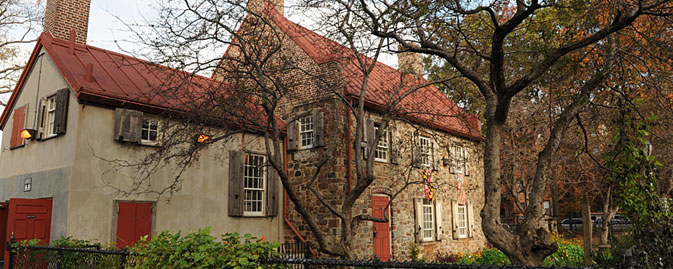
Frontal View of the House today


The Vechte-Cortelyou House in Brooklyn, New York, was built in 1699 by a Dutch settler named Claes Arenston Vechte. Vechte and his family worked the land, farming the neat fields and grazing animals in the verdant pastures of this rich farmland.  They also gathered oysters and other bounty from the nearby Gowanus Creek, which they used to ship their produce to Manhattan.  Around the time of the revolution the land was leased to the Cortelyou family, and one of them later purchased the property.  The simple architecture is classic Dutch colonial with a mixture of stone and mortar, steep tiled roof and a wood shingled appendage (what we might today call a "bump-out") that appears to function as the kitchen.

Major General Cornwallis

The house was situated near the intersection of today's 3rd Avenue and 5th Street in Park Slope. During the events leading up to the cataclysmic fight that took place there, the house served as the headquarters of William Alexander, who called himself "Lord Stirling," because of a claim to that Scottish peerage.While holding the passes south of the house, Lord Stirling found his army surrounded when Major General (himself a Lord) Cornwallis' force of several thousand seized the area around the house after a night march down the Jamaica Road into the unguarded east flank of the American Army. 


Lord Stirling


While he ordered most of his forces to attempt escape across the Gowanus Creek, Lord Stirling led some 400 hundred Continental Line from Maryland and Delaware against the British defending near the Old Stone House, which they had turned into a strong defensive position. Stirling led six assaults against the British at that location and around 250 Americans were killed there and are buried nearby (see my earlier blog on trying to find them entitled "On Hallowed Ground").  The importance of this battle is fully described in The Patriot Spy, and the fictional events that I added form the genesis of the Yankee Doodle Spies.
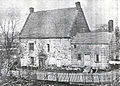
Thumbnail for version as of 09:46, 25 August 2011

The Original House


Interestingly, in the 19th century the original house once served as the headquarters of the Brooklyn baseball club that later became the famed Brooklyn Dodgers. You can see from this photograph the once prosperous farmstead had by the latter 19th century fallen into disrepair. 

Back View of The Old Stone House Today


The original Cortelyou House was later torn down but a reconstruction was built from dug up debris and replica materials and can be found in J.J. Byrne Park in the Park Slope section of Brooklyn. It serves as a museum that celebrates the events of August 1776 that took place on the hallowed ground around it. 
Sadly, little of the feel or look of the times can be found there.  However, nearby Prospect Park and Greenwood Cemetery do present views that might have been "enjoyed" by Lords Stirling and Cornwallis back in August of 1776.
As you can see, the reconstructed house is smack in the heart of a major urban area.  Note the Gowanus Canal, the remains of the Gowanus Creek, not too far distant. 

Where in the world is the Cortelyou House?