Followers

Sunday, August 25, 2013

The Red Lion Inn

Most Americans are familiar with the American Revolution in New York. Still, even fewer are aware of the war on Long Island, which in 1776 encompassed the area on Long Island today known as Brooklyn. Sadly, those who actually live in the "How Sweet it Is" borough (also known as Kings County) may know the least.  History is ultimately about people and places, yet most Americans know little of their local history. I confess to sometimes falling into that category.  I blame the localities, not the schools, for failing to properly celebrate themselves.  Okay - rant over. Time to discuss a place, specifically a building, that was center stage for a few hours during the largest battle in the American War for Independence.


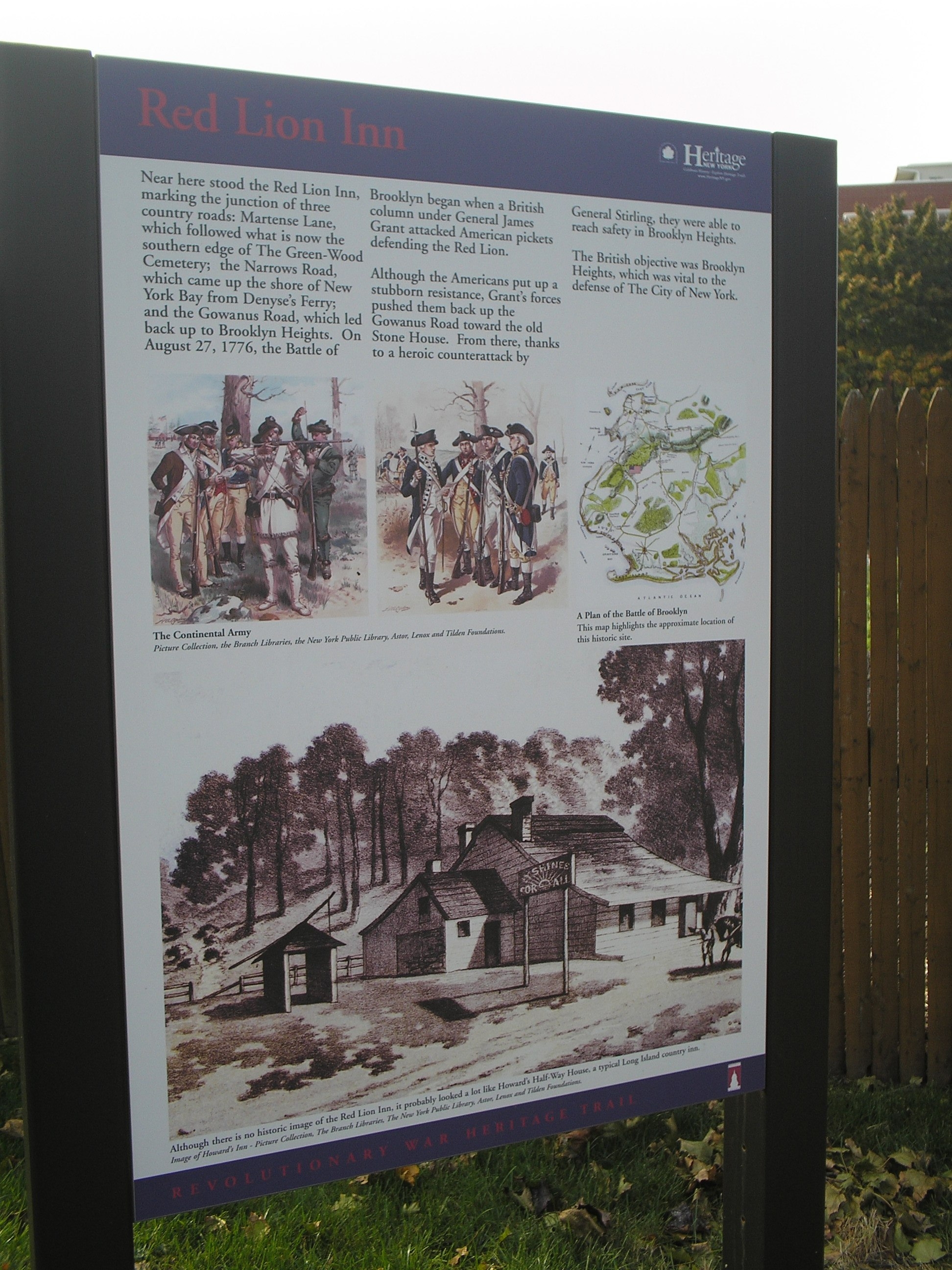
There is no existing image of the Red Lion Inn.
The building itself is Howard's Tavern located at the Jamaica Pass
Both were half-way houses.


The Tavern


The Red Lion Inn was named after the tavern where English King Henry V rested after defeating the French at the Battle of Agincourt. It is fitting that the first action in the first major British victory of the American Revolution took place near the inn. The Red Lion Inn was located at the junction of three country roads: Martense Lane, which followed what is now the southern edge of Green-Wood Cemetery; the Narrows Road, which came up the shore of New York Bay from Denny’s Ferry; and the Gowanus Road, which led back up to Brooklyn Heights. This area is roughly 39th Street and 3rd Ave. in Brooklyn, although other accounts place it on 4th and 40th. I refer to Mark M. Boatner's "Landmarks of the American Revolution" as my guide. Boatner states that many battle markers in Brooklyn are imprecise, and I agree. You can read an earlier blog of mine about my personal visit to that part of Brooklyn a few years ago.


The passes and the British flank march around the Americans.
The Red Lion lay along the Flatbush (western-most)
pass on the left


The Action 


Gen James Grant
On August 27, 1776, the Battle of Brooklyn started when a British column led by General James Grant attacked American pickets defending near the Red Lion Inn. Some accounts say the British were foraging for melons when they startled a rebel picket. It was in this, the westernmost pass, that American Major General William Alexander, a Jersey native also known as "Lord Stirling," stood with the largest force defending the Heights of Guan. The British commander was General James Grant, a Scotsman known for his stout heart and physique. Grant hated rebels and urged his men forward with a ferocity rarely seen from the British. His column of about five thousand professionals rolled into the pass, thirsting for action. But Lord Stirling managed to organize some of the Americans into a line of battle on a piece of high ground just off the Gowanus Road. He was joined by a two-gun artillery battery that covered the road. Grant's troops formed into battle lines—creating maximum volley fire at the front—and advanced up the road. This was perhaps the first open-field battle of the war. Stirling held a strong position, and the initial British assault was repelled by American musket fire and cannon shots. Grant then brought up some of his guns and bombarded the American position. His goal was to pin the Americans while a larger part of his forces completed their envelopment. Later, Grant sent a force to the left of the road, but Stirling countered with a detachment that stopped the British.


Lord Stirling


The  Finale


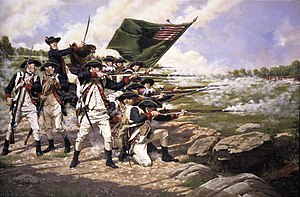
From 7 to 11 a.m., the Americans resisted stubbornly, but eventually, Grant’s forces pushed them back up the Gowanus Road toward the old Stone House. From there, thanks to a heroic counterattack by Lord Stirling, the remaining Americans managed to reach safety in Brooklyn Heights, the British objective, which was crucial for defending The City of New York. Stirling led 400 men from the Maryland and Delaware Continental Line in several frontal assaults on the British troops who had outflanked the defenders and now blocked their way. All but nine were killed, wounded, or captured in the fight. From those Heights, George Washington watched one-third of his force get wiped out. This is the pivotal event in my novel, The Patriot Spy.


Delaware Regiment on Long Island


A Factor?


The Red Lion Inn was not a factor in the battle, unlike the Old Stone House. However, it served as an important landmark. During a time when maps were scarce and often inaccurate, this was significant. Orders frequently referenced landmarks such as bridges, mills, taverns, or farms. Consequently, accounts from both sides mentioned "the Red Lion" or "the Red Lyon" to describe their locations during certain phases of the battle. One might imagine a sign hanging out front showing a red lion, since many taverns used visuals at a time when most men could not read.


Marker at Greenwood Cemetery commemorating
action near the Red Lion Inn (note: Howard's Tavern is the visual)

Saturday, August 10, 2013

How(e) did he lose?

Okay, sue me. I’m the king of bad puns. But today, August 10th, is Lord Howe's birthday, so let's move on to the main topic. With a formidable professional army, paid German mercenaries (the world's better fighters), a large Loyalist following, real money, and the best navy in the world—how could Lord William Howe lose his job and set a trend that led to an impasse and eventual defeat by the pitiful rebels in America? Howe took command of British forces in Boston in 1775, replacing General Gage, whose failures included Concord and Bunker Hill. Howe's leadership shaped British actions from then until his recall in early 1778. When his reinforcements arrived, he commanded the largest force England ever sent to America during the trying times that tested men's hearts.


William Howe


Let's examine William, the 5th Viscount Howe, before discussing his death. We can begin with his background. William Howe was born on August 10, 1729, to the 2nd Viscount Howe and Charlotte Von Keilmansegg, daughter of the Countess of Leinster and Darlington. This connection helped launch him and his two brothers into notable military careers. But it gets better—his grandmother was the illegitimate daughter of King George I, making him a cousin to George III. Whether illegitimate or not, connections—including land and titles—carried significant weight in Georgian England. Howe and his brothers served their kinsman, King George II, during the Seven Years’ War (the French and Indian War). 

William rose to command the 58th Regiment of Foot as a lieutenant colonel. To say he served bravely and effectively is an understatement. At the siege of Louisbourg in Nova Scotia, he led an amphibious landing that earned him praise. Howe's greatest achievement in the war (though not his last) was leading a force of elite light infantry up a steep, narrow trail that climbed the cliffs overlooking the St. Lawrence River. His bold move under the cover of darkness surprised the French and helped General Wolfe's army defeat the Marquis de Montcalm on the Plains of Abraham outside Quebec. This victory ultimately placed French Canada under British rule. Later in the war, Howe achieved further successes in Canada, France, and Cuba.


 Howe's brother George, a general, died during the French and Indian War, and William took his seat in Parliament in 1757. His politics were, as they said back then, "Whiggish." The Whig party, while not as liberal as today, supported limits on the King's authority. He was sympathetic to many American grievances and kept that sympathy throughout the American War for Independence. When he assumed command of the British forces besieged in Boston, Howe was promoted to lieutenant general in January 1776. 

Howe was a thorough planner and understood tactical, operational, and strategic warfare better than most of his peers. He was well helped by his equally wise brother, Admiral Richard Howe. Richard, called "Black Dick" by Royal Navy sailors because of his dark complexion, was a daring and charismatic leader. With more reinforcements on the way, the Howes started a strategy to isolate New England from the other colonies instead of trying to conquer it. A large naval maneuver moved his forces to Newport, Rhode Island, and from there launched an "envelopment from the sea" on New York, through Staten Island and Long Island. This campaign served as the background for my novel, The Patriot Spy.


The Howe brothers organized multiple amphibious landings, sieges, and sweeping flanking maneuvers under cover of darkness, and they won several pitched battles. Truly, a masterwork of combined arms warfare in 18th-century style! Howe eventually took New York and pushed Washington's army across the Jerseys in a blitzkrieg-like manner. 

Howe liked Americans (but not rebels), so in the Jerseys, Howe's whiggish tendencies led him to attempt a clumsy form of rehabilitation that, had it succeeded, might have ended the war. But it didn't, and his grand maneuvers, successful assaults, and (not so) hot pursuits ultimately failed. To top it off, Howe's decision to move south in his own campaign against the rebel capital at Philadelphia sealed General John Burgoyne's fate at Saratoga in 1777, which proved to be the turning point (sorta) in the war.


Howe liked Americans so much he took one as his mistress. Mrs. Elizabeth Loring was the beautiful young wife of Loyalist schemer Joshua Loring, who traded his wife's charms for a position as Commissary for Prisons, a post that offered Loring opportunities for graft at the expense of his charges. The starvation and disease that plagued American prisoners throughout the war attested to that fact. Howe's interest in his amiable companion led to accusations that she was causing him to linger so long that victory might slip away from the grasp of the victorious British. Many ribald poems and ditties were crafted by citizens and soldiers to celebrate the affair and poke fun at Howe.

One such ditty went...

Sir William he,
snug as a flea,
Lay all this time a snoring,
Nor dreamed of harm
as he lay warm,
In bed with Mrs. Loring.


And another...

Awake, arouse, Sir Billy, 
There's forage on the plain. 
Ah, leave your little filly, 
And open the campaign.


So where did Howe fail? Simply put, he was not a closer—except, it seems, in bed. He also lacked the respect of his two main subordinates, Charles Cornwallis and Henry Clinton. Howe sometimes moved at a sluggish pace. The blitz across New Jersey was led by the vanguard under General Cornwallis. Throughout Howe's campaigns, Cornwallis and Clinton often chafed and complained that Howe was missing decisive follow-up. 

Howe's slow approach repeatedly allowed George Washington's forces to escape. Confident of victory, Howe preferred a steady, methodical approach, hoping to reconcile the rebels. Although he outmaneuvered and outfought Washington from New York to Philadelphia, he never managed to defeat him completely. Washington endured two harsh winters, fearing Howe would attack his weakened Continental Army, but he ultimately escaped.


Henry Clinton


The surrender of Burgoyne's army sent shockwaves from Horse Guards to Hampton Court. Parliament erupted in reaction. Maintaining professional armies was expensive, and the Royal Treasury had its limits. Sensing the pressure, Howe resigned as the winter of 1777-78 drew to a close. His occupation of Philadelphia offered no strategic benefit to the British war effort, and Lord George Germain, the Minister for the Colonies, accepted his resignation. With Charles Cornwallis back in England to care for a sick wife, General Henry Clinton was set to take command.


The story ends in a strange way. Howe was sent off with a wild and costly farewell party called the "Mischianza." This was a Bacchanalia-like mixture of music, plays, exotic costumes, and women dressed in elaborate outfits. The event concluded with a grand revue featuring fireworks and plenty of food, drink, and merrymaking. The organizer was Major John Andre, who would later become known for recruiting the spy, Benedict Arnold. Many British officers attending the Mischianza thought it was an over-the-top display of luxury during a wartime period of hardship. Sir William Howe went back to England and held a series of pretty unremarkable positions until he died in 1814.


Sunday, July 28, 2013

How I spent my Summer Vacation - Part II

Let me say upfront this is the first summer that I have been able to go on two different trips - one north - one south. However, both took me to coastal beaches. And both took me back in time...at least notionally. Part two took me to North Carolina.  I briefly lived in North Carolina many years ago but my Army duties and other interests kept me from truly exploring the state.  This trip convinced me of the error of my ways. I stayed at Kill Devil Hills on the Outer Banks.  My place was within sight of the place where the Wright brothers changed the world forever and about twenty-five yards from the beach.


Driving down to the Banks took me through some notable places during the time of the Yankee Doodle Spies.  I took Highway 15 and then 17 instead of the interstate. The route took me through the Virginia Piedmont to Fredericksburg, which was an operating seaport during the 18th century. There begins a trip through the upper tidewater region. Mary Washington's last home, purchased for her by her son in 1772, is in Fredericksburg, Va.


American field guns at Yorktown


Highway 17 takes you through Gloucester, which is across the York River from the famous town of that name. Crossing the York River you find yourself at historic Yorktown. The National Park Service maintains a fabulous battlefield center there and the park extends into part of the town itself. As most know, a combined French-American force besieged General Cornwallis there and caused his surrender in 1781, forcing the British to begin negotiations with the rebels and the French.


My GPS routed me through Yorktown, Newport News, Smith Island, and finally to Portsmouth and meandered south. At that point, I left 17 for the more traditional (and traffic-laden) approach to the Banks. Had I stayed on 17 I would have passed near the Great Dismal Swamp, a hundred-mile square area of marsh connected by a series of small streams - all heavily wooded at the time of the Yankee Doodle Spies.  George Washington and many of his Virginia peers lost a bit of money in a venture aimed at developing the swamp as an inland waterway.

Great Dismal Swamp


Little of this has anything to do with the time of the Yankee Doodle Spies but geography often dictates history.  And so I expand on that idea a bit. The British government's main advantage over their rebellious colonies was the Royal Navy. They had the largest and best navy in the world and the Americans had none at the war's start. However, navies need ports to make them most effective - and North Carolina had few of note. To that end, the Outer Banks served as a more than 100-mile long barrier against British naval supremacy in North Carolina. This limited British operations from the sea and thus no naval actions of note took place there. Late in the war, when the British invaded North Carolina, they did so over land, and the series of events leading to Yorktown ensued.


Fort George marker 

But further, down the coast from the Banks, there was an attempt to maintain a coastal base at New Bern, Wilmington, and Bald Head Island, which guards the mouth of the Cape Fear River. The main British forts were Fort George (on Bald Head itself) and Fort Johnston. The British clung to these but never found a way to exploit them, thanks to aggressive patriot actions that continued throughout the war.

Saturday, July 13, 2013

How I Spent My Summer Vacation

New York - resort?


I took my annual summer resort vacation...in New York City! Now many folks wouldn't think of New York City as a resort and certainly not as a summer resort. But for most of its history, New York was precisely that - especially for the poor and middle class that make/made up so much of the city's populace. Why? Because they couldn't afford the time or the money to reach out to the numerous lakes in the mountains north of town or the expansive beaches of eastern Long Island. Nope, hundreds of thousands made do with the likes of the Bronx's Orchard Beach and City Island. The trolley and later the subway brought droves to Brooklyn's Coney Island, Manhattan Beach, Plum Beach, and Brighton Beach. Sheepshead Bay (it looks like a sheep's head from the air) offers deep-sea fishing at a reasonable price. And the prime resort area remains the Rockaways.  Queens's seven mile-plus stretch of sand from Far Rockaway to Rockaway Point with views of New Jersey's Atlantic Highlands provides some of the finest beaches on the east coast.


Some work - some play


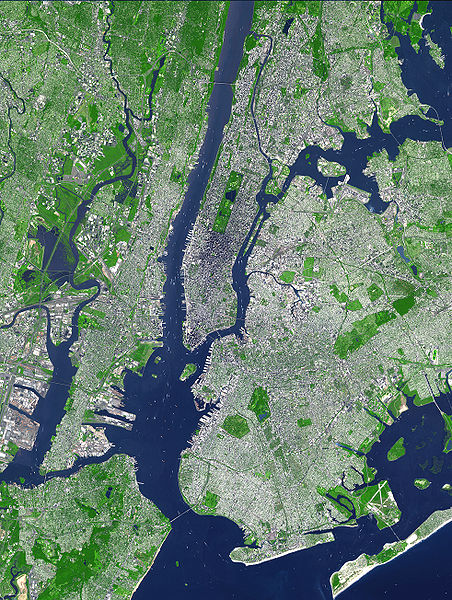
Although I was in Rockaway, this year my resort activity was somewhat curtailed.  I was under a deadline to get the edited manuscript of The Cavalier Spy reviewed and back to the publisher (done). So my summer fun in the sun was restricted to a one day visit to the beach. However, I took advantage of a special deal set up by NYC as a result of Hurricane Sandy.  Because of Sandy's impact on mass transit in the Rockaways, the city contracted a fast boat to go from Beach 108th Street and Jamaica Bay around the end of the Rockaways and up New York bay to lower  Manhattan. Readers of The Patriot Spy know Manhattan was called The Island of New York during the time of the American Revolution. The trip takes an average of 38 minutes each way for the round trip cost of $4! Like that, badabing, you are staring up at the lofty buildings of New York's financial district.  So what the heck does this have to do with the American Revolution? Well, the boat ride passed many of the critical points of the British invasion of New York back in the summer of 1776.


Sailing into the past


British cross the harbor towards Gravesend Bay


As the boat eased out of Jamaica Bay and turned into New York's impressive lower harbor, I could look to the southwest and see Sandy Hook, New Jersey. But back in 1776, the Sandy Hook included a sand bar that blocked the lower harbor, preventing large British warships from crossing over it except during extreme high tide. A few minutes later we were approaching the Verrazano Narrows. The British went through the narrows and landed an army of twenty-four thousand or so on Staten Island, then a Tory stronghold. After recovering for a few weeks they launched barges and longboats across the narrows and landed troops at Gravesend Bay. This was on my right (starboard side) just before I reached the narrows, not far from today's Fort Hamilton. The few American defenders there ran off at the sight of the British. We continued on another ten minutes with Bayonne on our port and Bay Ridge, then Red Hook, on our starboard. Near Red Hook is the Gowanus Canal: the remnant of the Gowanus Creek that played such a critical role in Washington's defenses on Long Island. The boat soon approached Governor's Island, where the Royal Governors resided during colonial times.  The last  Royal Governor of colonial New York, nasty William Tryon, evacuated a year earlier but returned in 1776 with the British armada.


The Sea Streak sails from the Rockaway peninsula on the lower right and up
the harbor to the lower extreme of Manhattan. Note the narrows and
 Governors Island. The Sandy Hook is just off the bottom of the photo,


The final heading


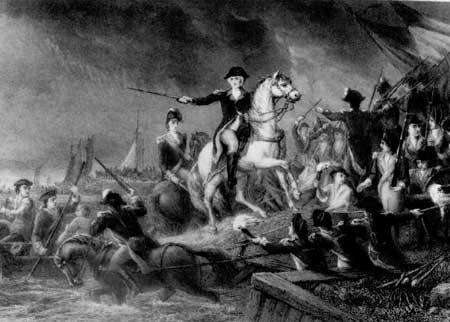
The Gloucester Regiment evacuates Washington's army from its defenses
near the Heights of Brooklyn
Passing the narrow channel between Governor's Island and Brooklyn, the boat entered the waters of the lower East River. To our starboard front lay Brooklyn Heights, just south of the famed Brooklyn Bridge. This was the location of Washington's headquarters during the battle for Long Island, and the point from which the Gloucester seamen evacuated the beleaguered army on a stormy night with the British front lines not more than a few hundred yards distant! The crossing from Brooklyn to New York was considerably wider than it is today, as the Manhattan's expansive use of landfill has narrowed the river by almost a quarter-mile.


The (old) City of New York


We arrived at lower New York, which during the time of the Yankee Doodle Spies extended not too far beyond today's Wall Street. We landed in the lower central portion of this image of early colonial New York. Note how the city abruptly ends at the Wall Street, it extended past Chambers Street by the mid-1700s.


Pearl Street was a contemporary thoroughfare about a half-mile north of where we landed. It probably looked little different from this image from the Dutch era, although the docks and buildings would be more extensive as the city had grown. I will do a future blog on some of the revolutionary war era sites that still remain in the city.  Of course, the march of history (not progress) has limited them to only a few.

Dutch-style buildings still dominated New York during the
time of the Yankee Doodle Spies


I

Wednesday, July 3, 2013

Espionage: Born on the 4th of July


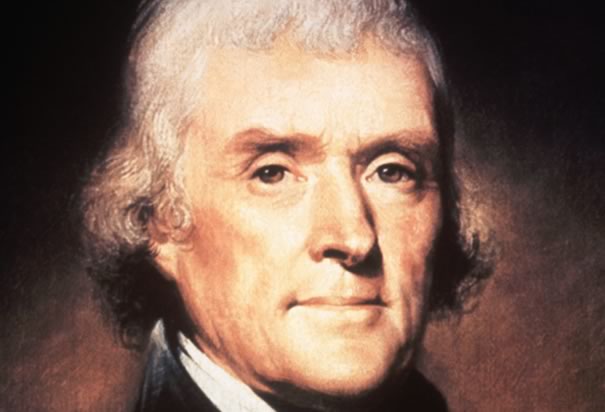
Thomas Jefferson
The birth of our nation is rightly celebrated on the 4th of July, although the actual signing was not on the fourth and Thomas Jefferson drafted what is perhaps the most famous document in the world between the 21st and 28th of June, 1776.  But, as of the 4th of July, the British colonies in North America were no longer fighting for their rights as Englishmen, but for their independence as a sovereign nation.


What has this to do with espionage and the Yankee Doodle Spies?  Well, everything. The Yankee Doodle Spies are stories of action and espionage during the American Revolution. Counterintelligence plays no small role in the stories and its prime purpose is to root out spies to be prosecuted for treason.  Espionage is a legal term for treason acted out by passing a nation's secrets to a foreign power.  So, you have to have a nation to have treason, and by extension, you have to have a nation to have espionage.


Intelligence gathering was a little known but widespread activity by both sides throughout the eight year war that was the American Revolution. One famous (or infamous) spy during the war was Doctor Benjamin Church.  In the environs of Boston, this chief medical officer for the rebel army passed secrets to the British high command through his mistress in Boston.  His mistress betrayed him. Exposed and convicted at court martial - he could not be found guilty of treason (espionage) because as British subjects, the rebels came under British law and treason (espionage) could only be committed against the King.  The irony was rich!


Church was nonetheless kept under arrest for some years and finally exchanged in 1778.  He died when the ship he was returning to England in was lost in a storm at sea.


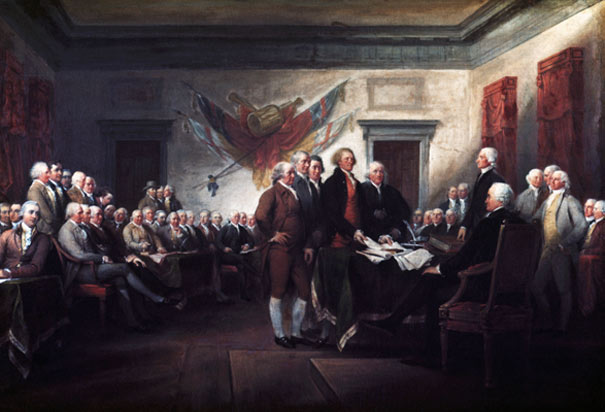
Had Church been identified after July 4th 1776, however, he would have been traitor to a nation and thus guilty of treason (espionage).  The states had committees for detecting spies, but these were informal and poorly coordinated efforts that often confused misplaced loyalty with treason.  As Americans celebrate the birth of our nation with the usual parades, fireworks and barbecues, we should keep in mind that the Declaration of Independence, which birthed the world's first modern republic and set the precedent that ideas can challenge dynasties...created the political and military conditions for a counterintelligence service that could ultimately bring charges of espionage against traitors to the Glorious Cause.

Signing the Declaration of Independence


Saturday, June 15, 2013

Founding Fathers - The Most Famous Duo

The Franklins


A Promising Beginning


The most famous father-son duo of the American Revolution is the Franklins: famed scientist, publisher, philosopher, and diplomat Benjamin Franklin and his son, William Franklin. As with everything about Franklin, this tale is complex and twisted, evoking the tragedy of a war that was as much a civil conflict as a revolution. William lived in his father's shadow, who was arguably the most celebrated and renowned man of his age - a truly international celebrity. William played a pivotal role in some of Franklin's most famous exploits (the electricity experiment, for instance) but received little to no credit or recognition. Living under the shadow of a famous father had both advantages and disadvantages. The often frugal Ben Franklin paid for William to attend the prestigious Inns at Court, where he studied law. This launched him into a career that, had the British won the war, would have marked him as one of the Empire's premier men.


Founding Father Benjamin Franklin


The Bastard Prodigy


William was illegitimate and may have been the child of Ben’s long-suffering wife, Deborah Read, prior to their marriage. Benjamin acknowledged his son after he had been married to Deborah for seven years, the legally allotted time before bastards could be legitimized. The recognition of William’s parentage was kept secret at that time. After completing his studies at the Inns of Court, William returned to America in 1762 with Downes, a wealthy heiress to a sugar plantation fortune in Barbados. However, the elder Franklin was displeased with this choice, as he had another bride in mind for William. Disagreement over William’s marriage further strained an already troubled relationship. Before the rebellion escalated into a revolution, the two Franklins were partners in politics, publishing, grand real estate schemes in the Illinois country, and conflicts with Indians on the Pennsylvania frontier. However, William was very much the junior partner, dependent on his father for income even after his appointment as governor. William’s salary was often delayed for as much as three years.


Royal Governor of New Jersey William Franklin


The King's Servants?


While in England, William developed close relationships with government ministers, leading to his appointment as Royal Governor of New Jersey in 1762. This prestigious appointment came at an unfortunate time. Just as William assumed his new role, a newspaper hostile to the Franklin family revealed the younger Franklin’s illegitimacy. At the very moment William became one of the most significant political figures in colonial America, the scandal of his illegitimacy erupted on both sides of the Atlantic. Meanwhile, Ben Franklin began his journey from loyal conciliator to ardent rebel. His dealings with the British as the colonies' representative in London made him realize that Americans would always be viewed as second-class citizens. Called before the Council on a trumped-up charge, his treatment resulted in a definitive break, and Franklin became the elder statesman of the American Revolution from that time on.


Proprietary House - NJ Governor's Mansion


A Loyal Prisoner


But William continued to act as George III’s loyal subject. As Royal Governor and supporter of the British constitution, he urged conciliation on both sides. As the war escalated, William engaged in what was inaccurately labeled as treasonous correspondence with members of Parliament and the King’s ministers. His letters provided information on American troop movements and included pleas for reasonableness from the crown. William was arrested by order of the Continental Congress but refused to give his “parole” or word that he would cease his counter-revolutionary activities. Over a two-year period beginning in 1776, William was confined under increasingly horrific conditions. Ben refused to intercede for him. He finally left Litchfield, Connecticut, under terrible conditions. While most upper-class prisoners would stay at Moses Seymour's house, Franklin was thrown into the common jail, in a dungeon-like cell filled with excrement. 


Franklin was confined in a common prison like this


During his incarceration, William’s wife had become seriously ill. Her serious condition even prompted George Washington to plead for her husband’s freedom to save her life. However, William spent eight months in Litchfield jail before he was exchanged for a POW held by the British. The once robust and handsome Franklin emerged toothless, emaciated, and destitute; his health ruined and his hair gone. Washington’s fears about William’s wife were validated. Shortly before her husband’s release, Elizabeth Downes Franklin died at the age of 43. William believed his wife’s death was caused by their long separation and his ill-treatment while imprisoned.


Family Feud outlives Political Peace


After the war, the Franklins' relationship remained strained, and they never reconciled. Like so many Loyalists—perhaps around 100,000—William went into exile. In 1785, just before Benjamin’s final return to America, William sought reconciliation during a meeting in France. Benjamin, at 79, obese and suffering from debilitating gout and kidney stones, rejected his son. Franklin bequeathed the majority of his fortune to his grandson William Temple Franklin while demanding payment for loans his son had repaid years earlier. William suppressed his anger and transferred all of his extensive property in America, including his mansion in New Jersey. After his release in 1778, the ex-governor moved to London, where he rented a modest home. He passed away in 1813.


William Temple Franklin


Thursday, June 13, 2013

Founding Fathers Part Two  - Another Palmetto Duo


Father:  Slave Trader and Political Leader


Henry Laurens was one of the wealthiest and influential of the South Carolina planter class.  Laurens became a political leader during the Revolutionary War. He also happened to be the largest slave trader in the colonies too.  In the 1750s alone, his Charleston firm oversaw the sale of more than 8,000 African slaves. When Laurens succeeded John Hancock as President of the Congress he became an important political ally of George Washington and the two maintained close correspondence throughout some of the darkest days of the war. The elder Laurens was someone who Washington could trust would work the sometimes feckless and indecisive Congress.  His support for the Indispensable Man is a little-noted but critical sidebar that led to Washington's continued leadership of a Cause often thought lost but never forsaken.

                                                                               
                                                                         Henry Laurens
                                                                

An Idealistic Son


His son John Laurens was born in Charleston on October 28, 1754. The younger Laurens traveled to London in 1771 for schooling before moving to Geneva, Switzerland, in May 1772. Laurens returned to London to study law in the Middle Temple at the Inns of Court. He returned to an America at war with its motherland and was appointed to the staff of George Washington. Laurens was perhaps the most idealistic and forward-thinking of the First Patriots. While on Washington’s staff he became very close friends with Alexander Hamilton and (along with his father in Congress) played a key role in countering a movement against the commander in chief, which included his winning a duel with one of Washington’s adversaries. He showed reckless courage at the battles of Brandywine, Germantown in which he was wounded, and Monmouth, where his horse was shot out from under him. Lafayette praised his courage and marveled that he had not fallen in the battle. Laurens was an idealist who believed that the republican principals the Americans were fighting for were hypocritical if they continued to utilize slave labor. Strongly influenced by the growing abolitionist literature that circulated in England while he was studying, Laurens encouraged those around him, including Washington, to consider freeing their slaves. The responses that Laurens received were mixed. Some, such as the Marquis de Lafayette, eventually came to the same conclusion. Others, such as Washington, remained hesitant, fearing the economic and social upheaval such a measure would cause.


                                                                      John Laurens

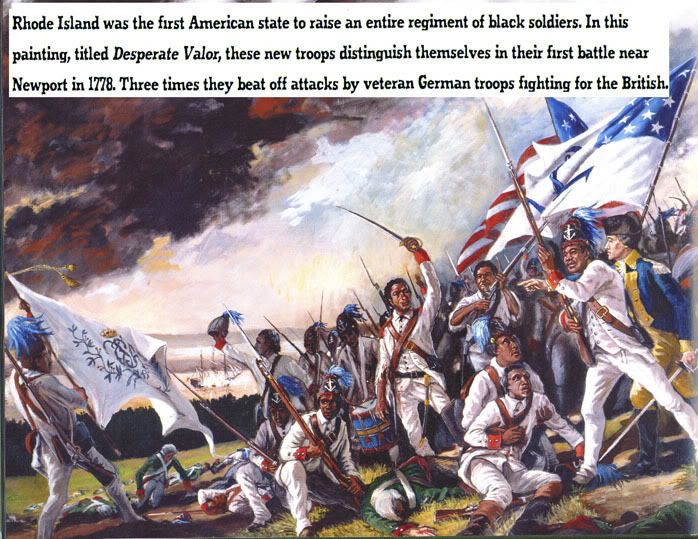
After the British shifted military operations to the South, Laurens proposed that South Carolina arm slaves and grant them freedom in return for their military service. In March 1779 Congress approved his idea and commissioned him a lieutenant colonel. Elected to the South Carolina House of Representatives, Laurens introduced his black regiment plan but met overwhelming defeat. His belief that blacks shared a similar nature with whites and could aspire to freedom in a republican society would set Laurens apart from most prominent southerners in the Revolutionary period. When the British threatened Charleston in May 1779, Laurens opposed Governor John Rutledge’s plan to surrender the city. Later that year he commanded an infantry column in the failed assault on Savannah. Laurens was captured when Charleston finally surrendered to the British in May 1780 but was soon exchanged.


Siege of Charleston

A Youthful Diplomat


Because of his integrity and devotion to duty (and his French fluency), Congress appointed Laurens special minister to France. He arrived in France in March 1781 and quickly obtained a loan from the Netherlands to buy more military supplies and French assurances of active military support. Laurens served once more under Washington at Yorktown where the young prodigy represented the American army in negotiating the British surrender.


Clandestine Warfare and an Untimely Death


Returning south (and losing a final plea for a black regiment) Laurens served under General Nathaniel Greene in the always vicious southern theater. He operated a local spy network that gathered intelligence on British activities around Charleston. To the everlasting loss of his country and his state, Laurens was killed on August 27, 1782, during a meaningless skirmish on the Combahee River.